

Procurement Software for Complex Manufacturers: What to Look For
Published 2026-09-04 · Last updated 2026-09-04
Procurement software for complex manufacturers should do more than digitise purchasing. It should execute authorised work across sourcing, contracts, suppliers and quality, while the ERP remains the system of record and people retain critical decisions. With agentic AI expected to improve procurement efficiency by 25–40%, selecting the right platform is increasingly important. This guide explains how to evaluate ERP integration, workflow execution, governance, exception handling, auditability and multi-plant scalability.
.jpg)
Procurement software for a complex manufacturer should do more than digitise requisitions, add approval screens or create another supplier portal.
It should move authorised procurement work forward across sourcing, contracts, purchasing, suppliers and quality. It should do this while preserving the policies, approvals and human judgement the business depends on.
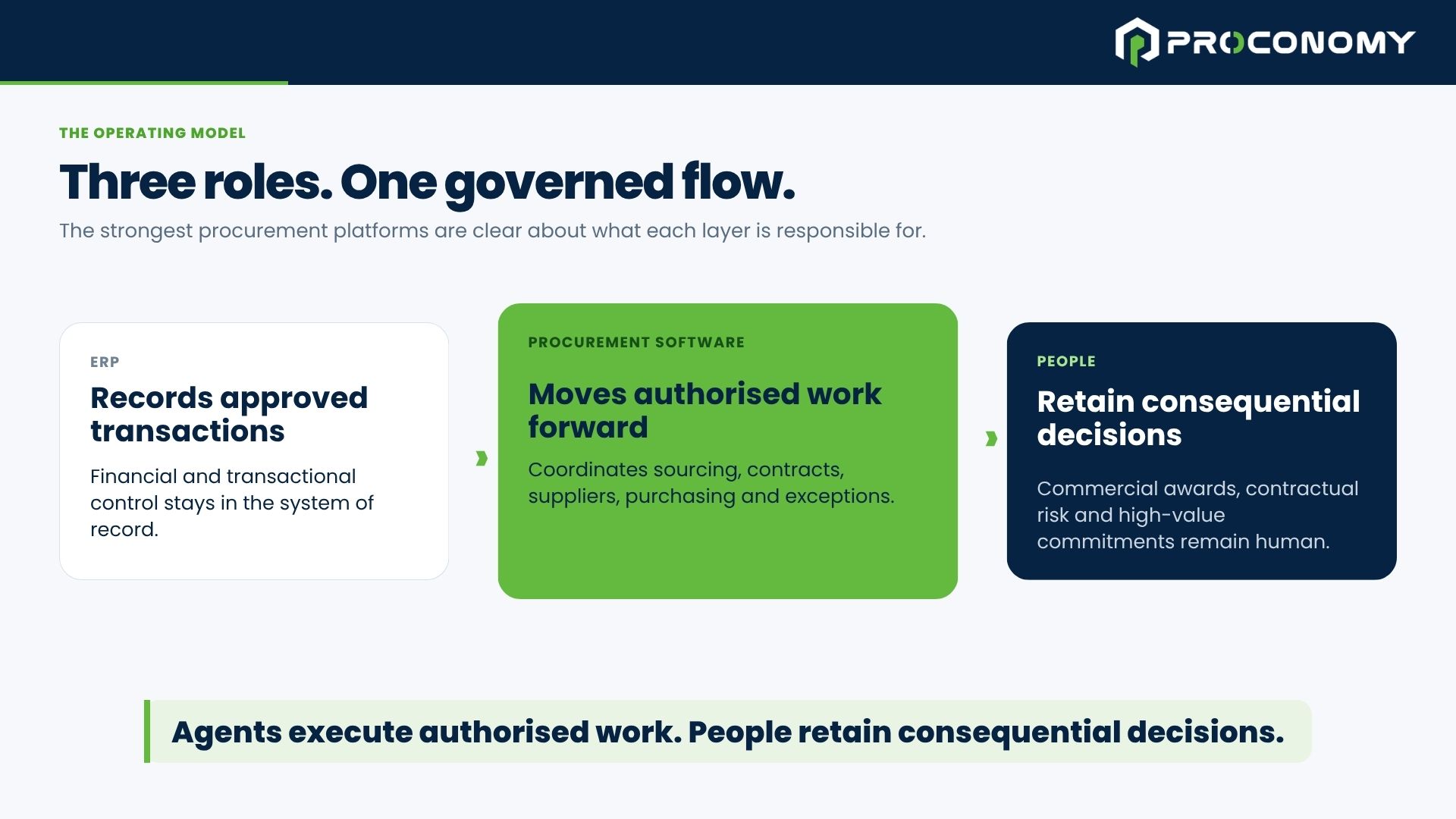
The ERP should remain the system of record. People should retain authority over consequential decisions. The software should execute the routine, authorised work between those two points.
That is the standard procurement leaders should use when evaluating a new platform.
Evaluating procurement software now? Explore the Proconomy platform or request a workflow demonstration using a procurement process from your own operation.
What is Procurement Software?
Procurement software is technology used to manage and execute purchasing, sourcing, supplier, contract and related procurement processes.
Basic purchasing software may help employees raise requisitions, route approvals and create purchase orders. Broader procurement management software may also support sourcing, contracts, supplier onboarding, spend analysis and compliance.
For a complex manufacturer, procurement software must go further.
It must connect the work that happens before, around and after an ERP transaction. This may include:
- Interpreting procurement requests
- Collecting missing information
- Selecting the correct buying route
- Running sourcing events
- Coordinating supplier responses
- Making quotations comparable
- Routing approvals
- Managing contracts and obligations
- Onboarding and qualifying suppliers
- Monitoring supplier performance, risk and quality
- Writing approved outcomes back to existing systems
- Retaining a record of every action and decision
The important distinction is between recording procurement and executing procurement.
An ERP records the approved transaction. Procurement software should move the governed work around that transaction forward.
Why Manufacturing Changes the Software Requirement?
A manufacturer with one plant, one entity and a manageable supplier base may be able to coordinate procurement through an ERP, spreadsheets and disciplined manual follow-up.
That operating model becomes harder to sustain as complexity increases. A complex manufacturer may have:
- Multiple plants and legal entities
- Different approval thresholds by location
- Direct, indirect, MRO and project procurement running simultaneously
- Technical specifications that change during sourcing
- Suppliers approved for one plant but not another
- Quality standing that must influence award decisions
- Contract terms that affect purchasing routes
- Several ERP instances
- Engineering, quality and finance systems holding relevant context
- Hundreds of requests, responses and exceptions requiring coordination
The ERP still performs an essential role. It records approved requisitions, purchase orders, receipts, invoices and financial transactions.
But recording a transaction is not the same as executing the work.
Someone must interpret an incomplete request. Someone must determine whether a contract applies. Someone must invite suppliers, chase responses, compare quotations, route approvals and follow up when a decision stalls.
In many organisations, that work still happens through Excel, email and individual effort.
The right procurement software replaces this manually coordinated execution with governed digital execution.
What procurement software should cover
A procurement platform for complex manufacturing should connect the major areas of the procurement lifecycle.
1. Procurement intake
Requests should enter through a governed process instead of an unstructured email.
The software should gather missing details, determine the category, identify the relevant entity and apply the correct buying policy.
2. Spend intelligence
Analysis should lead to action.
If the platform identifies fragmented spend, an expiring contract or a sourcing opportunity, authorised users should be able to begin the relevant workflow from that insight.
3. Strategic sourcing and RFx
The software should support event creation, supplier selection, response coordination, comparison and award approval.
Effective strategic sourcing and RFx software should reduce coordination work while leaving the commercial award with the authorised person.
4. Contract lifecycle management
Contracts should remain connected to the sourcing events, suppliers, obligations and purchases they govern.
Approved language, deviations, reviews and contractual acceptance should move through visible controls.
5. Purchasing
Approved requests and sourcing outcomes should progress into purchasing without rekeying information or rebuilding the decision context.
Only approved outcomes should reach the ERP.
6. Supplier management
Supplier onboarding, qualification, documents, risk, performance and quality should contribute to one supplier record.
A sourcing decision should be able to see whether a supplier is approved for the relevant plant and how that supplier is currently performing.
Explore how Proconomy approaches supplier management and onboarding.
7. Supplier quality
Quality information should influence procurement decisions before a supplier receives additional business.
Corrective actions, audits, qualification evidence and supplier changes should remain connected to supplier standing.
8.Governance and auditability
Every action should operate within permissions, policies, thresholds and approvals.
The resulting record should show what happened, who or what performed the action, which rule allowed it and where a person intervened.
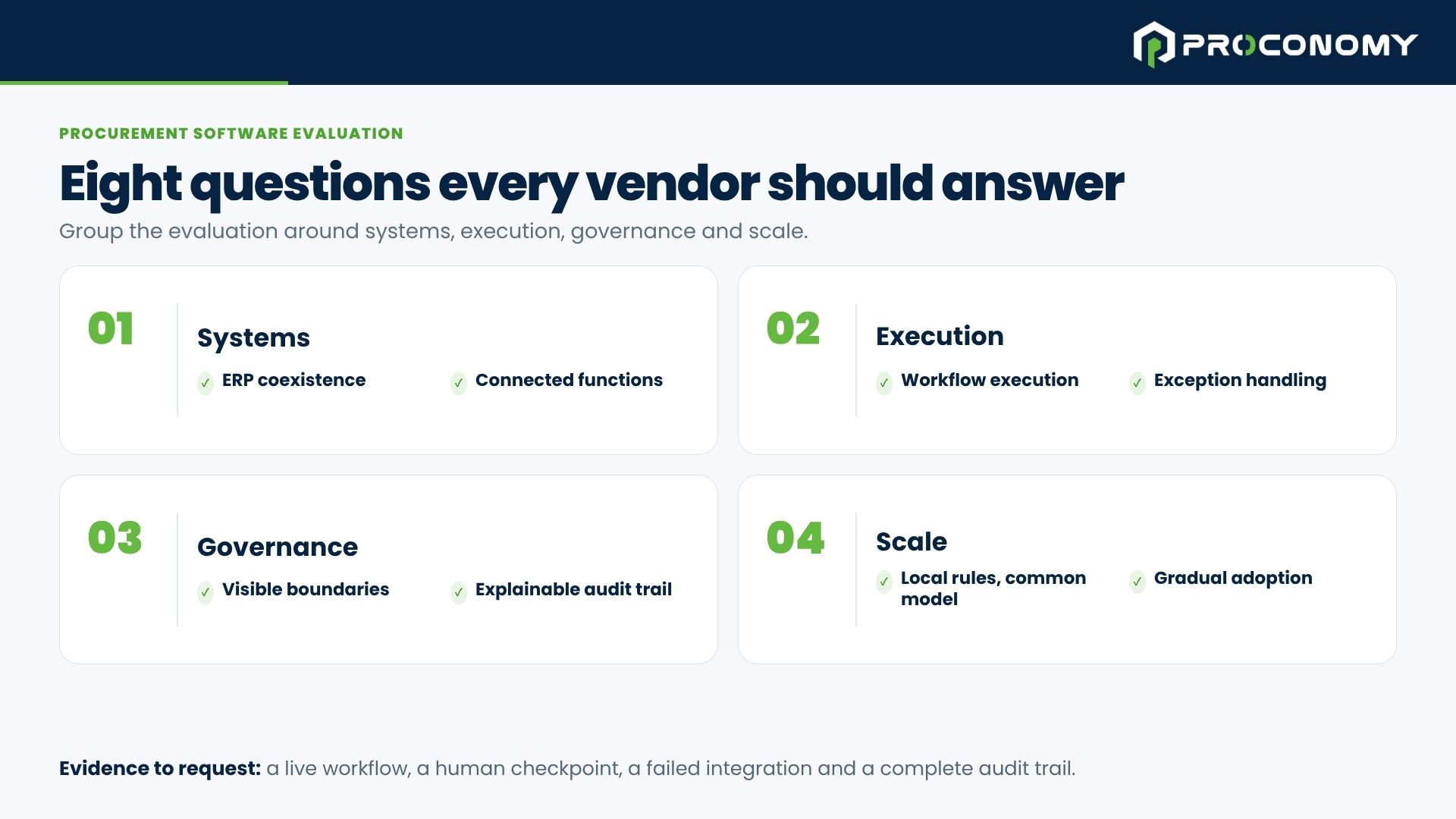
Eight things to look for in procurement software
The right platform should strengthen control, reduce manual coordination and work with the systems your teams already use.
1. It should work with your ERP
Complex manufacturers already depend on ERP systems for financial and transactional control.
Replacing that foundation is rarely the sensible starting point for procurement transformation.
Procurement software should instead:
- Read approved master and transaction data from the ERP
- Execute governed procurement work around those transactions
- Send approved outcomes back
- Prevent draft or unapproved activity from reaching the ERP
- Surface synchronisation failures
- Assign integration exceptions to an accountable owner
- Preserve the ERP as the authoritative system of record
Ask each vendor to explain exactly what remains in the ERP, what happens in its platform and which objects move between them.
A statement such as "we integrate with SAP or Oracle" is not enough.
The vendor should demonstrate the full sequence, including what happens when write-back fails.
Read more about how autonomous procurement works alongside an ERP and explore Proconomy's approach to procurement ERP integration.
2. It should execute workflows, not only record tasks
Many procurement tools create tasks, notifications and dashboards. A buyer must still open the task and move the work forward.
Look for software that can perform authorised coordination work, such as:
- Requesting missing information
- Selecting a buying route from policy
- Building an RFQ from an approved template
- Inviting eligible suppliers
- Chasing overdue responses
- Making quotations comparable
- Routing approvals
- Escalating exceptions
- Updating an approved record
People should continue to decide commercial awards, accept contractual risk, approve high-value commitments and resolve significant exceptions.
The operating principle should be clear:
Agents execute authorised work. People retain consequential decisions.
3. Autonomy should have visible boundaries
"AI-powered" is not a useful evaluation criterion.
Before allowing an agent to act, the organisation must know:
- What actions it may perform
- Which data it may access
- Which plants, entities and categories it may operate within
- Which financial or risk limits apply
- Where human approval is mandatory
- Who receives an exception
- What evidence is retained after each action
If these boundaries cannot be configured and demonstrated, the autonomy is not ready for enterprise procurement.
In governed autonomous procurement, autonomy describes the execution. Governance defines the authority around that execution.
Both matter.
4. It should support local rules inside a common model
One global workflow rarely matches every operating unit.
A plant may have different approval thresholds, supplier requirements or buying routes. Legal entities may use different currencies, tax rules, approvers and ERP instances.
Enterprise procurement software should let the organisation standardise what must be common while preserving legitimate local differences.
Evaluate whether rules can be configured by:
- Legal entity
- Plant or business unit
- Category
- Spend type
- Value band
- Risk level
- Supplier classification
- Contract position
- User or agent authority
The same request should be able to take different governed routes in different entities without becoming a completely separate process to maintain.
See how Proconomy supports multi-entity and multi-plant procurement governance.
5. It should connect procurement functions
Disconnected modules recreate manual handoffs digitally.
An approved sourcing award should move into contracting or purchasing without somebody rebuilding the context. A supplier's qualification, risk and quality position should be visible during the award decision.
Ask whether the platform shares context across:
- Intake
- Spend intelligence
- Sourcing
- Contracts
- Purchasing
- Supplier management
- Supplier risk
- Supplier quality
The important question is not how many modules appear in the product menu.
The important question is whether the context moves with the work.
6. It should handle manufacturing exceptions deliberately
The cleanest workflow is rarely the most useful vendor demonstration.
Ask the vendor to show what happens when:
- A requester omits a specification
- A supplier responds in an unexpected format
- An approver does not respond
- A request exceeds a delegated threshold
- A supplier is not approved for the relevant plant
- A quotation contains a commercial exception
- A contract deviation requires legal review
- ERP write-back fails
- A user attempts to bypass a mandatory checkpoint
Procurement software should not hide these situations or simply stop.
It should identify the relevant rule, block or escalate the action and send the case to a named person with the necessary context.
Exceptions are not unusual in manufacturing procurement. They are a substantial part of the work.
7. It should produce an explainable audit record
An activity log stating that a task was completed is not sufficient.
For each material action, the platform should retain:
- The original request or trigger
- The information used
- The policy or permission that allowed the action
- The agent or person responsible
- The approval or exception decision
- Any override and its reason
- The outcome sent to the system of record
This matters to procurement leadership, internal audit, information security and finance.
It also allows the organisation to expand autonomous execution based on real action history rather than general confidence in the technology.
8. It should support gradual adoption
A procurement platform should not require every workflow to change at once.
A practical adoption model begins with one urgent, coordination-heavy process.
The organisation can:
- Define who has authority.
- Express the policies and thresholds.
- Connect the minimum required data.
- Run the workflow.
- Review the action and exception history.
- Expand the permitted scope when the evidence supports it.
- Introduce the next workflow.
This makes the platform assessable.
Procurement, IT, finance and audit can see what the software does, where it stops and what remains under human control.
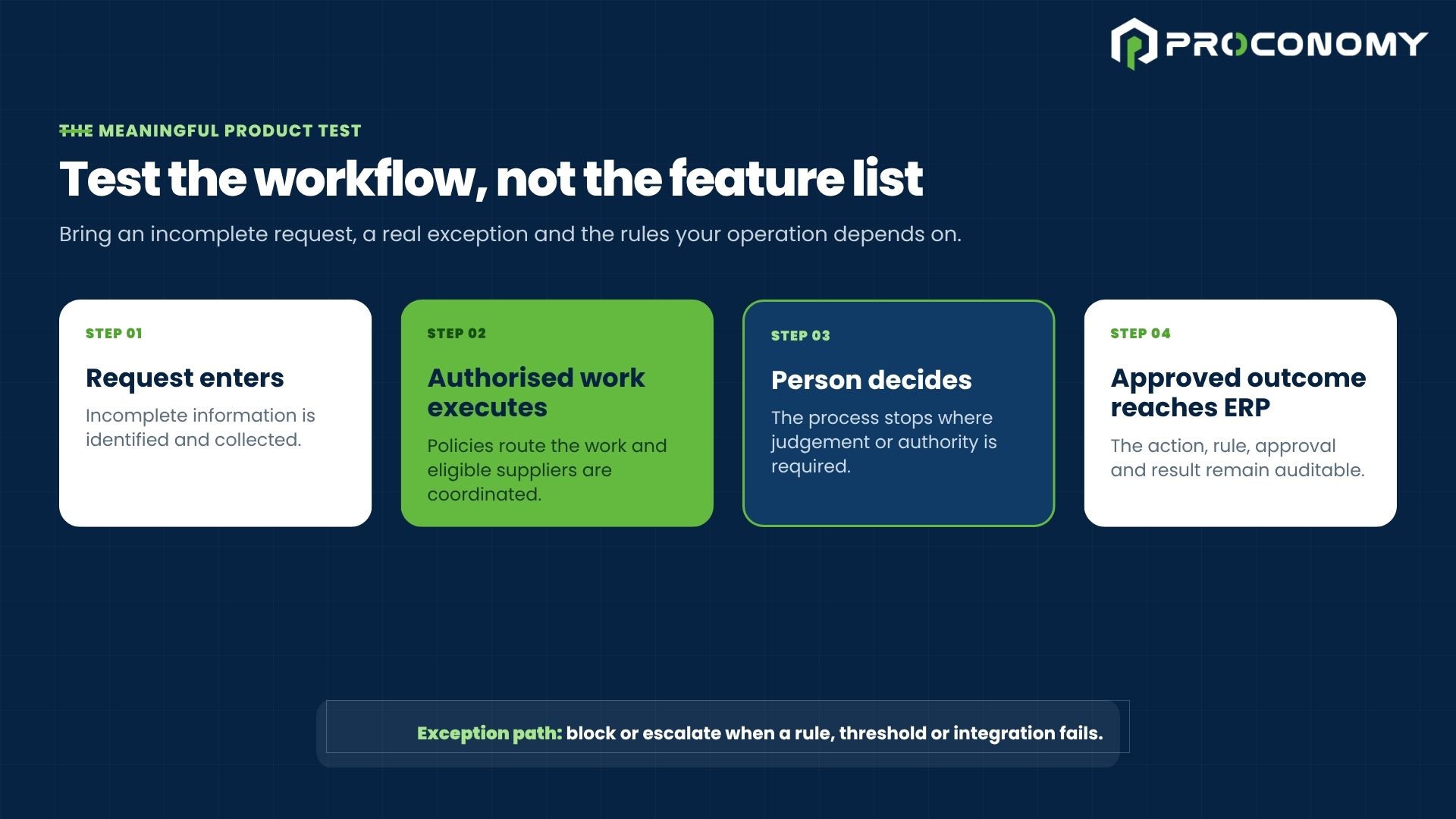
Conversion CTA: Test one difficult workflow Do not evaluate procurement software through a standard vendor presentation. Choose a workflow demonstration that reflects an actual process, including the exceptions that consume your team's time.
How procurement software works in a manufacturing scenario
Consider an urgent replacement component needed after a production-line failure. The initial request may arrive as a short description rather than a complete requisition.
Before a purchase order can be raised, the business may need to:
- Identify the correct plant, entity and category.
- Gather the technical specification.
- Check whether an existing contract applies.
- Confirm which suppliers are qualified.
- Review current supplier quality standing.
- Select the required sourcing or purchasing route.
- Obtain quotations where necessary.
- Make the responses comparable.
- Route the commercial decision to the authorised person.
- Write the approved outcome to the ERP.
- Retain the complete decision and action history.
Traditional electronic procurement software may record the request at the beginning and the purchase order at the end.
People coordinate everything between those points.
Modern procurement software should move authorised work through the sequence, stop wherever a person must decide and preserve a reconstructable record.
That is a meaningful demonstration.
A polished dashboard is not.
Procurement software evaluation checklist
| Evaluation area | Question to ask | Evidence to request |
|---|---|---|
| ERP coexistence | What remains in our ERP? | A complete read, execute and write-back sequence |
| Workflow execution | What work does the platform actually complete? | A live end-to-end workflow |
| Agent authority | What may each agent do? | Permitted actions, data scope and thresholds |
| Human control | Where must the process stop? | A mandatory checkpoint demonstration |
| Multi-entity support | Can plants follow different local rules? | The same request routed through two entities |
| Connected platform | Does context move across functions? | A sourcing-to-contract or supplier-to-award example |
| Exception handling | What happens when something goes wrong? | A failed approval, policy or integration scenario |
| Auditability | Can one transaction be reconstructed? | Trigger, rule, action, approval and outcome |
| Deployment | Can we start with one workflow? | A clearly defined first-use-case plan |
| Product truth | Can each important claim be demonstrated? | A working session rather than presentation slides |
Warning signs during a procurement software evaluation
Be cautious when a vendor:
- Proposes replacing the ERP without a clear operational reason
- Describes AI without defining permissions and limits
- Shows recommendations but no autonomous execution
- Shows successful workflows but no exceptions
- Cannot demonstrate where a person must decide
- Treats plants and legal entities as one approval model
- Depends on manual rekeying between modules
- Cannot show what happens when an integration fails
- Provides a list of features but no end-to-end workflow
- Makes savings claims before understanding your operation
A procurement system should be evaluated through evidence, not superlatives.
How Proconomy approaches procurement software
Proconomy is the governed autonomous procurement platform for complex manufacturers that have outgrown ERP, Excel and email as a way of coordinating procurement work.
It connects sourcing, contracts, purchasing, suppliers and quality on one AI-native operating layer.
People define the authority. Proconomy's agents execute authorised work, escalate exceptions and write approved outcomes back to existing systems.
The ERP remains the system of record.
High-value, high-risk and judgement-intensive decisions remain with people.
Every agent operates within defined permissions, policies, thresholds and checkpoints. Its actions and escalations remain visible in the audit history.
This is not autonomy without control.
It is governed autonomous execution.
Explore how governed autonomy works in practice or take a self-guided look through the available Proconomy product tours.
An industrial services group has also used Proconomy to connect procurement across 18 operating companies while retaining its existing systems of record.
Choose the workflow, not the feature list
The best procurement software for a complex manufacturer is not necessarily the product with the longest feature list.
It is the platform that can demonstrate:
- How work enters
- What the software executes
- Which rule permits every action
- Where execution stops for a person
- What reaches the ERP
- What remains on the audit record
- How exceptions are handled
- How the platform expands across workflows
Bring the workflow that consumes the most manual follow-up.
Include the incomplete requests, unusual supplier responses, delayed approvals and policy exceptions.
Those moments reveal whether the software merely digitises procurement or genuinely changes how procurement gets done.
Primary CTA: See Proconomy on your own workflow Request a workflow demonstration and bring the procurement process that costs your team the most coordination effort. You will see where the agents act, where the platform stops for a person, what reaches the ERP and what remains on the audit record.
See this on your own workflow