

How Procurement Management Software Fixes the ERP Execution Gap
Published 2026-09-25 · Last updated 2026-09-25
Procurement management software can add the execution layer that is often missing around SAP or Oracle without replacing the ERP. It can capture incomplete requests, coordinate sourcing and supplier activity, apply procurement policy, route human decisions, manage exceptions and write approved outcomes back to the system of record. This matters as procurement teams face rising demand with constrained resources. The Hackett Group projects that procurement workloads will increase by 8% this year, even as headcount and operating budgets decline.
.jpg)
Procurement management software should add execution, not replace ERP
Procurement management software is often evaluated as if it must compete with SAP, Oracle or another enterprise resource planning system. That framing creates an unnecessary choice.
For most established manufacturers, ERP replacement is not the business problem. The ERP already controls supplier masters, purchase requisitions, purchase orders, receipts, invoices, payments, cost centres and financial postings. It is integrated with finance, inventory, production and reporting. Replacing it would create a large programme with broad operational risk.
The real problem is usually the work that happens before, between and around those transactions.
A plant engineer raises an urgent need in an email. A buyer has to collect missing specifications. A supplier submits a quotation in a different format. Quality needs to confirm approved-source status. An approver needs context from three systems. A price or receipt mismatch needs an accountable owner. The final approved result then has to be entered into ERP.
The transaction is controlled, but the process that creates it is still coordinated manually.
This execution gap is becoming harder to absorb. The Hackett Group’s 2026 Procurement Key Issues Study projects an 8% increase in procurement workload this year, while headcount and operating budgets decline. Adding more inbox management and spreadsheet tracking is not a sustainable response.
The better architecture is to keep SAP or Oracle as the authoritative system of record and add a governed procurement execution layer around it. That layer structures demand, coordinates work, applies procurement rules, manages exceptions and writes approved results back.
The division of responsibility is simple:
- ERP records and controls enterprise transactions.
- Procurement management software coordinates and executes the work required to reach those transactions.
- People retain authority over decisions that policy assigns to them.
This guide explains how to make that model work without creating a competing source of truth.
Why procurement stays manual around ERP
ERP platforms are designed for structured business events. Procurement often begins before the event is structured.
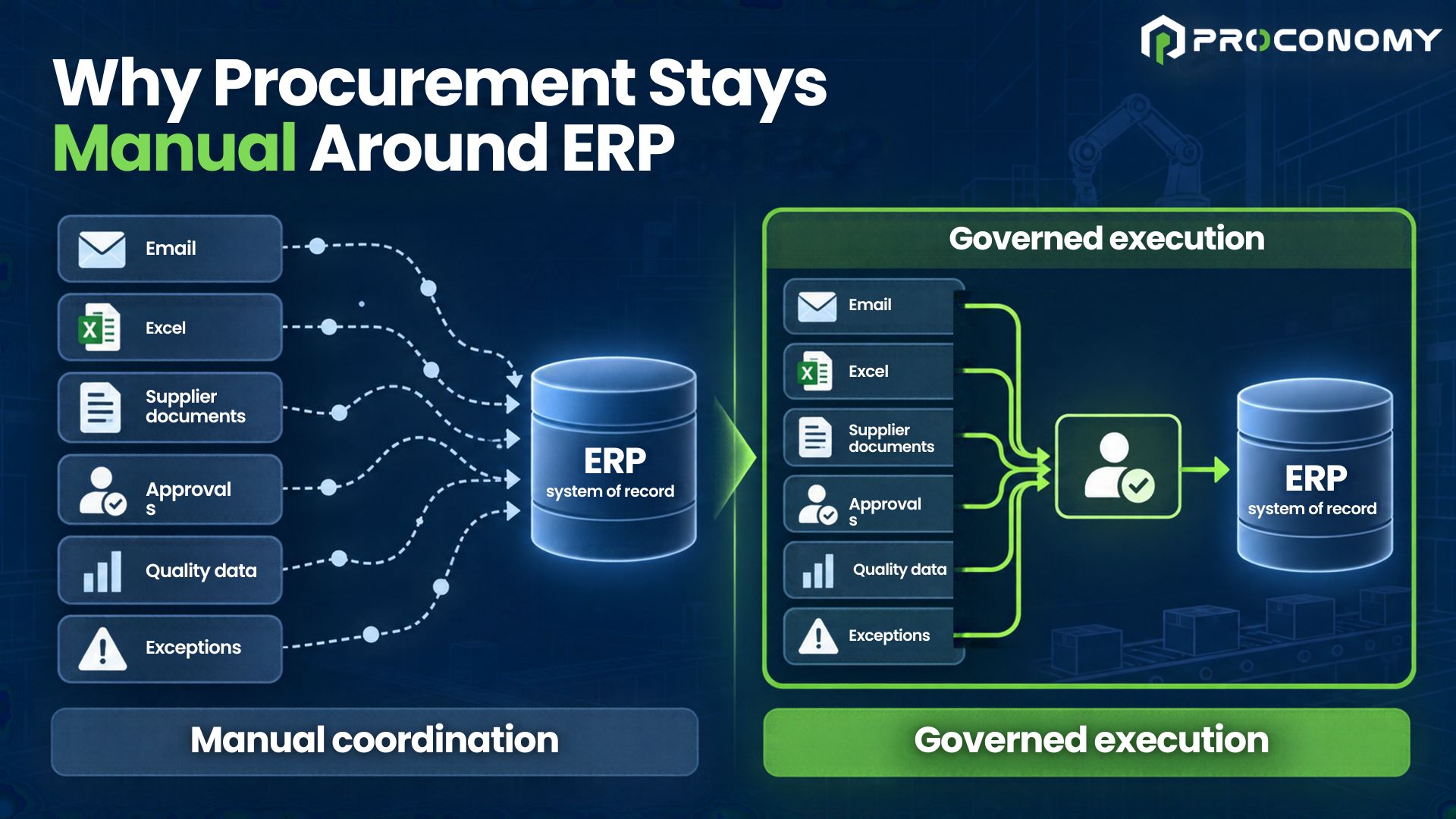
1. Requests are not transaction-ready
A request can arrive without a material code, category, quantity, delivery point, budget reference, supplier, drawing or technical specification. ERP cannot create a reliable purchase requisition until someone fills the gaps.
That work often happens in email, calls and spreadsheets because requesters do not know which fields or buying route apply. This is why many manufacturers need to move procurement beyond ERP, Excel and email without disturbing the ERP foundation.
2. Decisions require context from several systems
A sourcing or supplier decision may depend on information held across several enterprise systems. Each system contributes a different part of the decision context, including:
- ERP for suppliers, orders, receipts and spend
- PLM for parts, specifications and engineering changes
- QMS for audits, non-conformances and approved-source status
- Contract systems for negotiated terms and obligations
- Identity systems for users, roles and access
- Finance systems for budgets, cost centres and tax information
The buyer becomes the integration layer when these facts are not brought together inside the workflow. A governed ERP, PLM, QMS and finance integration model should assemble only the context required for the decision.
3. Supplier work sits outside the enterprise boundary
Suppliers do not usually work inside the manufacturer’s ERP. Quotations, certificates, onboarding documents, clarifications and corrective-action evidence arrive through portals, email and shared files.
Someone must connect that external activity to the internal transaction and retain the evidence. A connected supplier management and onboarding workflow can coordinate this work before the approved supplier record reaches ERP.
4. Policies describe decisions but do not execute them
An approval matrix may state who can approve a purchase. A sourcing policy may define when three quotations are required. A supplier policy may specify which quality documents must be current.
Those rules only create control when they are applied consistently to each case. If a buyer has to interpret and enforce every rule manually, the policy is still dependent on individual effort.
Governed autonomous procurement turns those documented rules into executable permissions, thresholds and checkpoints.
5. Exceptions create most of the coordination
Standard transactions may flow through ERP efficiently. Work slows when something is incomplete, late, inconsistent or outside tolerance. Common examples include:
- A quotation is missing freight or tax details
- A preferred supplier cannot meet the required date
- A certificate has expired
- An approver is unavailable
- A delivery quantity differs from the order
- An invoice does not match the receipt
- An engineering change affects an open sourcing event
- A plant requires a local exception to a group policy
These cases need context, ownership, escalation and evidence. A transactional workflow alone rarely provides all four.
For a deeper comparison of the two roles, the guide on procurement workflow software versus ERP explains where ERP workflow is sufficient and where a separate execution layer becomes useful.
What procurement management software should own?
The goal is not to move every procurement object into a new platform. It is to assign each responsibility to the system best suited to perform it.
A connected procurement operating platform should extend ERP execution without competing with ERP ownership.
| Responsibility | SAP or Oracle ERP | Procurement management software |
|---|---|---|
| Supplier and material master | Authoritative record | Reads approved data and initiates governed change requests |
| Requisitions and purchase orders | Final approved transaction | Prepares complete, policy-ready records and submits approved outcomes |
| Financial controls | Budget, account and posting control | Applies procurement policy before the financial transaction is created |
| Request intake | May accept structured forms | Captures free-text demand, collects missing information and selects the route |
| Sourcing and RFQ coordination | May provide modules or extensions | Coordinates suppliers, responses, clarifications, comparisons and approvals |
| Supplier onboarding | Creates or updates the approved supplier record | Collects evidence and coordinates procurement, quality, finance and risk reviews |
| Contract process | Stores references or commitments | Coordinates drafting, review, approval, obligation tracking and controlled buying |
| Supplier quality | May store status or transaction references | Coordinates PPAP, APQP, SCAR and 8D evidence with quality checkpoints |
| Exceptions | Controls transactional tolerances | Identifies the owner, gathers context, routes action and records the resolution |
| Audit evidence | Records the posted transaction | Retains the request, rule, agent or user action, approval and final outcome |
This split keeps master and transaction ownership clear. The procurement layer may hold a working record, but it should not silently become the authoritative source for data that belongs in ERP.
The same principle applies when the ERP already includes procurement modules. Use ERP capability where the process is structured, stable and close to the transaction. Add an execution layer where work begins unstructured, crosses functions or systems, involves suppliers, or contains variable exceptions.
A reference architecture for SAP and Oracle
An effective architecture has six connected layers. Each layer has a distinct purpose and control model.
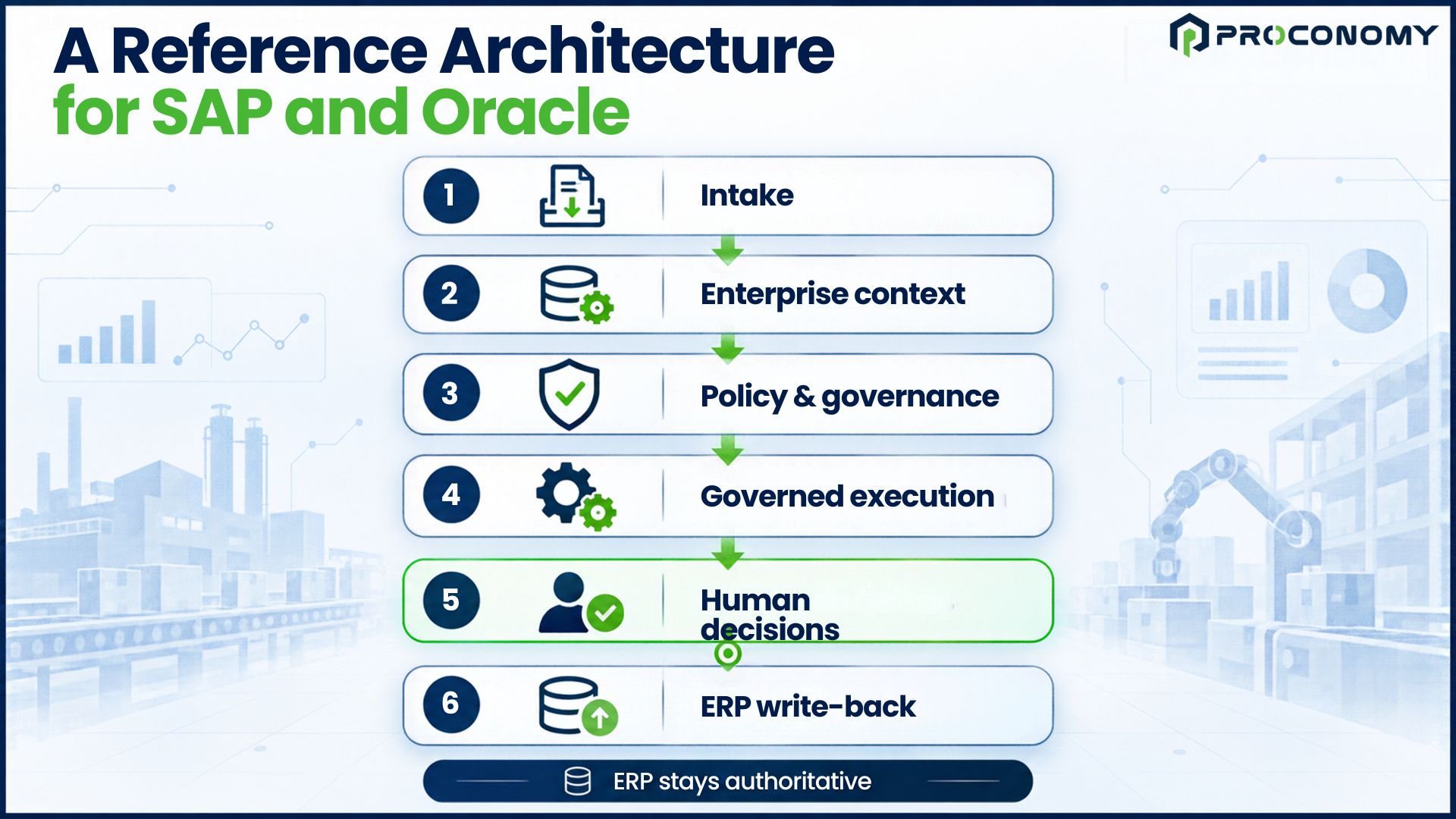
1. Intake layer
The intake layer provides one governed entry point for procurement demand. It can accept a form, free-text request, email, system event, inventory signal or project requirement.
Its role is to turn incomplete demand into structured, procurement-ready work. It should:
- Identify the requester, entity and plant
- Classify the need
- Collect missing information
- Detect urgency, value and risk
- Determine which procurement workflow should begin
The procurement intake and orchestration layer should improve the request before anything is written to ERP.
2. Enterprise context layer
The context layer reads only the information needed for the workflow. Depending on the use case, this can include supplier status, material data, open orders, contracts, quality records, inventory, budgets, cost centres and approval roles.
The architecture should avoid copying the full ERP estate into another database. Data should be read on demand, synchronised selectively or cached with clear ownership and refresh rules.
3. Policy and governance layer
This layer converts procurement policy into executable rules.
The policy layer should evaluate the conditions that determine the route, authority and evidence required for each case. Typical controls include:
- Spend and risk thresholds
- Required competition
- Approved supplier rules
- Category-specific buying routes
- Plant and legal entity differences
- Segregation of duties
- Delegation of authority
- Required documents and reviews
- Conditions that require human approval
The policy layer decides what may happen. It should not depend on a user’s ability to remember the policy.
4. Governed execution layer
The execution layer moves authorised work forward. Traditional automation can perform fixed tasks, while specialised agents can interpret variable inputs and choose among permitted next steps.
These actions should remove coordination effort while remaining inside the authority already defined by the organisation. Common examples include:
- Requesting missing information
- Preparing an RFQ from an approved template
- Inviting eligible suppliers
- Following up on incomplete responses
- Normalising commercial terms
- Creating tasks for technical or quality review
- Routing approvals
- Monitoring due dates
- Classifying a purchase order or invoice exception
The execution layer should act only inside explicit permissions. Access to a system does not automatically grant authority to approve a commercial decision.
The autonomous agents supporting the workflow need a defined job, boundary and escalation path.
5. Human decision layer
Consequential decisions return to the person named in the policy.
The exact checkpoint depends on the organisation’s delegation of authority and risk model. Decisions that commonly require a named person include:
- Supplier award
- Contract acceptance
- High-value purchase approval
- Supplier activation or suspension
- Quality disposition
- Policy exception
- Bank-detail change
The software should prepare the decision with the relevant context, then stop. A faster workflow must not weaken the organisation’s authority model.
6. ERP write-back and observability layer
After approval, the system creates or updates the authorised record in SAP, Oracle or another system of record.
Only final, authorised data should cross this boundary. Depending on the workflow, approved write-back can include:
- Purchase requisitions
- Purchase orders
- Supplier records
- Contract references
- Receipt or exception status
- Approval references
Every integration event should expose its status. Failed writes, rejected values and delayed synchronisation should be visible with an owner and a controlled retry point.
Proconomy’s ERP, PLM, QMS and finance integration model follows this pattern: approved context comes in, governed work runs around the transaction, and only approved outcomes are written back.
See the architecture in detail. Explore how procurement execution integrates with ERP and adjacent systems.
How data should move between procurement software and ERP
Integration design should begin with ownership, not with available connectors.
For every object, define the ownership and change path before selecting the connector or API. The following questions create a clear integration contract:
- Which system owns the authoritative value?
- Which workflows may read it?
- Which workflows may propose a change?
- Who or what can approve the change?
- Which system performs the final write?
- How will failures and duplicates be handled?
Read approved context into the workflow
The procurement layer may need current data on suppliers, materials, entities, cost centres, open orders and contracts. Reading that context at the point of work reduces decisions based on stale spreadsheets.
For SAP, this may involve standard APIs, business events, integration services or governed file exchange, depending on the ERP version and enterprise architecture. For Oracle, the same principle can be implemented through approved APIs, business events or integration services.
The transport mechanism matters, but ownership and control matter more.
Keep draft work outside ERP
Incomplete requests, draft sourcing events, unapproved supplier records and trial scenarios should remain in the execution layer until they are ready.
Writing drafts too early creates records that look official before the business has approved them. It can also create avoidable downstream problems such as:
- Duplicate records
- Incomplete requisitions
- Confusing status codes
- Unnecessary approval events
- Reconciliation work
ERP should receive a clean, authorised outcome rather than every intermediate step.
Write only approved outcomes
Write permissions should be narrower than read permissions. A workflow may read supplier and material data but write only approved requisitions.
A supplier onboarding process may create a supplier record only after finance, risk, quality and procurement have completed their required reviews.
The integration credential should not grant more authority than the workflow requires.
Make write-back idempotent
If a network interruption causes a retry, the integration must not create a second requisition, purchase order or supplier record.
Use a stable external reference, duplicate check and transaction status so the same approved outcome can be retried safely.
Surface integration exceptions
An integration error is part of the business process, not only an IT log.
The workflow should expose the error in business terms, not bury it in a technical log. Users and support teams should be able to see:
- The affected request or transaction
- The field or validation that failed
- The system response
- The current owner
- Whether a safe retry is available
- Whether the transaction was partially created
This prevents approved work from disappearing between systems.
Which procurement workflows to add first
The best starting workflow has visible coordination cost, clear boundaries and a measurable outcome. It should be valuable enough to matter but constrained enough to govern.
A workflow-led procurement transformation reduces risk because value can be proven before the scope expands.
Intake to approved requisition
This workflow captures an operational need, classifies it, collects missing fields, applies the buying policy and routes approval. The approved requisition is then created in ERP.
It is a strong starting point when buyers spend significant time interpreting requests or returning incomplete requisitions.
Request for quotation coordination
The execution layer can prepare an RFQ, invite eligible suppliers, issue reminders, collect responses and make commercial terms comparable. The buyer or authorised committee retains the award decision.
This is the operating model behind connected strategic sourcing and RFx software.
This workflow is valuable when sourcing volume is constrained by administrative effort rather than negotiation capacity.
Supplier onboarding
Supplier onboarding often crosses procurement, finance, risk, quality and compliance.
Procurement management software can collect documents once, route parallel reviews, verify completeness, monitor expiry dates and create the approved supplier record in ERP through a governed supplier onboarding process.
The result is a controlled process without asking each function to maintain a separate tracker.
Contract to controlled purchase
The execution layer can connect the approved award, contract review, negotiated terms and downstream purchase.
Connected contract lifecycle management helps prevent a valid contract from becoming disconnected from actual buying.
Procure-to-pay exceptions
ERP remains responsible for purchase orders, receipts, invoices and payments. The procurement layer can classify mismatches, gather order and contract context, route the issue to the right person and record the approved resolution.
The procure-to-pay execution model shows how approved purchase outcomes can reach ERP without manual re-entry while exceptions retain accountable ownership.
Supplier quality coordination
Manufacturers may also add supplier quality management workflows for PPAP, APQP, supplier corrective actions and 8D evidence.
These processes depend on technical judgement, so the software should coordinate the evidence and deadlines while quality professionals retain the decision.
ERP configuration, integration tools or a procurement execution layer
Not every gap requires procurement management software. CIOs and CPOs should decide whether the need belongs in ERP configuration, an integration platform or an execution layer.
The following comparison helps separate the role of each technology:
| Option | Best fit | Limitations to consider |
|---|---|---|
| ERP configuration | Stable, internal and transaction-centred processes | Can become costly when the workflow is highly variable, supplier-facing or spread across systems |
| ERP procurement module | Organisations that want deeper capability inside the ERP ecosystem | May still require coordination across quality, engineering, contracts and external suppliers |
| Integration platform or iPaaS | Moving and transforming data between systems | Connects systems but does not automatically provide procurement policy, approvals or case management |
| Robotic process automation | Repetitive tasks with predictable screens and inputs | Can be fragile when interfaces or process paths change |
| Procurement management software | Cross-system procurement execution, supplier coordination, policy enforcement and exception handling | Requires clear system ownership, governance and integration design |
Use ERP configuration when the process is already structured and belongs close to the transaction. Use integration tooling when the core problem is data movement. Use procurement management software when the problem is getting people, suppliers, policies and systems to complete a procurement outcome. In many enterprises, the final design uses all three. The mistake is asking one layer to perform every role.
Security and governance requirements
An execution layer has meaningful access and can influence transactions. Governance must therefore be part of the architecture, not a document added after implementation.
Least-privilege access
Each user, integration and agent should have only the data and actions required for its workflow. Read access and write access should be scoped separately.
Named identities
The audit trail must show whether an action was performed by a person, an integration or an autonomous agent. Shared technical accounts should not hide responsibility.
Non-bypassable human checkpoints
Supplier awards, contractual commitments, high-value approvals and policy exceptions should stop for the authorised person. A prompt or configuration change should not silently remove a mandatory checkpoint.
Segregation of duties
The design must preserve separation between creating a supplier, changing bank details, approving a purchase and releasing payment. Automation should not collapse controls that exist to prevent error or fraud.
Data boundaries
Document which data the procurement layer can read, retain and send to any AI service. Sensitive commercial, personal and technical information requires role-based access, retention controls and approved processing boundaries.
Action-level evidence
The record should make each action reconstructable from its trigger to the ERP outcome. At minimum, it should connect:
- The original request or trigger
- The data considered
- The rule or permission applied
- The action taken
- The person who approved the consequential step
- The outcome written to ERP
The security and AI governance model provides a useful checklist for bounded, visible and auditable execution.
Multi-entity controls
Group policy and local authority are not the same thing. A global sourcing rule may apply everywhere, while approval thresholds, approvers, tax requirements and supplier lists differ by legal entity or plant.
The multi-entity procurement governance model should allow one policy framework with controlled local configuration.
A practical implementation roadmap
Replacing manual coordination does not require an enterprise-wide rollout on day one. A workflow-led implementation reduces risk and creates evidence before the scope expands.
The same principle guides a practical procurement transformation roadmap: start with one measurable workflow, validate the controls and then scale.
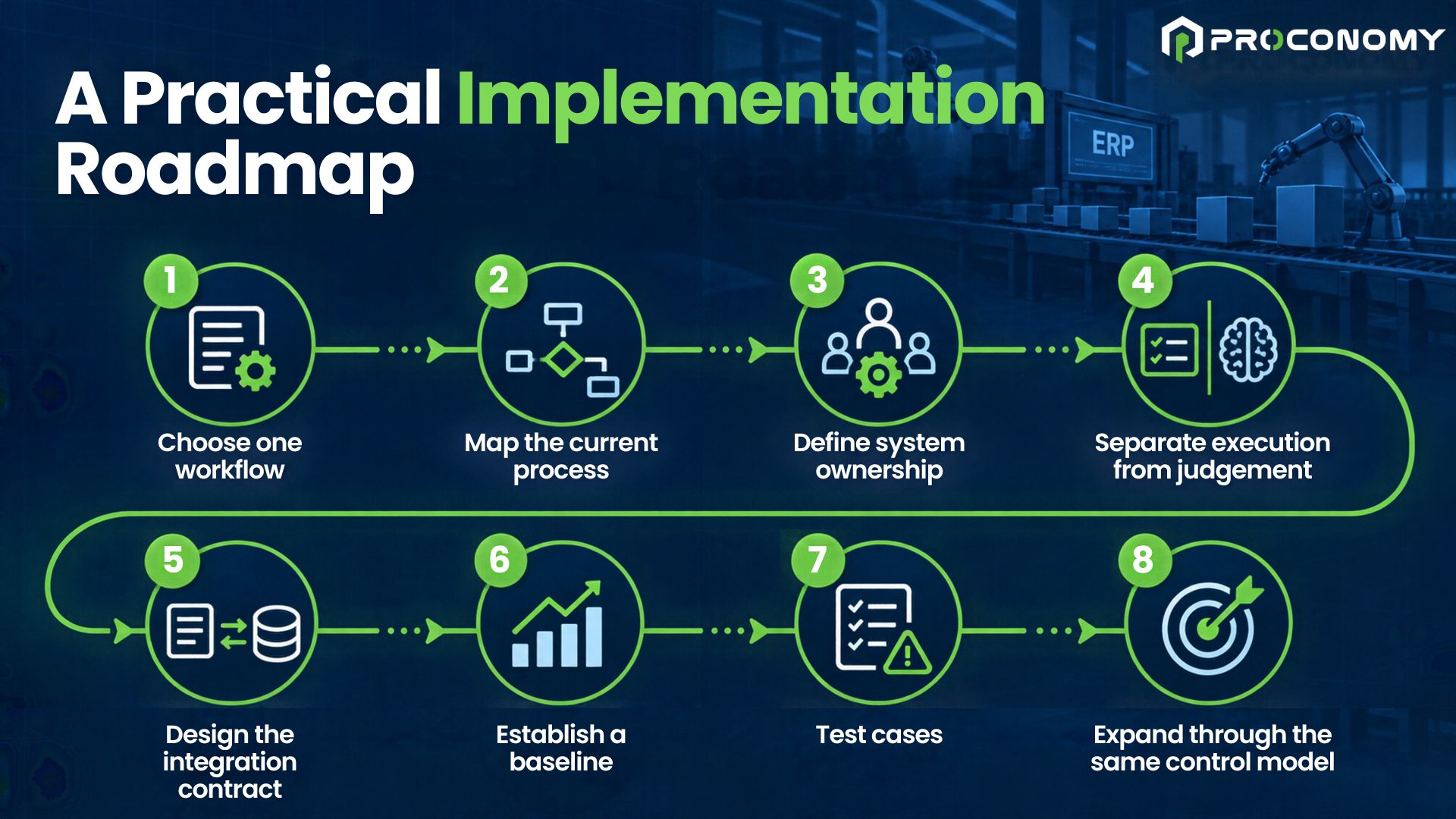
Step 1: Choose one workflow
Select a process with frequent volume, visible manual effort and a clear result. Avoid beginning with the broad goal of transforming all procurement.
Step 2: Map the current process
Document the trigger, systems, data, decisions, participants, approvals, exceptions and final record. Include the work performed in email and spreadsheets.
Step 3: Define system ownership
For each object, state whether SAP, Oracle, PLM, QMS, the procurement platform or another system is authoritative. Resolve ambiguity before building an integration.
Step 4: Separate execution from judgement
Identify the steps software may perform and the decisions that must remain with people. Define value limits, risk thresholds and exception routes.
Step 5: Design the integration contract
Specify the data read, write operations, identifiers, validations, response handling, retry logic, monitoring and ownership of failures.
Step 6: Establish a baseline
Measure current cycle time, buyer touches, follow-up effort, re-entry, exception volume, approval delay and policy compliance.
Step 7: Test normal and abnormal cases
Include missing fields, duplicate requests, invalid suppliers, unavailable approvers, expired documents, API failures and out-of-policy values. The edge cases reveal whether the process is truly governed.
Step 8: Expand through the same control model
Once the first workflow is stable, reuse the identity, permissions, checkpoints, audit and integration patterns for the next process. This creates a platform, not a collection of disconnected pilots.
Metrics that prove business value
Success should be measured at both the workflow and integration levels.
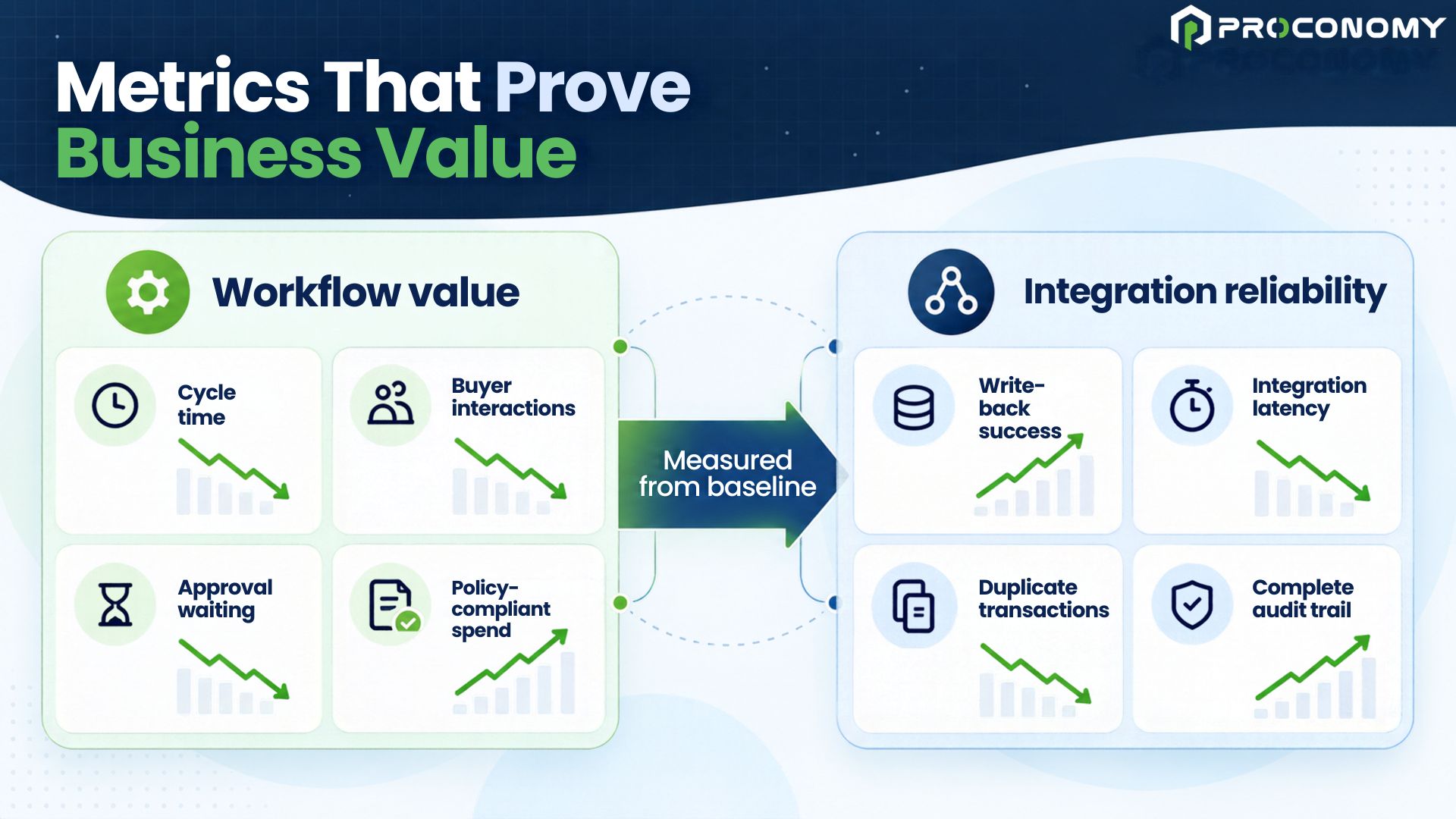
Workflow metrics
Workflow metrics should show whether the execution layer removes effort and improves control for procurement users. Establish the baseline before implementation, then track measures such as:
- Request-to-route cycle time
- Request-to-approved-requisition cycle time
- Buyer interactions per request
- Supplier follow-up effort
- Approval waiting time
- Percentage of requests returned for missing information
- Percentage of work completed without buyer intervention
- Exception resolution time
- Policy-compliant spend
- Sourcing events per buyer
Integration metrics
Integration metrics should show whether approved information moves between systems reliably and can be recovered when something fails. The core measures include:
- Successful write-back rate
- Integration latency
- Duplicate transaction rate
- Manual re-entry volume
- Failed synchronisations
- Mean time to resolve integration exceptions
- Percentage of transactions with a complete audit trail
- Time required to reconstruct a decision
The baseline matters more than a generic industry promise. Measure the workflow before implementation, then compare the same measures after adoption.
Connected spend intelligence can help relate operating improvements to policy compliance, sourcing coverage and spend visibility.
Evaluation questions for CIOs and CPOs
A product demonstration should prove how the architecture behaves when the process is imperfect.
Ask vendors to demonstrate how the product behaves when data is incomplete, an approval is unavailable or ERP rejects a write. The following questions move the evaluation beyond feature claims:
- Which system owns each supplier, material, requisition, order and approval record?
- What data does the platform read from SAP or Oracle, and when is it refreshed?
- Which outcomes can it write back?
- Can read and write permissions be scoped independently?
- How does the platform prevent duplicate records during retries?
- What happens when ERP rejects a transaction?
- Can the business user see an integration failure without opening an IT ticket?
- How are plant, entity, category and value rules applied?
- Which decisions always require a named human approver?
- How is segregation of duties preserved?
- Can supplier quality and engineering context influence the workflow without moving their authoritative data?
- What evidence is retained for each automated or agent action?
- Can an administrator suspend an agent or reduce its authority immediately?
- Can the vendor demonstrate one of your exceptions rather than only a clean scenario?
- Can the first workflow go live without replacing or redesigning the whole ERP landscape?
These questions move the conversation from feature lists to operating responsibility.
Common implementation mistakes
Implementation problems usually appear when system boundaries or decision rights remain unclear. The following mistakes can turn an execution layer into another source of complexity.
1. Creating a second system of record
If supplier, material or transaction data can be changed independently in two systems, reconciliation becomes permanent work. Define one authoritative owner and a governed change path.
2. Writing incomplete work into ERP
Draft requests and unapproved supplier records create noise. Keep work in the execution layer until it meets the validation and approval conditions for write-back.
3. Treating integration as a one-time connector
Interfaces fail, fields change and dependencies time out. Integration needs monitoring, ownership, incident handling and safe retries.
4. Automating the happy path only
A procurement process creates value when it handles missing documents, late suppliers, unavailable approvers and rejected transactions. Test these conditions before rollout.
5. Giving software broad access without defined authority
Technical permission is not business authority. Every automated action needs a defined purpose, boundary and escalation path.
6. Rebuilding every policy before starting
The first workflow should operationalise the policy the organisation already uses. Policy redesign can follow where evidence shows it is needed.
7. Measuring logins instead of outcomes
Adoption metrics do not prove that procurement capacity increased. Measure completed work, cycle time, intervention, exceptions and compliance.
Conclusion
The strongest procurement architecture does not force a choice between keeping ERP and improving execution.
SAP or Oracle can remain the authoritative system for suppliers, requisitions, purchase orders, receipts, invoices and financial records. Procurement management software can capture demand, assemble context, coordinate suppliers and functions, apply policy, manage exceptions and return approved results through one connected procurement platform.
That division of responsibility protects the ERP investment while addressing the manual work that continues around it.
Start with one workflow. Define what each system owns. Limit what the execution layer may read and write. Keep consequential decisions with the people your policy names. Measure the result before expanding.
Test the model on a real process. Request a workflow demonstration using one procurement workflow and the exception that causes the most manual follow-up today.
See this on your own workflow
Send us one process your team finds frustrating and we will show the model applied to it — governance included.