

Procurement Workflow Software vs ERP: Where Manual Work Still Happens
Published 2026-09-09 · Last updated 2026-09-09
A 2025 procurement survey found that 75% of business leaders struggle with manual procurement processes. This guide explains where ERP workflow ends, where procurement workflow software adds value, and how manufacturers can reduce manual coordination without replacing the ERP or weakening control.
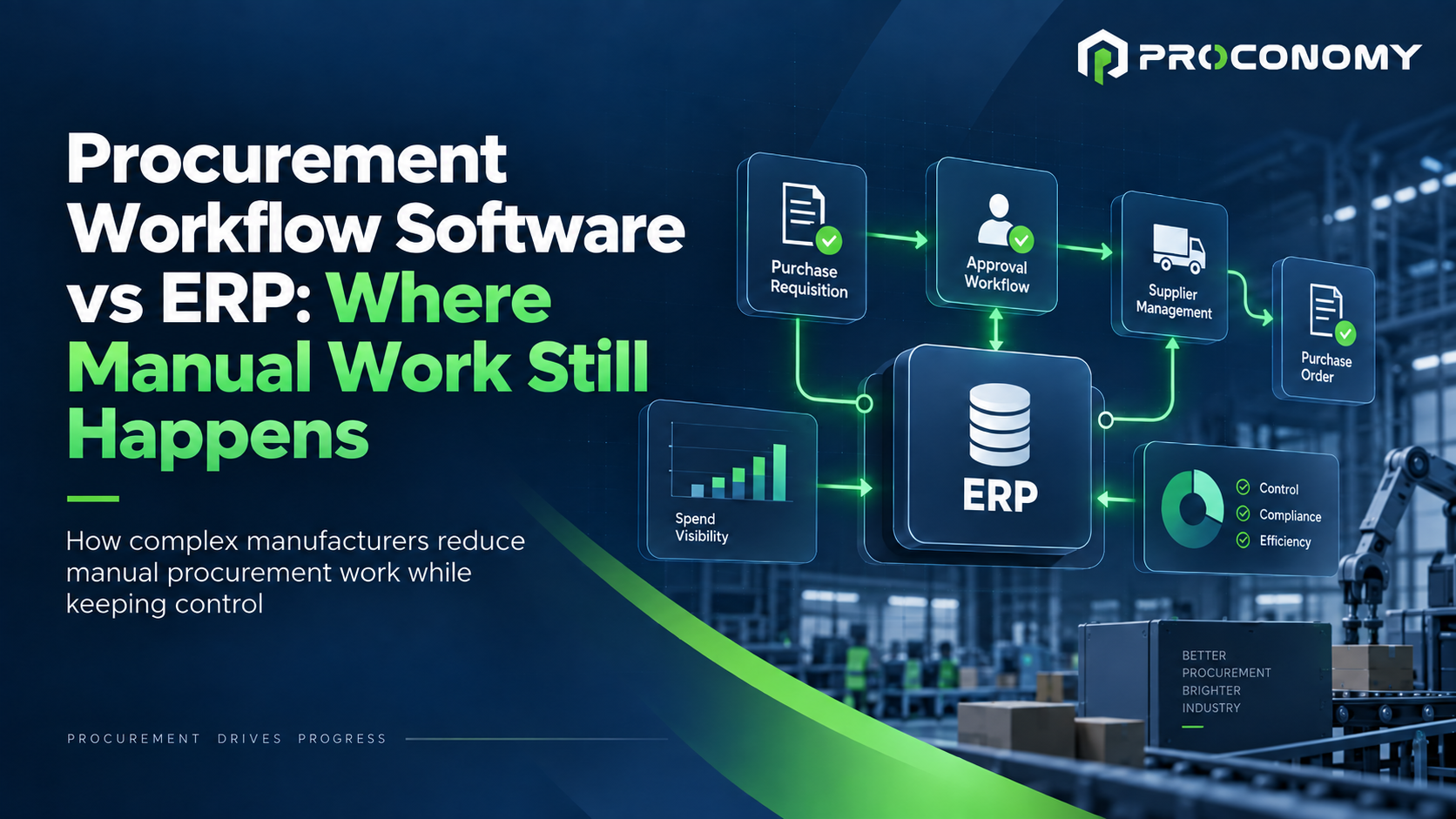
Most large manufacturers already have an ERP such as SAP, Oracle, or another enterprise platform managing purchase orders, supplier records, approvals, receipts, invoices, and financial transactions. Yet many procurement teams still rely heavily on Excel, email, supplier follow-ups, and manual coordination to get work from an initial request to an approved transaction.
This creates an important question for CPOs and CIOs evaluating procurement workflow software: if the ERP already has workflow capabilities, why is another workflow layer needed?
The answer is usually not that the ERP has failed. ERP workflow and procurement workflow software are designed to solve different parts of the procurement process. ERP systems are primarily built to control and record structured enterprise transactions, while procurement workflow software coordinates the work that happens before, between, and around those transactions.
For complex manufacturers, understanding that difference is essential. The goal should not be to replace a system that already works. It should be to reduce the manual procurement execution that still sits around it.
What is procurement workflow software?
Procurement workflow software manages how procurement work moves between requests, buyers, suppliers, approvers, policies, and enterprise systems.
It can coordinate processes such as procurement intake, sourcing, RFQs, supplier follow-ups, quote evaluation, approvals, supplier onboarding, contracting, exceptions, and ERP updates.
The key word is workflow.
Traditional procurement software may store data or provide a place for users to complete tasks. Procurement workflow software goes further by determining what should happen next, who or what should act, which rule applies, and where a human decision is required.
For example, a plant may submit a maintenance requirement without the correct category, supplier, specification, or approval information. A well-designed procurement workflow can gather missing context, apply the relevant policy, determine whether sourcing is required, route the right approvals, coordinate suppliers, and ultimately send the approved transaction to ERP.
This is why procurement workflow software is increasingly relevant for organisations where procurement has been digitised but execution remains manual.
What is ERP workflow?
ERP workflow is typically strongest when the process is already structured and closely linked to enterprise transactions.
It commonly manages purchase requisition approvals, purchase orders, supplier master changes, goods receipts, invoice processing, financial controls, budget checks, and other activities that need to be recorded within the enterprise system.
These capabilities are essential. In most manufacturing environments, the ERP should continue to serve as the system of record.
The challenge appears when procurement work is not yet a clean transaction. A sourcing requirement may be incomplete, a supplier may not have responded, engineering may need to review a quotation, or an approval may depend on information spread across multiple systems.
In those situations, someone still has to coordinate the process.
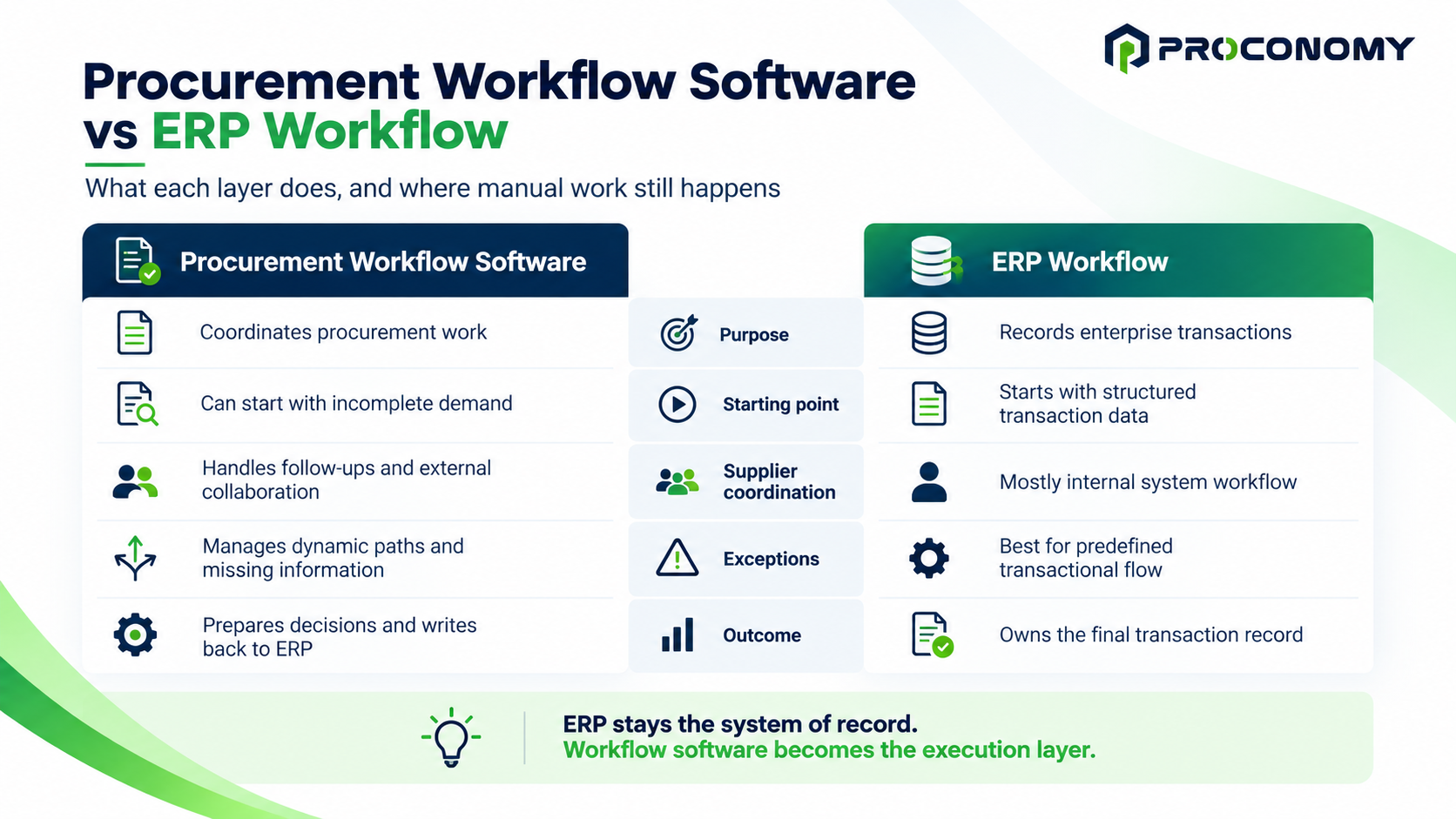
Procurement workflow software vs ERP workflow
The distinction becomes clearer when the two are compared side by side.
| Area | Procurement workflow software | ERP workflow |
|---|---|---|
| Primary purpose | Coordinate procurement execution | Record and control enterprise transactions |
| Starting point | Can begin with incomplete or unstructured demand | Usually begins with structured transaction data |
| Supplier interaction | Can manage supplier coordination and follow-ups | Usually limited outside the ERP environment |
| Exceptions | Designed to manage dynamic paths and missing information | Strongest in predefined transactional workflows |
| Sourcing | Can coordinate RFQs, responses, evaluation, and approvals | Often not the primary execution layer |
| Human decisions | Can prepare context and stop at defined decision points | Commonly routes transactions for approval |
| ERP integration | Sends approved outcomes to ERP | Owns the enterprise transaction |
| Main value | Reduce manual coordination | Maintain control and transactional integrity |
The question for procurement leaders is therefore not whether SAP, Oracle, or another ERP can support workflows. They can. The better question is:
Which procurement workflows still require people to move the process forward outside the ERP?
That is where procurement workflow software becomes relevant.
Why procurement still runs manually around ERP
ERP implementation does not automatically eliminate procurement coordination.
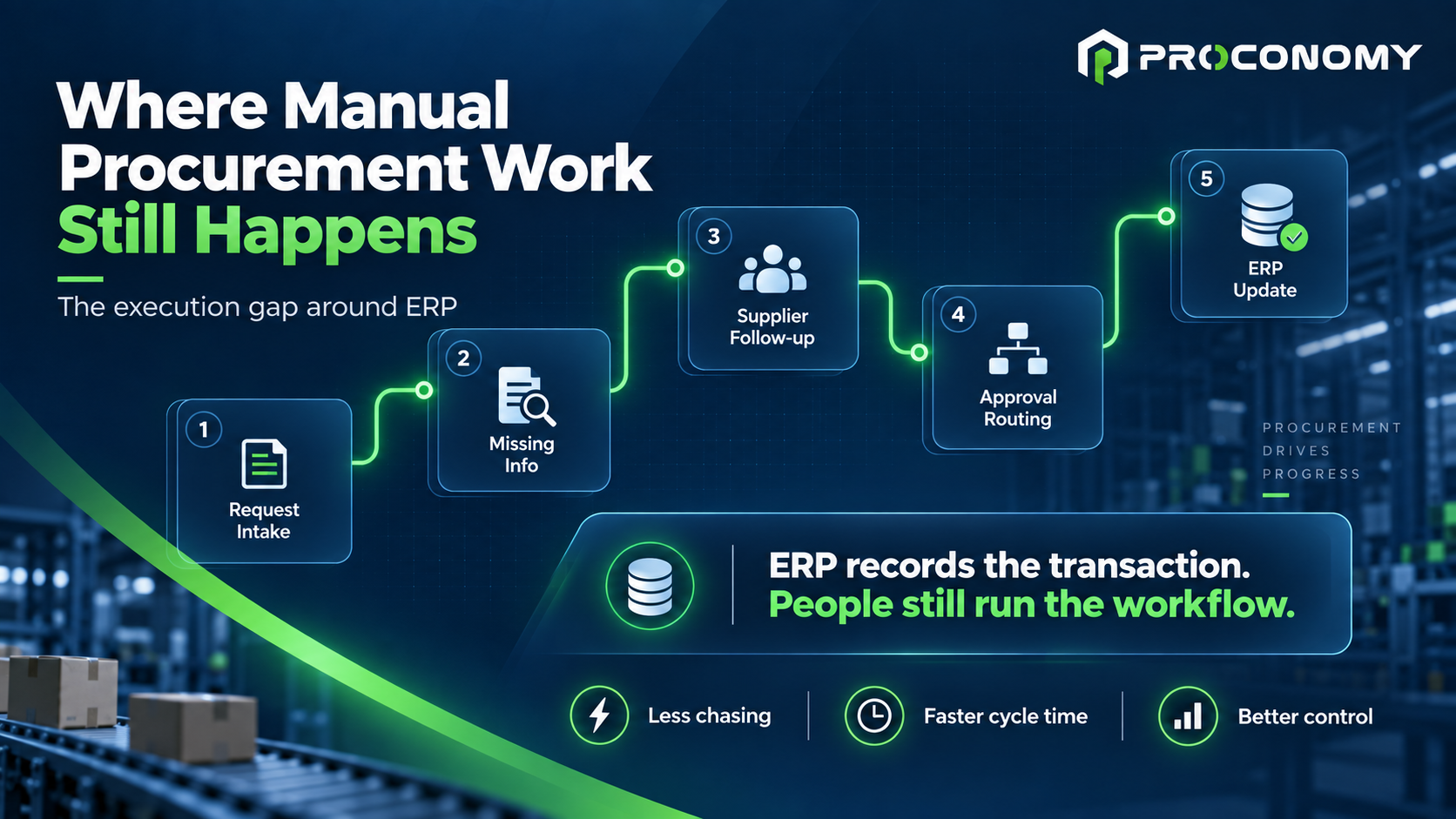
Consider a typical manufacturing RFQ. The ERP may already contain material data, approved suppliers, plant information, cost centres, purchasing history, and purchase orders. However, the work required to create a sourcing decision may still involve collecting specifications, selecting suppliers, sending RFQs, following up on responses, normalising quotes, coordinating technical evaluation, preparing the commercial recommendation, and obtaining approval.
The ERP can accurately record the resulting purchase order while people still execute most of the process that produces it.
This is the execution gap at the centre of Proconomy’s positioning:
ERP records procurement. People still run it.
The opportunity is not to discard ERP. It is to create a governed execution layer around it so more of the repetitive coordination can happen automatically while the ERP remains authoritative.
Explore how Proconomy approaches this on the Move Beyond ERP, Excel and Email page.
Where ERP workflow typically reaches its limits
The gap between ERP workflow and procurement execution tends to become visible in four areas.
1. Unstructured procurement intake
Business users do not always raise perfect purchase requests. Requirements may be missing specifications, categories, supporting documents, budget information, or supplier context.
Procurement often spends time turning an operational request into something that can enter a formal process. Procurement workflow software can help structure that information before a transaction needs to be created.
2. Supplier coordination
Suppliers operate outside the buyer’s ERP environment. Quotations, technical documents, clarifications, certifications, and other information may arrive through multiple channels.
A procurement workflow therefore needs to coordinate external participants as well as internal systems.
3. Cross-functional approvals
Manufacturing procurement frequently involves engineering, finance, quality, legal, plant teams, procurement, and suppliers.
The challenge is not simply sending an approval request. The approver needs the right commercial, technical, policy, and risk context to make the decision.
4. Exceptions
Procurement workflows rarely follow one perfect path. A supplier may miss a deadline, a quotation may be incomplete, a plant may raise an urgent requirement, or a request may exceed an approval threshold.
Modern procurement process management software should be able to handle these exceptions without forcing the buyer to become the process coordinator.
What good procurement workflow software should do
A useful platform should manage the complete movement of work, not simply digitise a task list.
It should be able to:
- Trigger workflows from requests, events, emails, system conditions, or supplier activity
- Collect and structure the context required for execution
- Apply procurement policies, thresholds, supplier rules, and approval logic
- Automate repetitive actions such as reminders, routing, completeness checks, and supplier follow-ups
- Prepare decisions with the relevant information
- Stop at clearly defined human decision points
- Update ERP or other systems only after the right approval has been obtained
- Retain an auditable history of actions, rules, decisions, and system updates
This distinction matters because procurement automation software is most valuable when it reduces coordination effort without weakening governance.
Example: From plant request to ERP purchase order
Consider a plant maintenance requirement.
Without a dedicated execution workflow, the requester may email procurement, the buyer may ask for missing information, determine whether sourcing is required, contact suppliers, compare quotations, coordinate approvals, and finally enter the approved transaction into ERP.
The ERP has done its job correctly. It records the approved purchase.
The problem is that the buyer has spent much of the process gathering, chasing, routing, consolidating, and updating.
With a governed procurement workflow, the same process can operate differently. Missing information can be requested automatically, policy can determine the sourcing route, supplier coordination can run within the workflow, decision context can be prepared for the approver, and the approved result can be written back to ERP.
The transaction still belongs in ERP. The manual coordination around it does not have to.
Proconomy demonstrates this pattern through its Governed Intake to ERP Purchase Order workflow.
See this on your own procurement process
If your team has a plant intake, sourcing, supplier onboarding, or approval process that still depends on email and follow-ups, bring that workflow to Proconomy.
Request a workflow demonstration and see how the process can move from trigger to governed ERP execution.
Does procurement workflow software replace ERP?
For most complex manufacturers, it should not need to.
ERP platforms perform critical functions across financial control, transaction recording, master data, purchase orders, receipts, invoices, accounting, and enterprise reporting.
Procurement workflow software solves a different problem.
It manages how the work gets from an operational requirement to an authorised outcome that the ERP can record.
This leads to a more useful architectural distinction:
ERP = system of record
Procurement workflow software = system of execution
The execution layer gathers context, coordinates participants, applies rules, manages exceptions, prepares decisions, and sends authorised outcomes back to the system of record.
For a CPO, that creates the possibility of increasing procurement capacity without replacing the existing technology backbone.
For a CIO, it reduces the risk of creating another competing source of transactional truth.
Procurement workflow software vs ERP customisation
Another reasonable question is whether organisations should simply extend their existing ERP workflows.
Sometimes that is the right approach.
If a process is highly structured, internal, transactional, stable, and already well represented in ERP, additional ERP workflow may be sufficient.
The case for a separate procurement workflow layer becomes stronger when the process includes external suppliers, unstructured requests, frequent exceptions, multiple systems, repeated follow-ups, cross-functional evaluation, or policy that varies across plants and legal entities.
The issue is not whether ERP customisation is technically possible.
The issue is whether ERP should become responsible for every dynamic procurement interaction surrounding the transaction.
Where should each type of work sit?
A practical manufacturing procurement architecture can separate responsibilities across three layers.
1. ERP should continue to own
Purchase orders, requisitions, invoices, receipts, financial postings, core master data, and official transaction history should normally remain within the ERP environment.
2. Procurement workflow software can execute
Activities such as intake, RFQ coordination, supplier follow-ups, quote collection, evaluation preparation, supplier onboarding, contract routing, exception management, and cross-functional approval orchestration can sit in an execution layer.
3. People should retain important decisions
Supplier awards, material commercial decisions, contractual acceptance, out-of-policy approvals, risk decisions, and financial authority should continue to sit with the appropriate people.
That separation is central to governed autonomous procurement.
The goal is not to remove humans from procurement. It is to stop requiring humans to personally carry every workflow from one step to the next.
Where AI agents fit into procurement workflow software
AI makes this distinction even more important.
A procurement copilot may help a buyer draft an RFQ, summarise a quotation, or write a supplier email. These capabilities can improve productivity, but the buyer may still need to execute every subsequent action.
Agentic workflow software goes further because it can take authorised actions such as requesting information, sending supplier invitations, checking rules, following up, routing approvals, or updating systems.
Once software is allowed to act, governance becomes essential.
CPOs and CIOs should know what the agent is authorised to do, which policy permits each action, what data it can access, when it must stop, who approves exceptions, and whether the full action history can be reviewed later.
This is why Proconomy positions automation around governed execution rather than unrestricted autonomy. The objective is to automate repetitive procurement work while preserving explicit decision authority.
What CPOs should look for
For the CPO, the strongest business case for procurement workflow software is usually procurement capacity.
Buyers and category teams often spend significant time chasing responses, moving approvals, compiling information, updating stakeholders, and transferring information between systems.
That time is not available for strategic sourcing, supplier development, negotiation, risk management, savings delivery, or other higher-value activities.
The CPO should therefore evaluate software against a practical question:
How much manual coordination will this workflow remove while preserving the controls we need?
A feature list alone will not answer that.
What CIOs should look for
The CIO has a different set of concerns.
Adding another procurement platform can create integration complexity, duplicated data, unclear system ownership, security risk, and additional application management.
Those concerns are valid and should be part of the evaluation.
A procurement workflow platform should therefore make it clear which system owns each record, what data is copied, what is written back to ERP, how permissions are controlled, how AI actions are governed, what happens if an integration fails, and how the workflow can be audited.
A strong execution layer should complement ERP rather than compete with it.
When should you consider procurement workflow software?
Procurement workflow software is particularly relevant when an organisation already has ERP but still experiences significant manual activity around sourcing, approvals, suppliers, or exceptions.
Common signals include:
- RFQs are still managed in spreadsheets
- Procurement requests arrive through email
- Buyers manually chase suppliers
- Approvals stall because context is fragmented
- Processes differ significantly across plants or entities
- Teams repeatedly move information between systems
- Procurement struggles to scale without adding headcount
- Important workflows remain manual despite an existing procurement suite
If those problems are not present, another platform may create unnecessary complexity.
If they are present across several processes, the execution layer is worth evaluating.
How to evaluate procurement workflow software
Do not begin with a generic product demonstration.
Start with one real procurement workflow.
Choose a process that currently creates visible friction, such as plant intake, source-to-award, supplier onboarding, contract routing, or an approval exception.
Then ask the vendor to demonstrate:
- What starts the workflow?
- How is missing information collected?
- Which procurement policies are applied?
- What does the software execute automatically?
- What happens when an exception occurs?
- Where is a human decision required?
- What gets written back to ERP?
- What remains in the audit trail?
This approach quickly separates procurement workflow software that genuinely executes work from software that mainly provides another interface for people to manage tasks.
Evaluate the workflow, not just the feature list Proconomy’s workflow demonstration library includes examples across intake, sourcing, supplier onboarding, contracting, and multi-entity governance.
Explore the workflows, then bring one of your own processes for a live demonstration.
Procurement workflow software is not another ERP
The most useful way to frame the category is not:
ERP versus procurement workflow software.
It is:
ERP plus governed procurement execution.
ERP continues to record the enterprise transaction and protect the financial system of record.
Procurement workflow software coordinates the work required to reach that authorised transaction.
People remain responsible for decisions where judgement, commercial authority, financial control, or risk demands it.
That model is particularly relevant for complex manufacturers because most of them do not suffer from a complete absence of technology.
They already have systems.
The problem is that too much procurement work still depends on people to connect those systems manually.
See procurement workflow software on your own process
If you are comparing procurement workflow software, ERP workflow, procurement automation software, or procurement process management software, start with your own workflow rather than a feature checklist.
Identify the process that consumes the most buyer coordination today. Bring the approvals, exceptions, ERP environment, and decision points that the technology needs to respect.
Then evaluate whether the platform can execute more of the work without taking away control.
Bring one workflow. We will run it.
See this on your own workflow