

Source-to-Pay Process: A Complete Guide for Complex Manufacturers
Published 2026-09-03 · Last updated 2026-09-03
A connected source-to-pay process helps manufacturers reduce delays, manual work and compliance gaps. McKinsey found that 56% of S2P tasks can be largely automated, increasing to 93% in payment processing, while process inefficiencies can consume 3–4% of external spend. The key is governed automation that moves routine work forward while keeping people in control of critical decisions.
More than half of the work inside the source-to-pay process can be automated.
McKinsey's task-level analysis found that 56% of S2P activities were fully or largely automatable; the opportunity rose to 88% for placing and receiving orders and 93% for payment processing.
Yet automation is not the same as an end-to-end process. A manufacturer can automate requisitions, run e-sourcing, issue purchase orders and match invoices and still depend on buyers to copy data, chase approvals, check supplier quality, reconcile plant-specific rules and explain why an award was made.
That coordination gap is where cycle time, control and value leak. This guide explains what source to pay includes, how the complete S2P process works in complex manufacturing, where it commonly breaks and what a connected, governed operating model should look like.
What is the Source-to-Pay Process?
The source-to-pay process covers every activity required to identify a need, find and select a supplier, contract for goods or services, place an order, receive what was ordered and pay the supplier. It also includes the data, policies, approvals and supplier-management activities that support those transactions.
McKinsey defines source to pay as the end-to-end value stream through which an organisation obtains and pays for goods and services, including sourcing strategy, supplier selection, contracting, ordering, receipt and payment.
For a complex manufacturer, that definition needs extra depth. The process must carry technical requirements, drawings and revisions; approved-source and quality status; capacity and lead-time commitments; plant and legal-entity rules; commercial terms; goods receipts; invoice exceptions; and ERP records. The transaction is only one part of the decision.
Source-to-Pay VS Procure-to-Pay
Procure-to-pay (P2P) starts later. It generally covers the transactional sequence from requisition and purchase order through receipt, invoice and payment. Source-to-pay includes P2P but begins upstream with demand, spend analysis, sourcing, supplier qualification, evaluation, award and contracting.
A practical test is simple: if the process begins after a supplier and commercial route have already been chosen, it is probably P2P. If it governs how the supplier and route are chosen - and connects that decision to the eventual order and payment - it is S2P.
The Eight Stages of the Source-to-Pay Cycle
Different organisations group the source-to-pay cycle in different ways. For manufacturers, the following eight-stage model is useful because it keeps the technical, supplier-quality, commercial and transactional work visible.
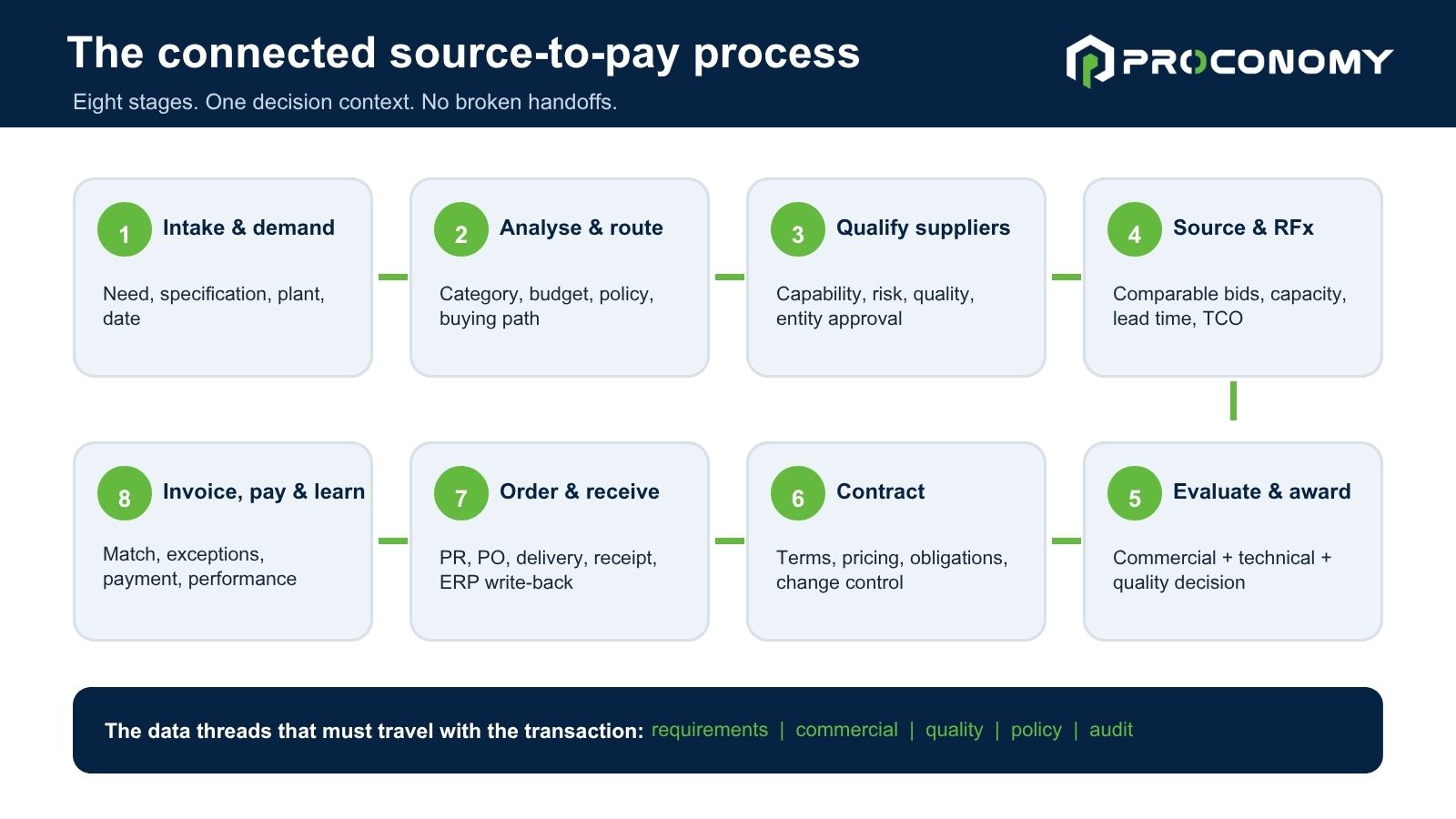
1. Capture demand and requirements
The S2P process begins before a requisition exists. A plant engineer may need a replacement gearbox, an MRP signal may show future demand, a project may release a bill of materials, or a function may request a service. Good intake converts that need into a structured record: part or service, specification, quantity, delivery point, required date, cost centre, plant, entity and requester.
2. Analyse spend and choose the buying route
The request must be classified and routed. Is the need covered by a catalogue or live contract? Does it require a new sourcing event? Is the supplier already approved for the relevant plant and category? Which budget, threshold, risk tier and approval path apply? This is where spend intelligence should launch action, not end in a dashboard.
3. Identify and qualify suppliers
Supplier discovery is not enough for manufacturing. Procurement needs to know whether a supplier can produce the item or deliver the service at the required volume, quality and location. Qualification may include capacity, financial and operational risk, certifications, plant approvals, quality history, data requirements and entity-specific controls.
4. Run sourcing, RFx or an eAuction
The sourcing event should make responses comparable. For direct materials, that may require normalising currency, units, incoterms, tooling, minimum order quantities, lead times, capacity commitments, logistics, warranty, quality cost and payment terms. The objective is not merely to collect three prices; it is to create a defensible decision set.
5. Evaluate, negotiate and award
Evaluation brings commercial, technical, quality, risk and operational inputs together. Total cost may matter more than unit price. An inexpensive part is not inexpensive if it creates line stoppages, premium freight, rework or warranty exposure. Rules can assemble and score evidence, but consequential award decisions should return to the people named in policy.
6. Create and manage the contract
The awarded position becomes enforceable through a contract, framework agreement or set of purchasing terms. Pricing schedules, volumes, specifications, service levels, quality obligations, liability, delivery, change procedures, renewals and termination rights need to remain connected to what is later bought and invoiced.
7. Requisition, order and receive
An approved outcome becomes a requisition or purchase order in the ERP. The supplier acknowledges it; goods or services are delivered; and the receiving team records quantity and condition. For manufacturers, receipts may also need inspection results, batch or serial data, advanced shipping information and links to quality evidence.
8. Match, resolve, pay and learn
Invoices are matched against the purchase order, receipt and, where relevant, contract terms. Exceptions go to the person who can resolve the underlying issue. After payment, supplier delivery, quality, responsiveness and commercial performance should feed future sourcing and ordering decisions. That closes the loop rather than merely closing the invoice.
Explore how intake, sourcing, contracts, purchasing, suppliers and quality can run on one connected foundation.
Why the Manufacturing Procurement Process is Harder
Manufacturing adds dependencies that general-purpose procurement models often treat as attachments or late-stage checks. The result is a process that looks complete in a system map but still requires people to bridge the gaps.
1. Technical requirements change
Drawings, revisions, materials, tolerances and bills of materials can change during sourcing or after award. The process must show which requirement each supplier priced and which version the contract and PO reference.
2. Supplier quality is part of the commercial decision
Approved-source status, PPAP or other qualification evidence, audit findings, nonconformance history and open corrective actions can affect whether a supplier should be invited, awarded or used for a specific plant.
3. Capacity and continuity matter
A supplier's ability to meet volume, lead time and ramp-up requirements may be as important as price. Single-source exposure, tooling ownership and sub-tier dependencies can change the real risk of an award.
4. Plants and entities need different authority.
A group may want common category rules while individual plants retain local thresholds, approvers, tax treatments, supplier eligibility and operational discretion.
5. Direct, indirect and MRO spend behave differently.
Direct materials follow engineering and quality controls; indirect categories may need stronger demand and contract governance; MRO often requires speed without abandoning policy.
6. The ERP records outcomes, not all the work around them.
ERP systems are essential systems of record, but the request interpretation, supplier chase, cross-functional review, exception resolution and policy explanation often remain in email and spreadsheets.
Six Common Source-to-Pay Failure Modes
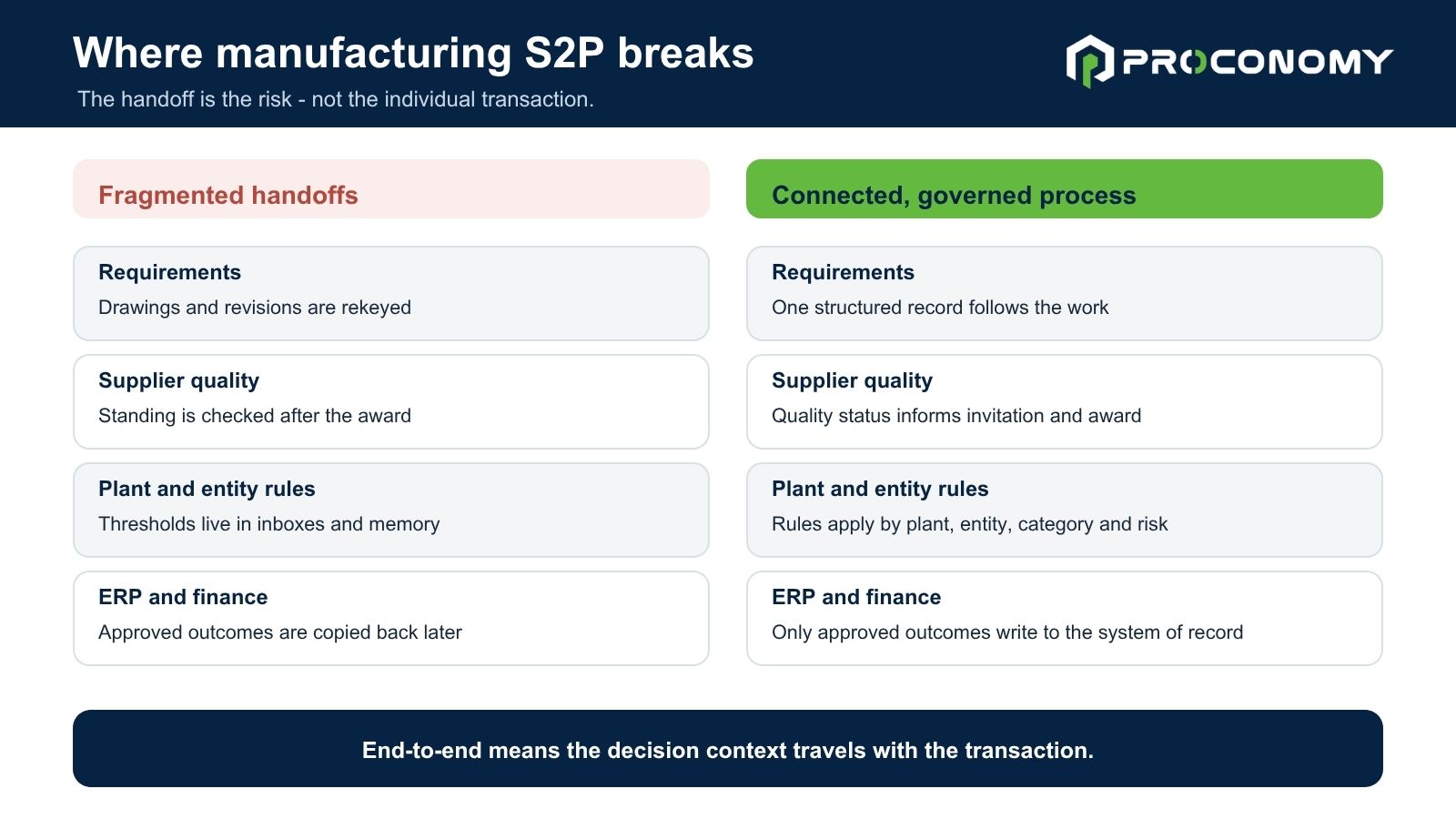
Even a well-designed source-to-pay process can break down when data, systems and teams are disconnected. In complex manufacturing environments, these gaps often appear at critical handoffs; creating delays, compliance risks, supplier issues and avoidable manual work. The following six failure modes are among the most common signs that the process needs greater integration and governance.
1. Intake begins in email
Requests arrive with missing specifications, dates or budget context. Buyers spend time interpreting and chasing before procurement work can even start. Better pattern: one intake layer that structures the request, asks for missing information and selects the buying route by rule.
2. Sourcing events are isolated
Supplier responses are compared in a sourcing tool, but quality standing, contract history, plant eligibility and past performance live elsewhere. Better pattern: evaluation uses a shared supplier and decision record.
3. Approvals are notifications, not controls
An approval email is sent, but reminders, escalation, thresholds and exceptions depend on manual follow-up. Better pattern: sequential, parallel and conditional approvals are executable, visible and tied to a named decision-maker.
4. Contracts disconnect after signature
The signed agreement is stored, but pricing schedules, obligations, expiry dates and deviations do not guide requisitions, orders or invoices. Better pattern: the contract remains part of the downstream buying and compliance context.
5. Supplier quality reacts after the commercial decision
A quality issue or open corrective action becomes visible only after an award or purchase. Better pattern: supplier standing reaches the invitation, evaluation and award stages before the decision is made.
6. ERP write-back requires rekeying
Approved data is copied into the ERP, creating delay and error risk. Better pattern: the ERP remains the system of record, while approved requisitions, orders or supplier outcomes are written back through monitored integration.
What a Strong End-to-End Procurement Process Should Deliver
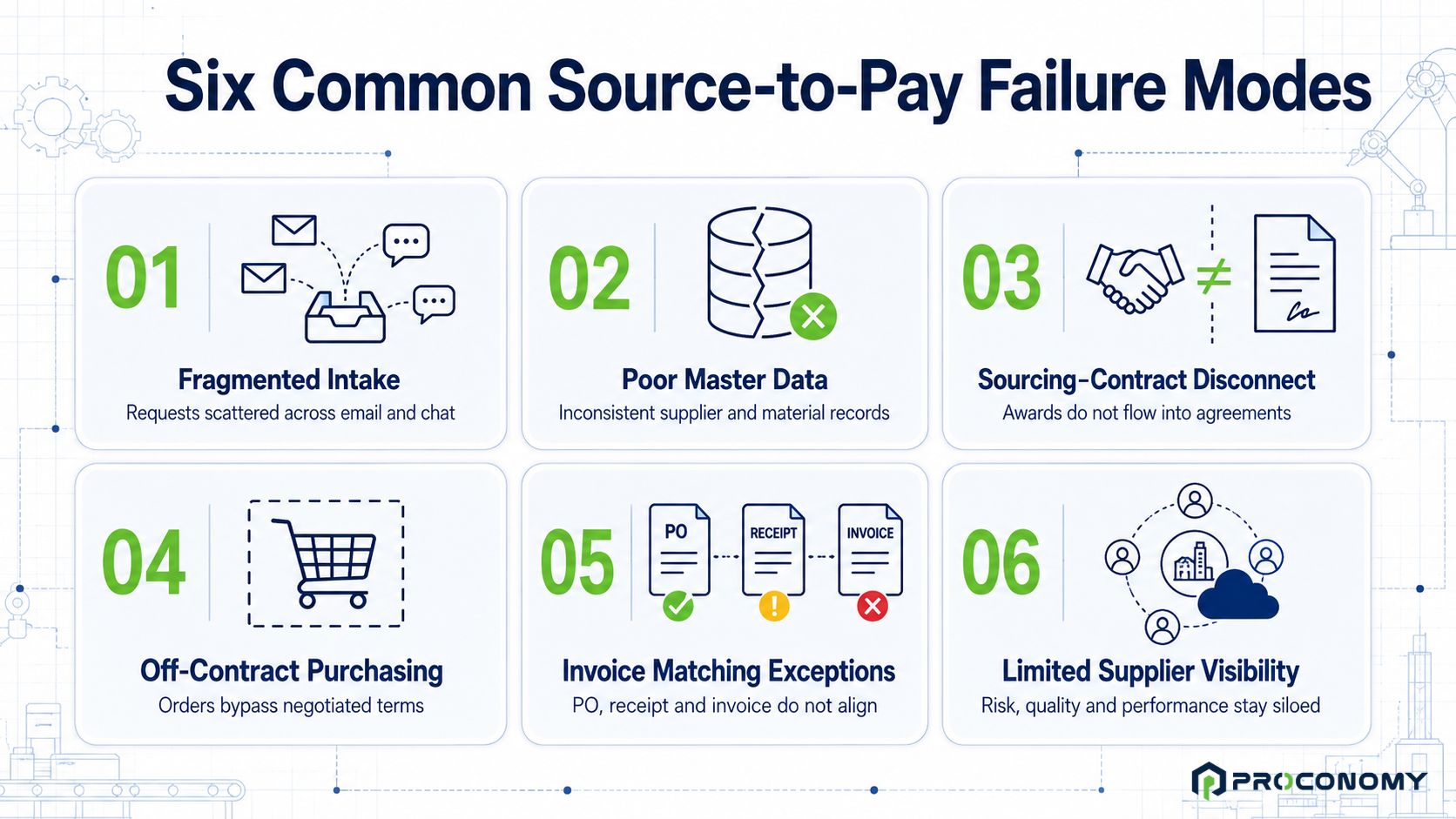
A high-performing S2P process is not defined by how many modules a company owns. It is defined by whether work, rules and evidence stay connected as the request moves across people and systems.
- One request and decision record. The original need, structured requirements, applied policy, supplier evidence, approvals, outcome and ERP reference remain linked.
- One supplier context. Qualification, documents, performance, risk and quality standing are available wherever a supplier decision is made.
- Executable policy. Category, value, entity, plant and risk determine routes, permissions, thresholds, approvals and exception paths.
- Human checkpoints for consequential decisions. Technology can prepare, route, compare, remind and write back, while awards, material exceptions and other judgement points stop for named people.
- Exception-led work. Routine activity progresses without constant manual coordination; people focus on incomplete data, non-standard terms, quality risk and decisions outside policy.
- ERP coexistence. Approved context is read from systems of record and approved outcomes return to them. Draft or unapproved activity does not silently become a financial record.
- Reconstructable evidence. A reviewer can see what happened, which rule fired, who or what acted, who approved and what was written back.
This connected-data requirement is becoming more important.
McKinsey estimates that procurement functions currently use less than 20% of the data available to support decisions and argues for a common data spine across spend, suppliers, contracts and market benchmarks.
From workflow Automation to Governed Autonomy
Traditional workflow automation moves a predefined task from one queue to another. Governed autonomy goes further: authorised agents can classify a request, collect missing information, normalise supplier responses, chase a deadline, check a rule or write an approved outcome back - but only inside explicit permissions, thresholds and checkpoints.
The distinction matters in procurement because speed without authority is risk, while authority without execution is still manual coordination. A safe operating model makes both visible:
- People set the rules. Policies define routes, limits, permissions, approvals and exceptions.
- Agents move authorised work forward. Repeatable preparation, routing, follow-up and system actions do not wait in a buyer's inbox.
- Consequential decisions return to people. Awards, non-standard commitments and actions above a threshold stop at a non-bypassable checkpoint.
- Every action leaves evidence. The actor, permission, rule, input, decision and outcome can be reconstructed.
Deloitte's 2025 Global CPO Survey similarly stresses that humans must remain in the loop to maximise technology investments.
How to Improve the Source-to-Pay process without Replacing ERP
A manufacturer does not need to redesign every procurement workflow at once. A practical transformation starts with the work that creates the most coordination cost or operational risk and proves the operating model there.
- Map one real workflow end to end. Start with an actual category or request type. Include the informal work: missing-data chase, engineering review, supplier communication, quality checks, approval reminders, exception handling and ERP rekeying.
- Identify the coordination drag. Find where work waits, where the same data is entered again, where policy depends on memory, where supplier evidence is checked late and where status requires a meeting.
- Write the authority model. Define what the system may do, what requires a person, which thresholds apply, who can override, how overdue work escalates and what evidence must be retained.
- Connect the record systems. Decide what context is read from ERP, PLM, QMS or finance systems and which approved outcomes are written back. Include error handling and ownership, not just the happy path.
- Measure the workflow before scaling. Track elapsed time, wait time, manual touches, exceptions, sourcing coverage, policy adherence and stakeholder effort. Use the results to select the next workflow.
Source-to-Pay KPIs that Reveal Whether the Process Works
Savings remains important, but an S2P transformation also changes capacity, control, working capital, supplier outcomes and user experience. A balanced scorecard should include leading and lagging measures.
- Intake-to-route time: How long it takes to turn an initial need into a complete, classified request on the correct buying path.
- Source-to-award cycle time: Elapsed time and approval wait time from sourcing launch to approved award.
- Sourcing coverage: Addressable spend competitively sourced rather than renewed or bought without structured comparison.
- Manual touches per transaction: Human interventions required for a request, sourcing event, PO, receipt or invoice.
- First-time-right rate: Requests, POs and invoices that progress without missing-data or coding rework.
- Exception rate and resolution time: Frequency of policy, contract, receipt, invoice and supplier exceptions, plus time to close.
- Contract utilisation and leakage: Purchases made against the intended agreement and value lost when terms are not applied.
- Supplier delivery and quality performance: On-time-in-full delivery, incoming defects, nonconformances, corrective-action ageing and repeat issues.
- Realised value: Savings, cost avoidance, rebates, discounts and working-capital benefits confirmed through downstream transactions.
- Stakeholder effort and satisfaction: Requester time, buyer time and the ease of knowing what is required and where work stands.
Put a Number on the Effort. Estimate where procurement time goes across categories and model the value of reducing manual S2P work.
A Practical S2P Process Checklist for Manufacturers
Use these questions to test whether your process is genuinely connected:
- Can every request enter through one governed intake path without forcing requesters to understand procurement categories?
- Do drawings, specifications, revisions and delivery requirements stay attached to the sourcing and award record?
- Does supplier qualification and quality standing influence who can be invited, awarded and ordered from?
- Are plant, entity, category, value and risk rules applied consistently but with local authority where required?
- Can supplier responses be normalised across price, units, currency, incoterms, lead time, capacity and quality?
- Do contracts guide downstream buying, matching, obligations and renewals?
- Are approvals, reminders, escalations and overrides visible and executable?
- Does the ERP remain the system of record while approved outcomes are written back without rekeying?
- Can every exception reach the person capable of resolving its root cause?
- Can an auditor reconstruct the request, rule, evidence, approval, action and outcome from one linked history?
If several answers are no, the issue may not be a missing feature. It may be that the end-to-end process is still being held together by people.
How Proconomy Supports Connected Source to Pay
Proconomy is built as a governed procurement execution layer for complex manufacturers. Intake, spend intelligence, sourcing, eAuctions, contracts, purchasing, supplier management and supplier quality share one data and governance foundation. The ERP remains the system of record; governed work runs around it, and approved outcomes are written back.
The operating model is deliberately bounded: people define policy, permissions, thresholds and approvals; agents execute authorised work; and consequential decisions or exceptions return to named people. The result is not procurement without people. It is procurement with less manual coordination and clearer control.
The Next Step: Test One Real Workflow
The best way to evaluate a source-to-pay model is not through a feature checklist alone. Bring one workflow that consumes buyer time, crosses functions or regularly creates exceptions. Run the real requirements, rules and approval thresholds through it. Then examine where technology acts, where a person decides, what reaches the ERP and what evidence remains.
That will tell you whether the process is merely digitised or genuinely connected, governed and ready to scale.
Bring One Workflow. See the process run with your policy, thresholds and exceptions included.
See this on your own workflow
Send us one process your team finds frustrating and we will show the model applied to it — governance included.