

Source-to-Pay vs Procure-to-Pay: Where Does Your Plant Need More Control?
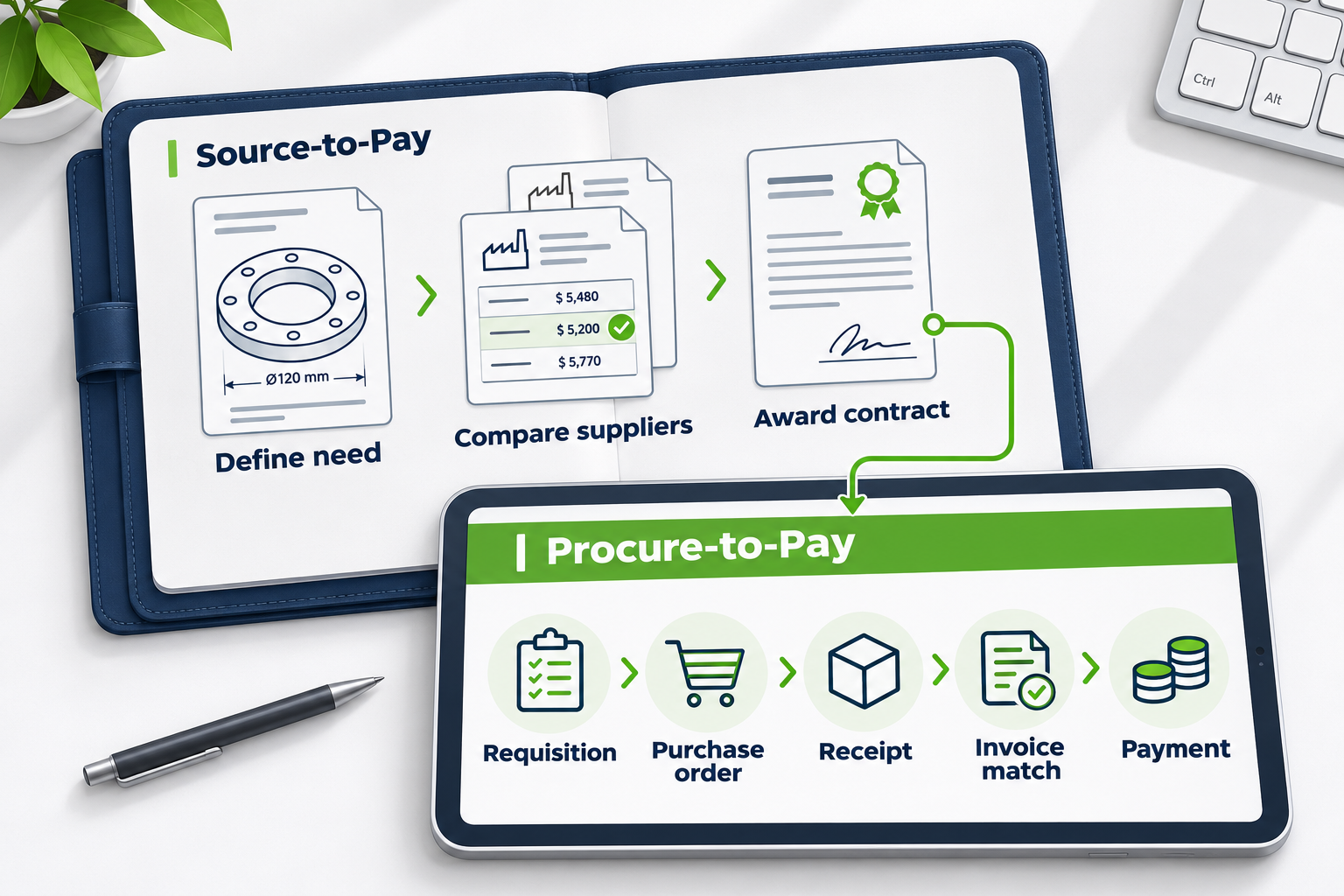
Procure-to-pay (P2P) controls how a plant orders, receives, and pays for goods and services. Source-to-pay (S2P) also covers how procurement selects the supplier and agrees on the terms behind the order. Ardent Partners reported an average invoice exception rate of 18.4% in its 2025 AP benchmark. To decide where your plant needs more control, take one blocked invoice and trace it back. A missing goods receipt points to P2P. A freight charge nobody agreed on points to sourcing. An approved charge that disappeared from the purchase order points to the handoff between them.
Accounts payable opens an invoice for 100 pump seals. The supplier has added ₹12,000 for freight. The purchase order lists the seals and their unit price, but says nothing about delivery charges. The goods have arrived, and the supplier is asking when it will be paid.
AP can flag the difference. It takes a buyer to answer the question that will release or correct the invoice: Did we agree to pay for freight?
Before putting invoice automation in the project budget, find the approved answer. Where that answer lives, and how far it traveled with the order, will tell you whether to improve P2P, revisit sourcing, or connect the two.
What is the difference between source-to-pay and procure-to-pay?
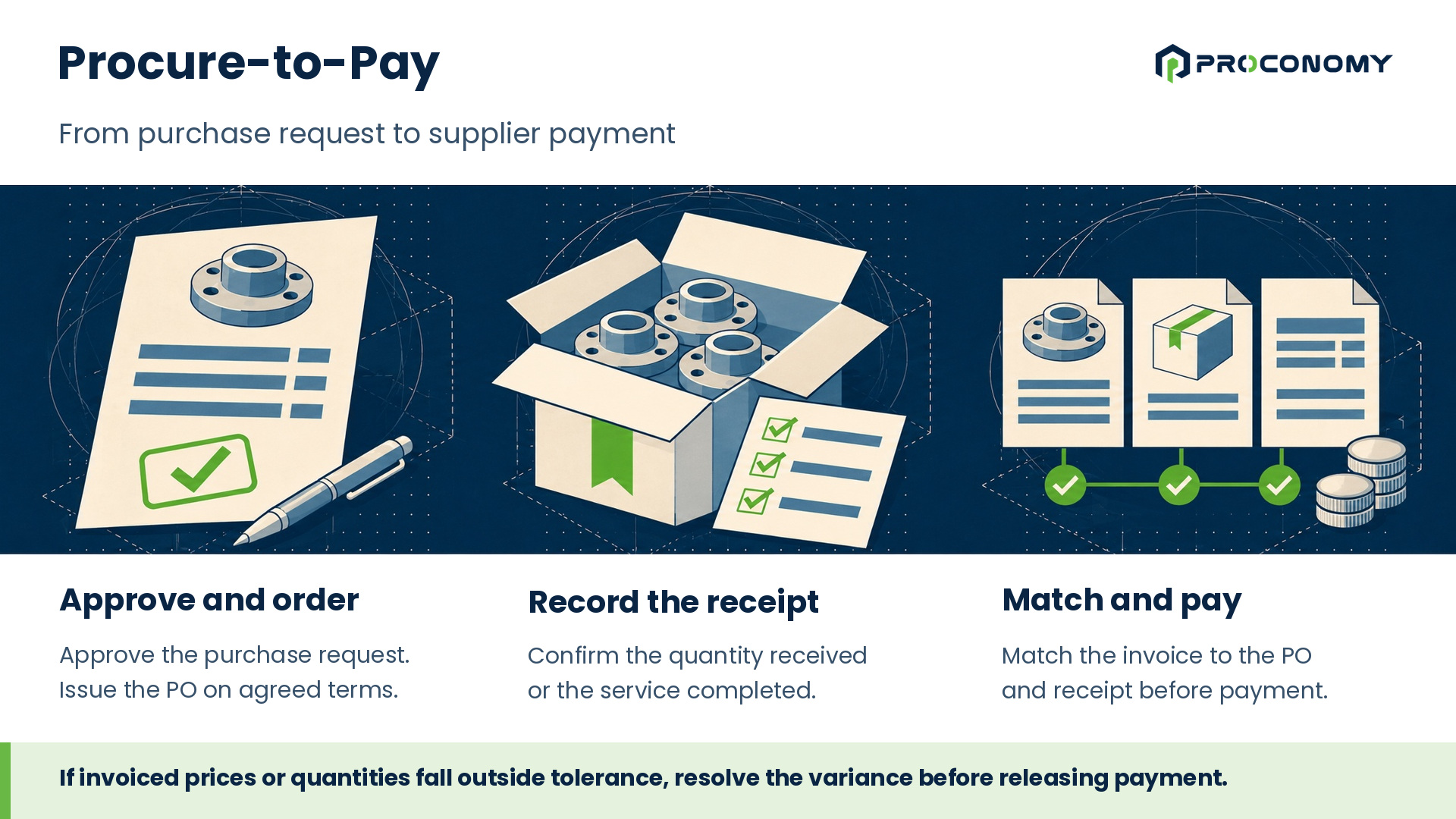
Procure-to-pay starts with a purchase request and runs through approval, purchase order (PO), receipt of goods or acceptance of services, invoice matching, and payment. It answers an operational question: _Did we order, receive, and pay for this purchase according to the approved terms?_
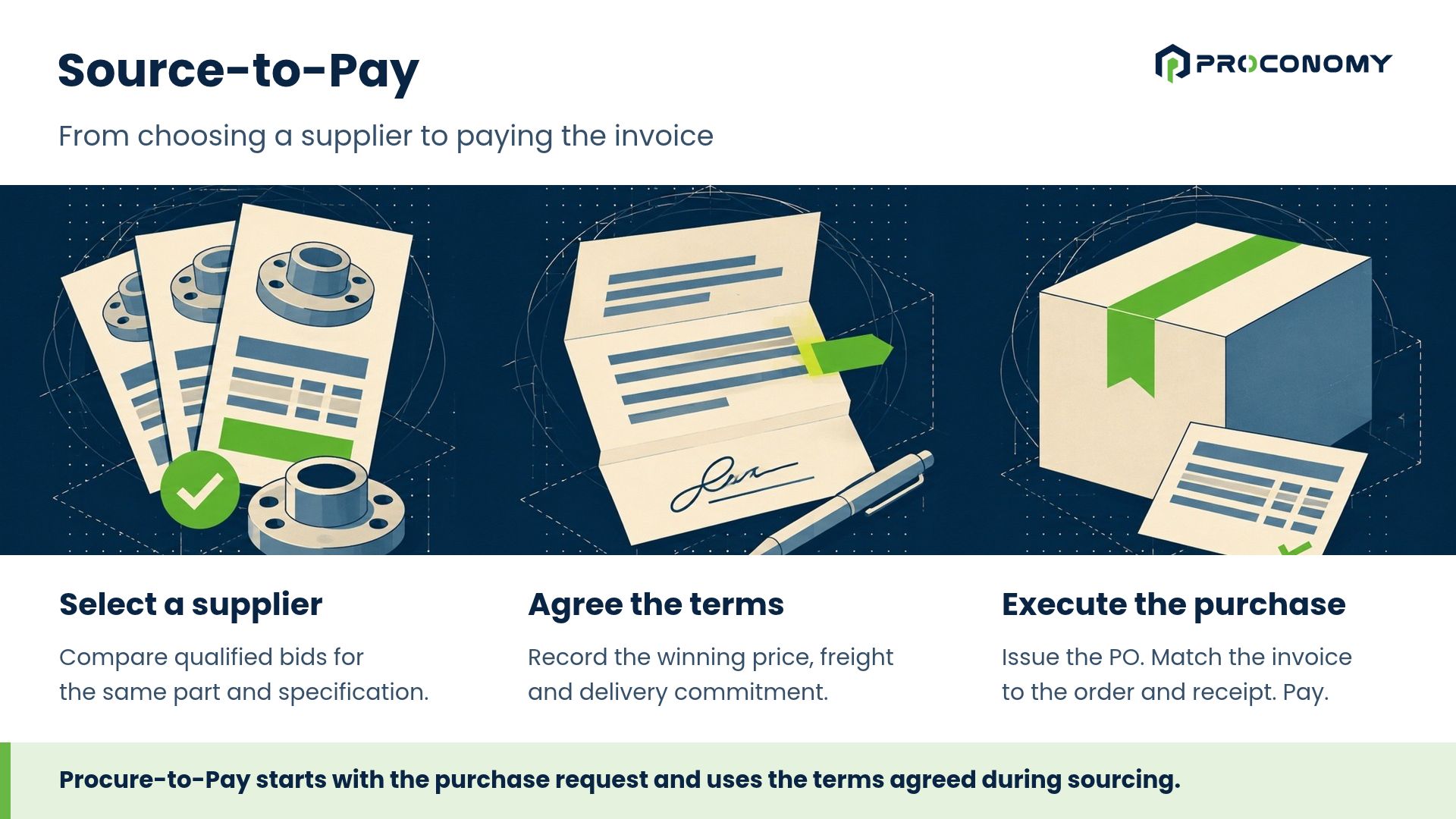
Source-to-pay includes the procure-to-pay process and the work that establishes those terms. It covers defining the requirement, inviting qualified suppliers, comparing offers, approving an award, and capturing the agreement. It answers a broader question: _Who did we agree to buy from, on what terms, and did the plant receive what procurement negotiated?_
| Decision | What P2P controls | What S2P adds |
|---|---|---|
| Which supplier can the plant use? | The buyer orders from a supplier approved for the purchase. | Procurement and quality establish which suppliers qualify for the part, specification, and plant. |
| What price should appear on the PO? | Purchasing applies the current agreement or approved price. | Sourcing evaluates competing offers and records the winning price, freight, tooling, and volume conditions. |
| Who approves a change? | Purchasing routes a PO amendment or invoice variance to the person with authority. | Procurement can also trace the proposed change to the original award and any approved contract amendment. |
| What evidence supports payment? | AP checks the invoice against the PO and the goods receipt or service acceptance. | The buyer can trace a disputed PO term back to the supplier’s offer and the agreement that governs it. |
A plant buying standard bearings against a current rate agreement can go straight to P2P. It does not need a fresh sourcing event for each order. A plant buying a newly designed component has an earlier decision to make. Engineering must confirm the specification, quality must confirm eligible sources, and procurement must evaluate the offers. Both purchases end with an invoice. They need different controls before the PO is issued. Explore the source-to-pay process for manufacturers.
One freight charge, three different procurement problems
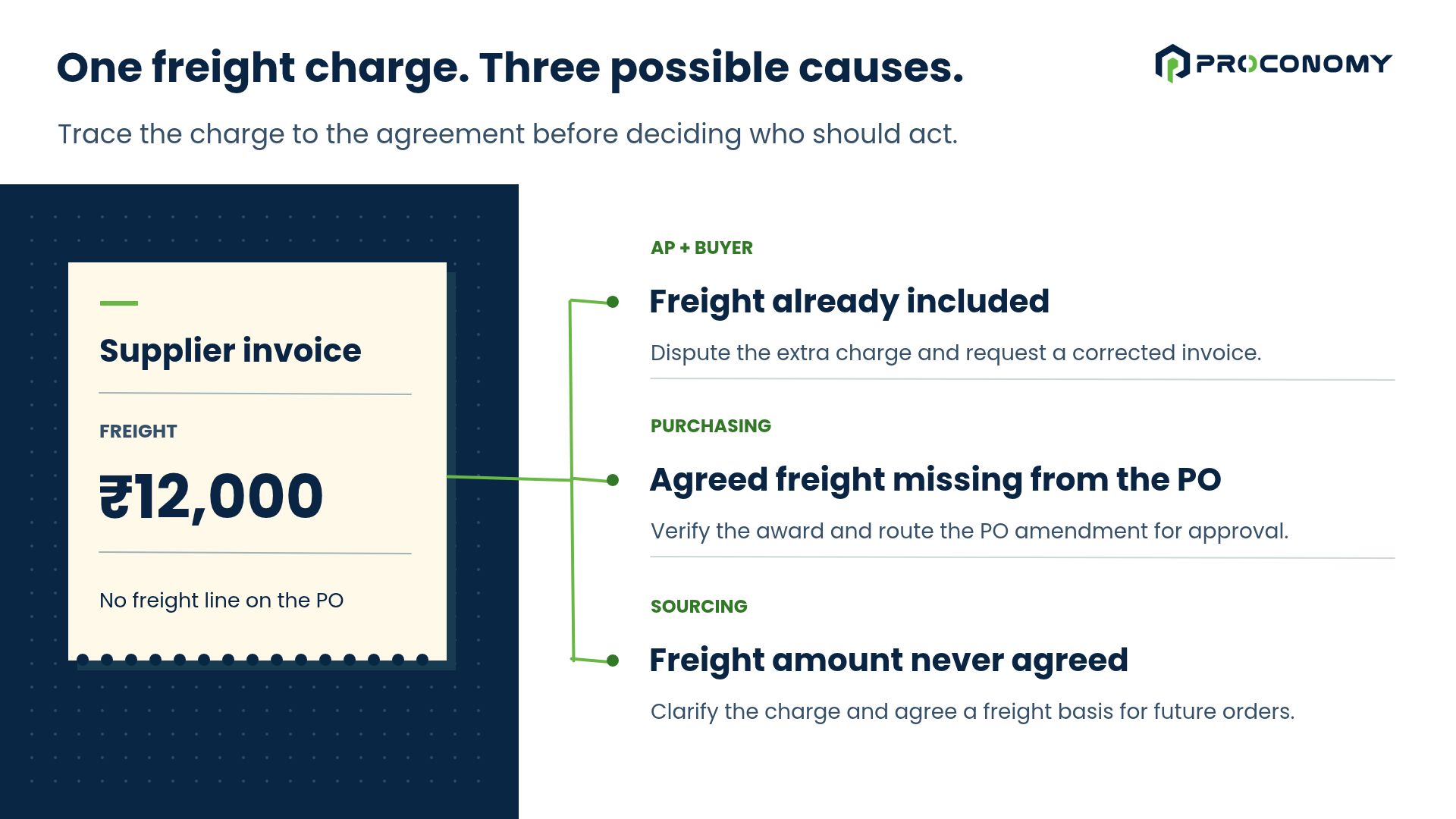
Return to the ₹12,000 freight charge. The example is illustrative. Assume the plant received and accepted all 100 seals, the supplier invoiced the agreed unit price, and the only dispute is freight. Three versions of the same purchase lead to three different project decisions.
| What the buyer finds | What should happen to this invoice? | Where to improve control |
|---|---|---|
| The agreement says delivery is included. The PO references that agreement. The supplier billed freight separately. | AP flags the charge. The buyer confirms the delivery term and asks the supplier for a corrected invoice or credit through the plant’s usual process. | P2P. Make the governing term visible to the invoice reviewer and route the dispute to the buyer with the evidence attached. |
| The approved agreement allows ₹12,000 for freight. The buyer copied the unit price into the PO but omitted the freight line. | Purchasing verifies the approved term and routes a PO correction through the authorized amendment process. AP can then match the invoice against the corrected record. | Award-to-PO handoff. Carry approved charges into the order and check them before release. The supplier has billed what the plant agreed to pay. |
| The supplier’s offer says “freight extra.” Neither the award nor the agreement specifies an amount or a calculation method. | The category manager clarifies the commercial position with the supplier. The authorized owner decides how to resolve the charge and records the decision. | Upstream sourcing. Require bidders to state the delivered price or freight basis. Resolve open charges before approving the award. |
All three invoices could arrive in the same AP queue with the label “price variance.” Routing them faster would help AP find an owner. Only the first case can be resolved using the existing purchasing record as it stands. In the second, the plant already had the answer and lost it. In the third, procurement had yet to settle the question.
There is also a cost AP may never see. Suppose the supplier bills exactly what the PO says, and the receipt matches. The invoice can pass a three-way match even if the buyer copied a higher price than the one procurement negotiated. To find that error, compare the PO with the agreement. Proconomy illustrates that control in its award-to-contract-to-purchase workflow.
When should your plant start with procure-to-pay?
Start with P2P when buyers generally have reliable suppliers, prices, and terms, but purchases still stall between requisition and payment. Pick a recent exception where everyone agrees on what the plant bought. Then look at what prevented finance from paying it correctly and on time.
| What happens at the plant | First control to test | Who needs to be involved |
|---|---|---|
| A supplier invoices 100 units. Stores has received 80, and the remaining 20 are due next week. | Record the partial receipt against the PO line. Make the outstanding quantity visible so AP can apply the plant’s partial-invoice policy. | Stores and AP |
| A maintenance contractor completes a shutdown job. The invoice waits because nobody confirms the work. | Name the service acceptance owner on the order and show what evidence that person needs to sign off. | Maintenance, the requester, and AP |
| A supervisor places an urgent order by phone. Purchasing creates the PO after delivery. | Give emergency purchases an approval route that works during a shutdown, with an owner and a record of who authorized the commitment. | Plant operations and purchasing |
| A valid invoice waits in a shared inbox while two plants debate who owns it. | Route the discrepancy by plant, PO, and exception type. Give AP visibility into the owner and the age of the hold. | AP and the relevant plant buyer |
These are practical requirements for a P2P project. For example, “support goods receipts” is too broad to test. “Show AP how many units each plant accepted, who owns the missing receipt, and whether the invoice can proceed under our policy” gives the project team a usable acceptance test. See how Proconomy handles procure-to-pay controls and exceptions.
When does the problem start upstream in sourcing?
Look upstream when the buyer cannot produce an approved answer to a commercial or technical question. A faster PO approval will do little for a buyer who still has to call three people to establish which drawing revision, price break, or delivery term applies.
Three signals are especially useful when scoping the source-to-pay process for a manufacturer.
- Two suppliers appear to have quoted for the same part, but the offers cover different work. One price includes inspection and delivery. The other covers machining only. The category manager needs a comparable cost breakdown before recommending an award.
- A supplier is active in the ERP, but its approval applies to a different plant or specification. Quality and sourcing need to establish eligibility for this purchase. An active supplier record alone cannot answer that question.
- The negotiated price depends on a condition the plant buyer cannot see. A volume tier, tooling recovery charge, or freight allowance can change the price payable on a particular release. Capture the condition in the award and make it available when purchasing creates the order.
If the evidence points here, test the category team’s workflow with one completed sourcing event. Ask someone outside the negotiation to explain who won, what the supplier committed to, and which charges belong on the first PO. The time they spend reconstructing that answer identifies the handoff to improve. Explore Proconomy’s strategic sourcing and RFx workflow.
Unsure which workflow deserves the first investment? Have the procurement lead and AP head complete the procurement maturity assessment together. Where their answers differ, use one recent purchase to check what each team can actually see.
How to scope your first S2P or P2P project
Ardent Partners reported an 18.4% average invoice exception rate in _The State of ePayables_. That benchmark measures how often invoices needed attention across the organizations studied. Your plant needs one more piece of information before choosing a project: which team could have prevented its recurring exceptions, and at what point in the purchase?
Start with one plant and one spend category. Choose several recent exceptions and a few invoices that matched successfully. Including successful matches lets you check whether purchasing used the negotiated terms even when AP saw no discrepancy.
- Reconstruct each purchase. Put the supplier quote or agreement, approved PO, receipt or service entry, invoice, and resolution side by side. Record the first point at which a required fact was missing, changed, or ignored.
- Group cases by cause and owner. Separate late receipts, unapproved commitments, omitted PO terms, and unresolved award terms. Record the buyer hours, days on hold, or amounts under dispute where those figures are available.
- Choose a pilot that addresses the recurring cause. If service invoices wait for acceptance, pilot a service-entry workflow with maintenance. If buyers repeatedly omit freight, pilot the transfer of freight terms from award to PO for one category. Both are narrower and easier to test than “automate procurement.”
- Give the pilot a measurable outcome. For AP, track the share of invoices held for the selected reason and the median time to resolve them. For procurement, track the share of sampled PO lines that reflect the approved commercial terms. For finance transformation, test who can authorize a variance and whether the ERP records the approved outcome.
The project scope should fit in a sentence. For example: _For maintenance services at Plant A, the maintenance supervisor will confirm completed work against the PO so AP can see the accepted amount before the invoice becomes due._ Procurement, operations, and finance can each tell what they own and how to check whether the change worked.
Test the scope with one of your plant’s invoices
Bring an anonymized supplier invoice, its PO, and the agreement behind it. Ask to see where the discrepancy first becomes visible, who receives it, and what evidence allows finance to release payment. If the terms were already agreed, can the plant use them without calling the original buyer? If they were never agreed, can procurement catch the gap before issuing the next order?
Book a Proconomy workflow demo using your plant’s purchasing scenario
See this on your own workflow