

Source to Pay Explained for Manufacturing Procurement Leaders
Published 2026-09-07 · Last updated 2026-09-07
A recent study found that manufacturing companies spend a median 6,186 hours annually on indirect-material procurement processes. Source-to-Pay can reduce this execution burden by connecting sourcing, supplier workflows, contracting, purchasing and ERP processes while keeping approvals and decision control with the right people.
For many manufacturing procurement teams, the technology stack already looks reasonably complete.
There is an ERP.
There may be a sourcing platform.
Supplier records exist somewhere.
Contracts are stored somewhere else.
Purchase orders eventually make their way into the ERP.
Yet procurement teams still spend a surprising amount of time coordinating work manually.
A sourcing request arrives over email. A buyer asks for missing specifications. Suppliers are contacted one by one. Responses are chased. Quotes are normalised in spreadsheets. Engineering is pulled into an approval thread. Commercial decisions are recorded separately. The final outcome is eventually entered into the ERP.
The transaction is digital.
The work around the transaction often is not.
This is the problem a modern Source-to-Pay operating model needs to solve.
For manufacturing procurement leaders, Source-to-Pay should not simply mean buying another suite of procurement modules. It should mean creating a connected, governed process from the moment procurement work begins to the point where an approved transaction reaches the system of record.
That distinction matters.
What is Source-to-Pay?
Source-to-Pay, often shortened to S2P, is the end-to-end procurement process that connects sourcing, supplier engagement, contracting, purchasing and payment-related workflows.
In practical terms, the Source-to-Pay process can include:
- Procurement intake
- Spend analysis
- Sourcing and RFx
- Supplier evaluation
- eAuctions
- Supplier onboarding and qualification
- Contracting
- Requisition and approval
- Purchase order creation
- Receipt and invoice-related workflows
- Procurement reporting and governance
The exact boundaries vary from organisation to organisation.
What matters is the operating principle.
Procurement work should move through one connected sequence rather than becoming a series of disconnected handoffs between teams, spreadsheets, emails and systems.
For a complex manufacturer, that is particularly important because procurement rarely happens in a simple linear flow.
A single requirement may involve a plant buyer, category manager, engineering, finance, quality, legal, suppliers and an ERP system before a commercial decision can be completed.
The challenge is not simply recording each step.
The challenge is getting the work to move.
Why Source-to-Pay matters more in manufacturing
Manufacturing procurement has a level of operational complexity that generic procurement diagrams often understate.
A sourcing decision may depend on:
- Plant and legal entity
- Material specifications
- Approved supplier status
- Tooling requirements
- Quality history
- Lead time
- Incoterms
- Capacity
- Engineering approval
- Commercial thresholds
- Contract position
- Supplier risk
- Delegation of authority
The result is a Source-to-Pay process with many legitimate decision points.
That creates an important distinction.
Manufacturers usually do not need to remove governance.
They need to remove the manual coordination required to enforce that governance.
A buyer should not have to personally chase every supplier because a response is overdue.
A category manager should not have to manually compile every quotation before people can compare offers.
A procurement excellence team should not have to rely on another spreadsheet to know where a sourcing event has stalled.
A plant should not need to email procurement for an update when the workflow already knows the current status.
A better Source-to-Pay model automates the work around the decisions while keeping consequential authority with the right people.
The traditional Source-to-Pay process
At a high level, a Source-to-Pay process typically moves through several stages.
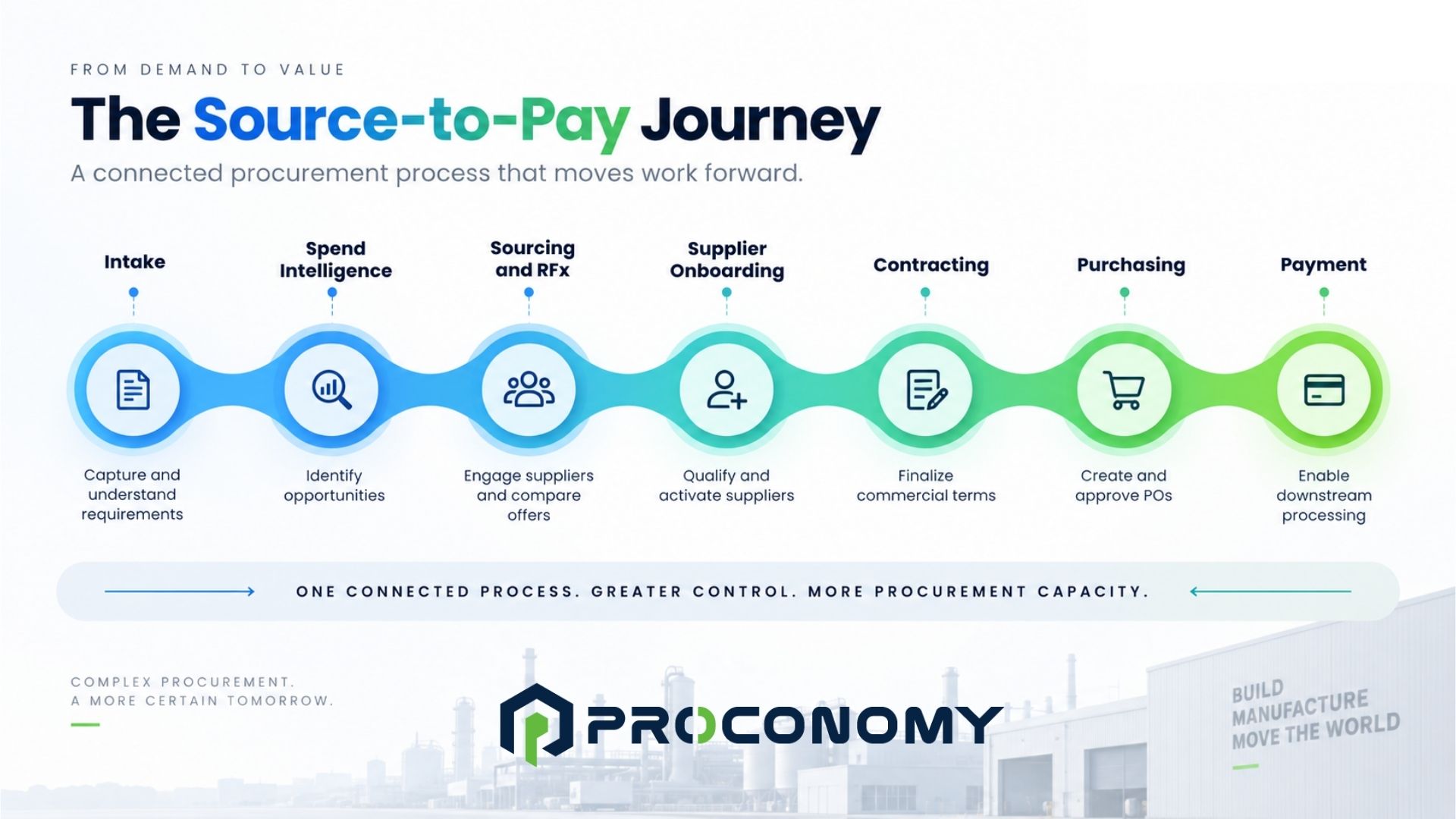
1. Intake and demand capture
Procurement first needs to understand what the business is asking for. That sounds straightforward until a request arrives with:
- An incomplete description
- No category
- Missing specifications
- No required date
- An unclear budget
- No preferred supplier
- No supporting documents
- No obvious approval route
In many organisations, procurement begins by manually interpreting and cleaning the request.
A more structured Source-to-Pay process should identify missing information, classify the requirement and route it according to policy before a buyer needs to intervene.
For Proconomy, this is part of a broader connected Source-to-Pay operating layer where intake, spend intelligence, sourcing, contracts and purchasing can operate as one governed sequence.
2. Spend intelligence and opportunity identification
Spend analysis is often treated as the analytical layer of procurement.
Teams identify:
- Fragmented spend
- Tail spend
- Price variance
- Supplier concentration
- Contract leakage
- Categories that could be competitively sourced
But identifying an opportunity and executing it are two different things.
A dashboard might tell a procurement leader that a category should be sourced.
Someone still needs to turn that insight into work.
The category needs to be defined.
Suppliers need to be identified.
An RFQ needs to be prepared.
Responses need to be collected.
Approvals need to happen.
The Source-to-Pay process becomes more valuable when analysis does not stop at visibility. It should create a governed path from insight to execution.
3. Sourcing and RFx
This is where a large amount of procurement coordination typically appears.
A sourcing event may require a buyer to:
- Build the event
- Confirm specifications
- Select eligible suppliers
- Send invitations
- Answer clarification questions
- Chase responses
- Validate submissions
- Normalise quotations
- Coordinate technical review
- Prepare commercial comparisons
- Route the recommendation for approval
Only a small part of this work requires a human commercial judgement.
Much of it is coordination.
This is where the difference between simple procurement automation and governed execution becomes important.
Routine work can move automatically.
Supplier invitations can be triggered according to eligibility.
Missing responses can be followed up.
Submissions can be structured for comparison.
Approvals can be routed according to policy.
But a supplier award can still return to the person who has the authority to make it.
That is central to Proconomy’s position on governed autonomous procurement.
Automation should increase procurement capacity without quietly transferring important commercial authority to an algorithm.
See how a sourcing requirement can move from intake to an approved award without buyers manually moving every step.
4. Supplier onboarding and qualification
Winning a sourcing event does not automatically mean a supplier is ready to transact.
Manufacturers may require:
- Financial information
- Tax documentation
- Certifications
- Quality approvals
- Plant-specific requirements
- Category qualification
- Banking verification
- Compliance documentation
- Risk checks
- Multiple functional approvals
The problem is often not the existence of these controls.
The problem is that four different teams may administer them separately.
Supplier information is requested repeatedly.
Documents are stored in different places.
Expiry dates are tracked manually.
Quality status may not be visible during sourcing.
A stronger Source-to-Pay process connects supplier onboarding with the sourcing and purchasing workflows that depend on supplier status.
You can see how Proconomy approaches that through its supplier management workflow and supplier portal.
5. Contracting
After sourcing comes another common handoff.
The commercial award is approved.
Then procurement or legal begins reconstructing the context required to create the contract.
This can introduce another series of emails, document versions and approval requests.
A connected Source-to-Pay process should carry forward the information already established during sourcing:
- Supplier
- Commercial terms
- Approved award
- Quantity or scope
- Business entity
- Category
- Approval history
- Negotiated conditions
Legal should spend its time on meaningful contractual risk, not recovering information that the procurement process already produced.
6. Procure-to-Pay
Source-to-Pay includes Procure-to-Pay, but the two terms are not interchangeable.
Source-to-Pay begins earlier.
It includes the activities required to determine what should be bought, from whom and under what commercial conditions.
Procure-to-Pay focuses more closely on the transactional journey from requisition and purchase order through receipt and invoice processing.
This distinction matters because many manufacturers have relatively mature P2P capabilities inside their ERP while sourcing work around those transactions remains highly manual.
Your ERP may be perfectly capable of recording an approved purchase order.
The problem may be everything that had to happen before the purchase order was ready.
Proconomy’s approach is not to replace that system of record.
The goal is to execute governed procurement work around it, then write the approved outcome back.
See how that model works in Procure-to-Pay while keeping the ERP as the system of record.
Source-to-Pay vs Procure-to-Pay
The simplest way to distinguish the two is this:
| Source-to-Pay | Procure-to-Pay |
|---|---|
| Begins with procurement demand or sourcing opportunity | Usually begins with a requisition or buying requirement |
| Includes sourcing and supplier selection | Focuses on purchasing execution |
| Includes RFx and commercial evaluation | Includes requisition, approval and PO |
| Can include supplier onboarding | Relies on approved supplier and buying data |
| Can include contracting | Uses negotiated agreements and buying rules |
| Determines what and from whom to buy | Executes the approved purchase |
| Broader strategic and operational process | More transaction-focused process |
For procurement leaders, the question is not which model is better.
The question is where manual execution remains.
If P2P is automated but sourcing still runs through spreadsheets and inboxes, the overall Source-to-Pay process is still fragmented.
The Source-to-Pay execution gap
This is where many procurement transformation programmes struggle.
The ERP is working.
The procurement platform is working.
The supplier portal may be working.
But people are still connecting those systems manually.
Consider a relatively normal sourcing workflow.
A plant submits a requirement.
Procurement asks engineering for specifications.
The category manager identifies suppliers.
Suppliers receive an RFQ.
Three respond. Two do not. The buyer sends reminders.
One supplier submits the wrong unit of measure.
Procurement fixes the comparison. Engineering reviews the technical response. Finance needs to approve the commercial recommendation.
The category manager records the award. Someone raises the requisition.
The purchase order is eventually created in ERP.
Every system involved may have worked exactly as designed.
Yet the procurement team still ran the process.
This is why our core view at Proconomy is simple:
ERP records procurement. People still run it.
The Source-to-Pay opportunity is to reduce that execution burden without dismantling the systems a manufacturer already trusts.
Why replacing the ERP is usually the wrong starting point
When procurement workflows remain manual, it is tempting to conclude that the ERP is the problem. Often, it is not.
ERP systems are designed to provide control over:
- Master data
- Financial transactions
- Purchase orders
- Receipts
- Invoices
- Accounting
- Enterprise records
Those capabilities are essential.
The limitation appears when procurement work becomes dynamic.
A supplier is late.
A specification is missing.
A sourcing response needs clarification.
A contract contains a deviation.
A quality event changes supplier eligibility.
An approval needs to be escalated.
A person normally notices the exception and starts coordinating.
This is where an execution layer can sit around the ERP rather than replacing it.
Proconomy is designed around that model.
A trigger starts the work.
Agents gather the information required.
Rules determine what is permitted.
Agents execute authorised actions.
Consequential decisions return to people.
Approved outcomes reach the relevant system.
The full history remains reconstructable.
You can explore this operating model in more detail on Move Procurement Beyond ERP, Excel and Email.
What should be automated in Source-to-Pay?
The right question is not:
“Can AI automate this?”
The better question is:
“What part of this workflow can be executed automatically without moving decision authority away from the people who should hold it?”
A useful distinction is:
Good candidates for autonomous execution
- Collecting missing information
- Classifying requests
- Routing work
- Inviting eligible suppliers
- Following up on deadlines
- Checking completeness
- Structuring supplier responses
- Normalising comparable data
- Preparing drafts
- Routing approvals
- Updating stakeholders
- Writing approved outcomes to systems
- Maintaining audit history
Decisions that may remain human-controlled
- Supplier award
- Significant commercial negotiation
- Acceptance of contractual deviations
- Approval outside policy
- Supplier qualification exceptions
- Material risk decisions
- Financial authority
- Strategic sourcing choices
This is the core idea behind governed autonomous procurement.
The goal is not a procurement function with no people.
The goal is a procurement function where people spend less time carrying work from one step to the next.
What good Source-to-Pay looks like for a manufacturer
A strong Source-to-Pay process should create several operational characteristics.
One workflow, not a chain of inboxes
People should be able to see where work is, what is waiting and what happens next without reconstructing the process from email.
Policies become executable
Approval thresholds, supplier eligibility rules and entity-specific requirements should determine how work moves.
Governance should be built into execution.
Routine coordination happens automatically
Procurement should not need a person to remind the system that a supplier response is overdue.
Humans retain consequential decisions
Automation should prepare decisions, not obscure accountability.
The ERP remains authoritative
Approved commercial outcomes should reach the system of record rather than creating a second transactional truth.
The process is auditable
Teams should be able to reconstruct:
- What triggered the workflow
- What action occurred
- Which rule permitted it
- Which person approved it
- What system changed
- What final outcome was recorded
That becomes especially important as more procurement activity is executed by software agents.
Where should manufacturing leaders start?
Trying to transform the complete Source-to-Pay process at once can become another long technology programme.
A more practical approach is to identify the workflow creating the most coordination burden.
For example:
- Procurement intake
- RFQ preparation
- Supplier follow-up
- Source-to-award
- Supplier onboarding
- Contract routing
- Requisition preparation
- Procurement exception handling
Then ask five questions.
1. How much manual coordination happens today?
Look beyond transaction processing.
Measure follow-ups, spreadsheet preparation, email handling, status updates and manual handoffs.
2. Which steps actually require judgement?
Separate decision-making from workflow administration.
This often reveals that a significant amount of procurement effort sits around the decision rather than inside it.
3. What rules already govern the process?
Approval matrices, category rules, supplier eligibility and entity requirements already exist in most organisations.
The opportunity is to make those rules executable.
4. Where should the workflow stop for a person?
Define human authority deliberately.
Do not automate first and design governance later.
5. What outcome should improve?
Choose an operational measure. For example:
- Sourcing events per category manager
- Cycle time
- Competitive sourcing coverage
- Supplier onboarding time
- Manual follow-ups
- Approval turnaround
- Exception volume
- Procurement capacity released
Want to quantify where your Source-to-Pay team is spending coordination effort?
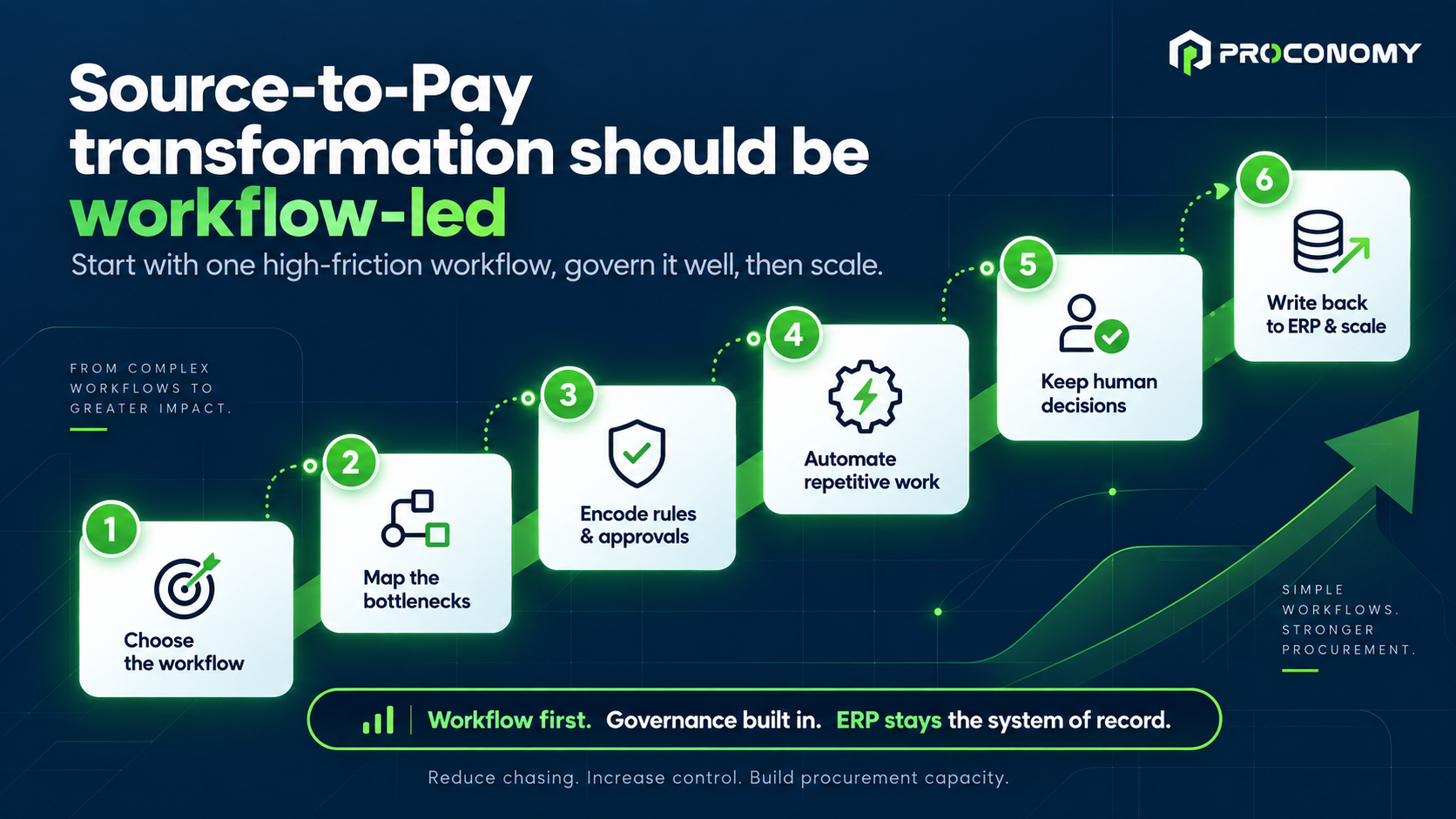
Source-to-Pay transformation should be workflow-led
The biggest mistake procurement leaders can make is treating Source-to-Pay transformation as a software catalogue exercise.
It is easy to ask:
- Do we have sourcing?
- Do we have contracts?
- Do we have P2P?
- Do we have supplier management?
- Do we have analytics?
A manufacturer can answer yes to every question and still have procurement teams coordinating critical workflows manually. The more useful questions are:
- Where does work stop?
- Who has to notice?
- Who has to chase?
- Who has to re-enter information?
- Who has to build the comparison?
- Who has to determine the next step?
- Which decision genuinely needs a person?
- Which approved outcome should return to ERP?
That is where Source-to-Pay becomes an operating model rather than a collection of software modules.
Proconomy’s broader procurement transformation approach follows the same principle: start with a high-friction workflow, encode the policy that already exists, execute what can be governed safely and expand from there.
Explore the approach on the Procurement Transformation page.
From Source-to-Pay software to Source-to-Pay execution
For manufacturing procurement leaders, the next phase of Source-to-Pay maturity is not simply better digitisation.
Most large organisations already have digital systems.
The bigger opportunity is reducing the dependence on people to connect those systems.
Procurement teams should be able to move from:
Software records the process, people execute the workflow
to:
Software executes governed work, people retain decision authority
That is the shift Proconomy is built around.
The ERP remains the system of record.
Procurement policy still determines what is allowed.
Named people retain commercial and risk authority.
But the repetitive work required to prepare, coordinate, chase, route and record procurement activity no longer needs to consume the buyer’s week.
See an end-to-end Source-to-Pay workflow
If you are evaluating how Source-to-Pay could work differently inside a complex manufacturing environment, do not start with a generic software demonstration.
Start with one of your real workflows.
Bring the sourcing event, supplier onboarding process, plant request or procurement exception that currently requires the most manual coordination.
We can show:
- What triggers the workflow
- What an agent can execute
- Which rules control it
- Where the workflow stops for a person
- What gets written back to your existing system
- What remains in the audit record
Bring one workflow. We will run it.
See this on your own workflow