

How to Govern Autonomous Procurement: 6 Controls to Keep AI Accountable
Published 2026-08-05 · Last updated 2026-09-30
Autonomous procurement needs clear permissions, enforceable policies, human checkpoints and a decision history that can be reconstructed. In Deloitte’s 2025 Global CPO Survey, 64% of respondents prioritised greater supply chain visibility as a risk mitigation strategy. Start with a bounded workflow, test all six controls and expand authority using evidence from real operations. Speed, accountability and supplier context should improve together.
Autonomous procurement can move requests, supplier follow-ups and purchasing workflows forward without someone coordinating every step.
But before an AI agent acts on your behalf, one question needs a clear answer: what is it authorised to do, and who remains accountable when it does?
For a manufacturer, that question has practical consequences. An agent might prepare an RFQ correctly but include a supplier that is not approved for the required component. It might route a purchase quickly but apply the wrong plant’s approval limits. A fast workflow still needs the right commercial, quality and financial controls.
The opportunity is to remove repetitive coordination while keeping authority explicit. People define the policy, agents perform permitted work, and exceptions reach the people authorised to resolve them.
This guide explains six controls to require, how they apply to manufacturing procurement, and what to test before expanding an agent’s authority.
What is Governed Autonomous Procurement?
Autonomous procurement uses software agents to carry out defined procurement tasks with limited manual intervention. Depending on the workflow and permissions, those tasks may include collecting missing request details, coordinating sourcing activities, chasing supplier responses or preparing transaction records.
Governed autonomous procurement adds an explicit authority structure: permitted actions, policy rules, approval requirements, escalation routes and retained evidence. The agent’s ability to perform a task does not automatically give it permission to perform that task.
Consider the difference in a sourcing workflow. A copilot might draft a supplier reminder for a buyer to send. An authorised agent can send an approved reminder when the conditions are met, record that action and escalate a supplier’s request to change commercial terms.
For more context, read Proconomy’s definition of governed autonomous procurement and its explanation of how governed autonomy works.
Why manufacturers need governance before scaling autonomy
Manufacturing procurement depends on more than the price of an item. The buying decision can also depend on the plant, legal entity, specification revision, approved supplier status, contractual terms and supplier quality evidence.
Those dependencies become harder to manage when the request, supplier documents and approval history sit in separate systems or email threads. An agent needs reliable context, along with a clear rule for what happens when that context is missing or contradictory.
In Deloitte’s Global Chief Procurement Officer Survey, 64% of respondents prioritised enabling greater visibility into the supply chain as a risk mitigation strategy.
Visibility also matters when authorising AI: the system needs to see the relevant supplier and transaction context before acting.
That survey measures procurement priorities, not the effectiveness of any particular AI platform. The practical implication is to evaluate visibility and decision controls together.
For a manufacturer, the most useful governance questions connect policy to a real purchasing situation:
- Can an agent act for the correct plant and legal entity only?
- Is the supplier approved for this item, process or application?
- What happens when required quality evidence is missing?
- Who approves a commercial award, contract deviation or supplier status change?
- Can someone reconstruct the decision without searching multiple inboxes?
Six controls every autonomous procurement workflow needs
The six controls work together. Access defines the operating scope, permissions define the allowed actions, and policy checks determine whether an otherwise permitted action can proceed in this particular transaction.
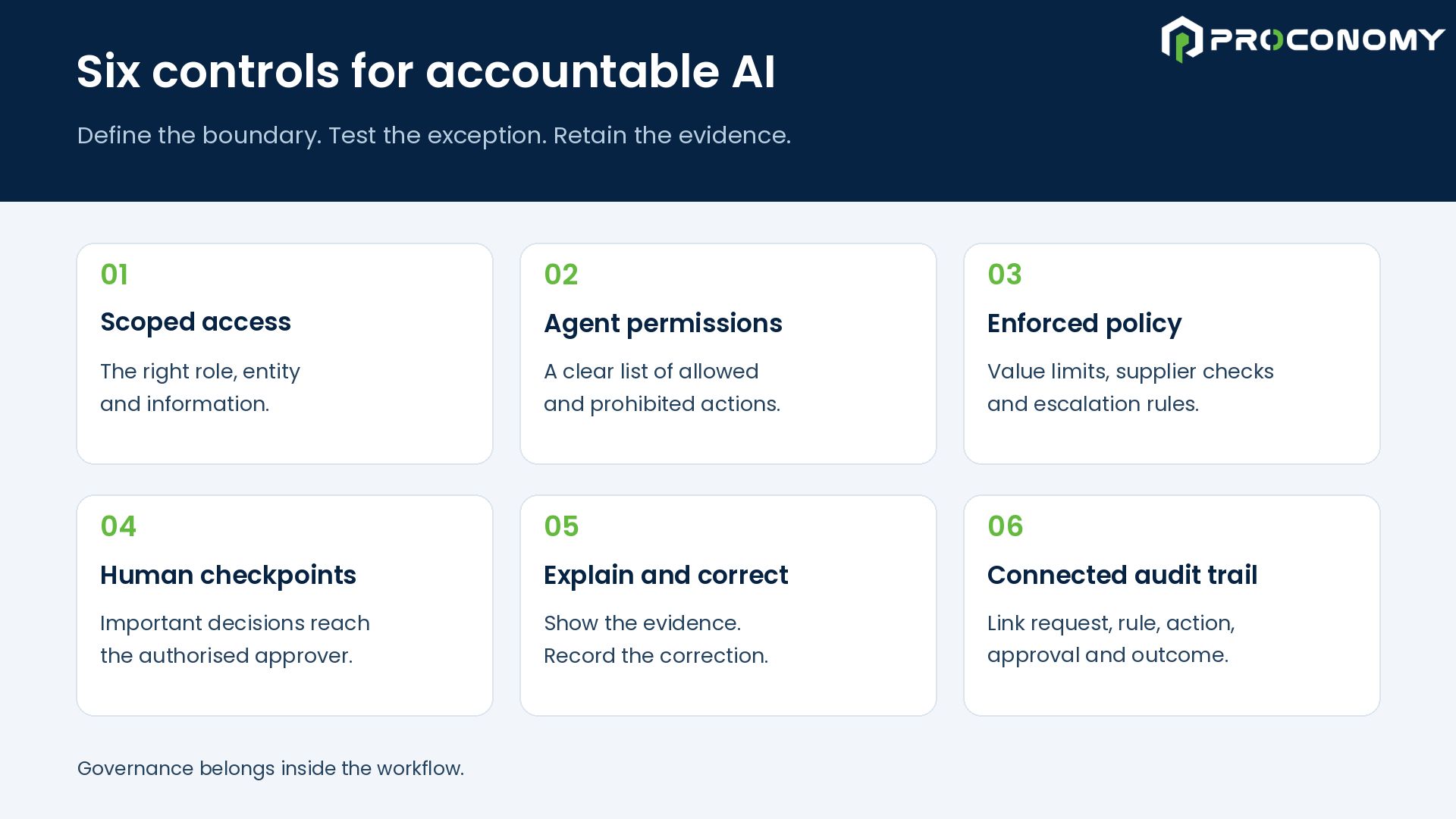
1. Scope access by role, entity and data
Role-based access should apply to agents as well as employees. A plant buyer, a group category manager and a supplier coordinator have different responsibilities, so their access to information and actions should reflect those differences.
For example, a supplier onboarding agent assigned to one legal entity should not automatically gain access to another entity’s confidential contracts. A buyer’s permission to view a sourcing event should not imply permission to approve its award.
Before deployment, define the scope of each role and test what happens outside it. Include both information access and transaction authority in that review.
Test to request: attempt to retrieve a restricted record or act for an unauthorised entity. The workflow should refuse the action and make the reason visible.
2. Give each agent a specific permission set
An agent should have a defined set of permitted actions. A broad instruction such as “manage sourcing” leaves too much ambiguity about supplier communication, commercial commitments and approvals.
For a supplier coordination agent, the permission set might allow approved reminders and requests for missing documents. It might explicitly prohibit changing supplier bank details, accepting revised payment terms or committing to an award.
Even routine communication needs boundaries. A reminder that shares the wrong attachment or promises an extension can have commercial consequences, so coordination authority deserves a defined scope too.
Test to request: show the agent’s permitted and prohibited actions in configuration, then attempt one prohibited action. A written description alone does not demonstrate enforcement.
3. Turn procurement policy into enforceable checks
A policy document describes what should happen. An operational control checks whether the next action meets that policy and stops or escalates the workflow when it does not.
Value thresholds are one part of that control. Others include supplier eligibility, contract validity, required documents, plant-specific buying routes and the approval conditions for an exception.
For example, an MRO request may be within a buyer’s normal value limit but involve an unapproved substitute part. The low purchase value should not remove the technical review requirement.
Supplier-submitted text or an agent’s explanation should never count as approval to change a policy. Policy changes need their own authorised review and record.
Test to request: submit a request that breaches a value limit and another that fails a non-financial rule. Inspect the reason for the block and the escalation route in each case.
4. Keep important decisions with named people
Human oversight is useful when it occurs at the decision that matters and gives the approver enough context to act. Asking someone to click “approve” on an unexplained recommendation provides weak oversight.
Commercial awards, contract acceptance, supplier status decisions and material exceptions should reach the roles your policy names. The approval package should show the relevant evidence, the proposed action and any unresolved issue.
An urgent request should follow a defined exception process. Urgency can change the route, but it should not silently remove the control or the record of who authorised the exception.
Test to request: show the workflow reaching the required approver, then attempt to proceed without that approval. Also test reassignment when the approver is unavailable.
5. Make actions explainable and corrections controlled
For a material action, the reviewer should be able to understand the input used, the policy applied and why the system proceeded, stopped or escalated. A persuasive AI explanation is insufficient if it cannot be checked against the transaction evidence.
Authorised people also need a way to stop or redirect the workflow and record their reason. This could mean correcting an incorrectly classified request or returning an incomplete supplier assessment for review.
Some actions cannot simply be undone. A sent supplier message or issued purchase order may need a formal correction, cancellation or amendment process. Ask how the platform handles those consequences rather than assuming every action is reversible.
Test to request: correct a classification, retrieve the original and revised decision records, and show how an already-issued transaction would be handled.
6. Retain a connected audit trail
An audit trail should let an authorised reviewer reconstruct the transaction. It needs more than a timestamp showing that a workflow step completed.
The useful record connects the request, source evidence, applicable policy, agent action, human approval, exception and final outcome. It should identify who or what acted and preserve the context relevant to that decision.
Retention and access requirements should be agreed with the organisation’s security and audit teams. Evidence is useful only if the people responsible for reviewing it can retrieve and interpret it.
Test to request: select a completed transaction and reconstruct its history from the platform’s records. Then inspect a transaction containing an exception or correction.
Proconomy’s Security & AI governance capabilities describe its approach to role-based access, agent permissions, thresholds, human checkpoints, explainability and action history. Use those controls as a demonstration agenda for your own workflow.
See the controls in action! Bring a purchasing or sourcing workflow and ask to see an agent’s permission boundary, a blocked action and the approval evidence.
What Governed Autonomy Looks Like in a Plant Purchase
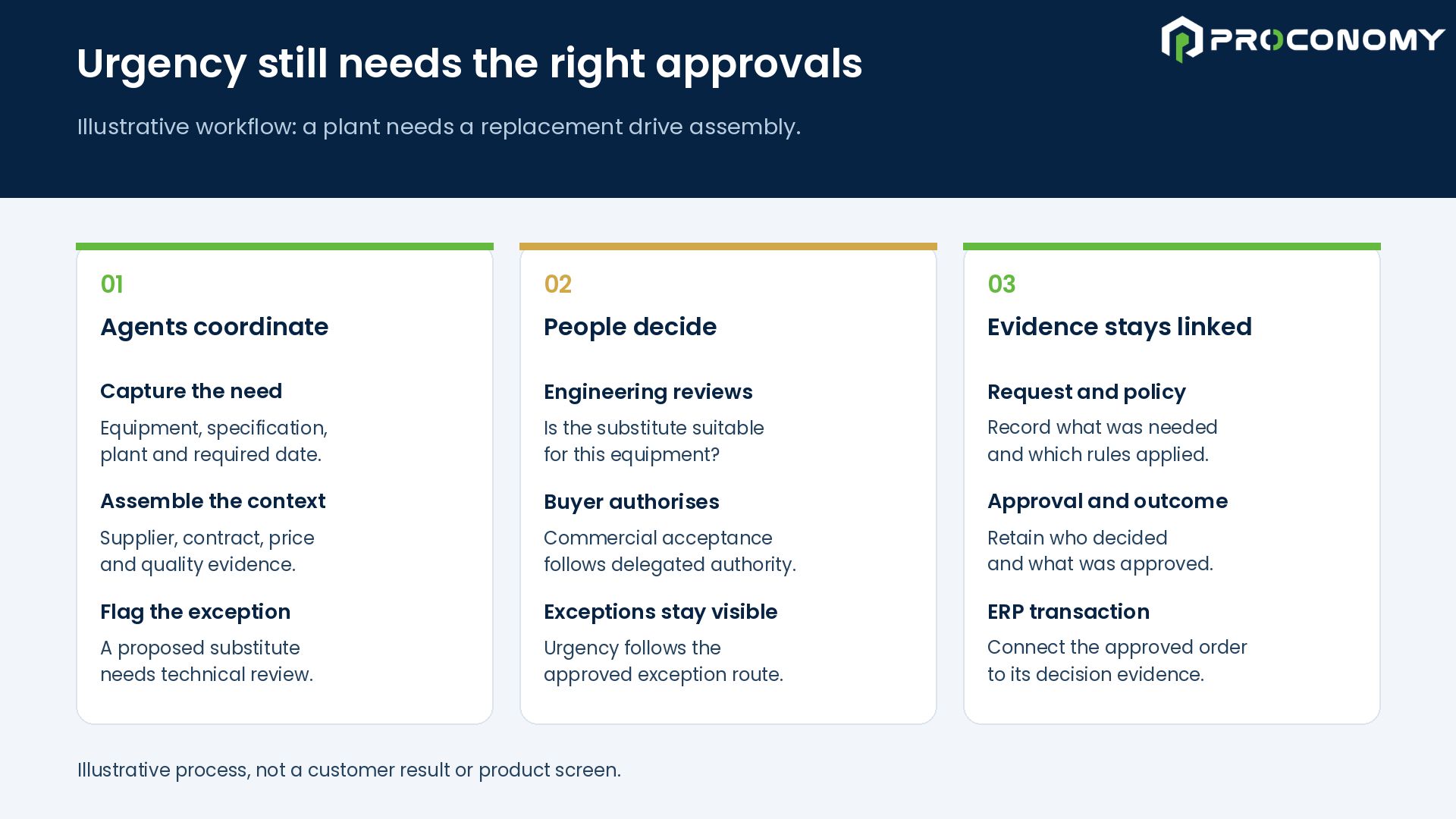
Consider an illustrative request for a replacement drive assembly at a manufacturing plant. The requester needs it urgently, the usual supplier offers a substitute, and that substitute requires engineering review. This is a workflow example, not a customer result.
The process should connect the operational need to the purchasing decision. Each step gives the agent permitted work to perform and a clear condition that returns responsibility to a person.
| Step | Work the agent may perform | Decision or control to retain |
|---|---|---|
| Capture the request | Gather equipment reference, specification, quantity, plant and required date | Requester confirms the requirement; missing details remain unresolved |
| Establish the buying route | Check supplier, contract and relevant item information | Supplier eligibility and the correct entity’s policy determine the route |
| Collect supplier responses | Request missing details and compare submitted information | A proposed substitute is flagged for engineering review |
| Prepare the approval package | Assemble price, delivery, technical evidence and unresolved issues | Engineering and the authorised buyer decide on suitability and commercial acceptance |
| Create the purchasing outcome | Prepare or transmit the approved transaction through a scoped integration | Required approvals must be complete; failed updates must be reconciled |
| Retain the evidence | Link the request, review, approval and transaction reference | Reviewers can reconstruct why the substitute was accepted or rejected |
The value comes from reducing manual assembly and follow-up while preserving the decisions that affect production, quality and spend. The substitute cannot become acceptable simply because the request is urgent.
Proconomy’s intake and orchestration workflow covers the starting point for requests. Its supplier quality management and contract lifecycle management product areas provide relevant context for assessing quality evidence and contractual conditions.
For companies retaining SAP, Oracle or another ERP, review the integration approach alongside the governance model. Confirm which system owns each record, what can be written back and how failed updates are resolved.
Apply segregation of duties to agents too
If one person prepares an award and another approves it, introducing an agent should preserve that separation. Preparation authority should not quietly become approval authority.
The same principle applies across supplier onboarding, purchasing and invoice workflows. An agent may collect supplier information, but approving a sensitive master-data change should follow the organisation’s separate verification and approval process.
Review separation of duties across the entire chain, including service accounts and integrations. Two workflow stages are not meaningfully independent if the same underlying account can bypass both.
For multi-plant businesses, multi-entity management is also relevant: group visibility and local approval authority need to coexist without one erasing the other.
A practical vendor evaluation checklist
A useful evaluation shows what happens when the workflow encounters a problem. Select one real process, prepare a normal transaction and introduce several exceptions before the demonstration.
Use the following questions to make the review concrete:
- Permissions: can the vendor show the actions and data available to a specific agent?
- Policy enforcement: what happens when the value limit is exceeded or required supplier evidence is missing?
- Approval integrity: can an agent, service account or workflow configuration skip a required checkpoint?
- Evidence: can you retrieve the inputs, applicable rule, approval and final transaction for one case?
- Correction: who can stop or redirect work, and what record does that leave?
- Data boundaries: what information reaches the model or external service, and what are the agreed retention and access arrangements?
- Integration failure: how does the workflow reconcile a failed write-back without issuing a duplicate transaction?
- Policy change: who can amend permissions or thresholds, and how is that change approved and recorded?
Procurement, IT/security and internal audit should review the same workflow. Add quality, engineering, finance or legal when their decisions form part of it. Each team should leave with evidence relevant to its responsibility.
For a broader risk-management reference, the NIST AI Risk Management Framework offers a voluntary framework for addressing AI risks. Use it alongside your procurement-specific controls and internal review requirements.
How to Expand Autonomy Without Losing Control
Begin with a workflow whose inputs, owner and decision boundaries can be described clearly. Supplier response chasing, request completion or sourcing coordination can be useful starting points when communications and data access are tightly scoped.
Establish the permitted actions before deployment. Then review actual operation before granting further authority.
Start with bounded coordination
Let the agent collect missing information, route work and prepare records within an approved scope. Define which suppliers it may contact, which templates it may use and which information it may share.
Compare evidence with the current process
Measure elapsed time and human effort alongside control performance. Useful measures include manual follow-ups per request, time to prepare an approval package, exception resolution time and the completeness of decision records.
Also inspect incorrect classifications, inappropriate escalations and attempts outside the permitted boundary. A shorter cycle time should not obscure a deterioration in control quality.
Widen authority after a joint review
Procurement, security and audit should agree on the evidence needed for the next stage. Expand a specific action or category, then review it again under the same discipline.
Define the conditions for reducing or withdrawing authority if performance changes. Every expansion should have a named owner, a documented boundary and an observable outcome.
How Proconomy Supports Governed Autonomous Procurement
Proconomy positions its platform around governed autonomous procurement for complex manufacturers, connecting Source-to-Pay, Contract Lifecycle Management and Supplier Quality Management.
That connected scope matters when the next purchasing action depends on information from more than one function. Supplier quality standing, contract conditions and the request’s approval route should inform the workflow together.
Its autonomous agents are presented as executing authorised work within defined controls. Its governed autonomy operating model explains where people retain decisions and how approved outcomes connect to the ERP.
Assess the fit using your own process, policy and exception cases. A workflow demonstration should make both the agent’s contribution and its stopping points visible.
Give agents clear authority before asking them to do more
Autonomous procurement becomes useful when teams can trust both the work performed and the controls around it. Define the permissions, test the exceptions and make the decision evidence easy to retrieve.
For manufacturers, the objective is practical: move procurement forward with less chasing while keeping supplier, quality, commercial and financial decisions accountable.
Bring us one procurement workflow! Choose a request, sourcing or supplier process that creates repeated follow-up. See how Proconomy handles the work, where it stops for a person and what evidence it retains.
Why governance is the buying decision
In most software categories, capability decides the purchase and governance is a compliance formality afterwards. In autonomous procurement the order reverses. A platform that cannot demonstrate a boundary does not reach a contract, however capable it is, because a security function cannot authorise what it cannot describe.
This means the governance model is not a section of the evaluation. It is the evaluation, and it is worth involving security and internal audit far earlier than a procurement technology purchase normally would.
The six controls, and what each prevents
Each control exists because of a specific failure it prevents. Stated that way they are easier to test.
- Role-based access — prevents an actor operating outside the entity, plant or category they are responsible for.
- Agent permissioning — prevents an agent performing an action nobody authorised, by enumerating what it may do rather than describing what it can.
- Executable thresholds — prevents value-based judgement being made by software, by returning it to a person above a configured level.
- Non-bypassable checkpoints — prevents time pressure removing a control, because no configuration can route around it.
- Explainability with override — prevents an unexplained action standing, by allowing a person to reverse it and recording who did so and why.
- Complete audit trail — prevents an action being unreconstructable later, which is the failure that surfaces during audit rather than during operation.
What a good review actually looks like
A governance review that consists of a questionnaire and a policy document tells you very little. A useful one is performed live, in a session, on the vendor's system.
Ask them to attempt an action outside an agent's authority and observe the refusal. Ask them to block an action at a threshold and show what the approver then receives. Perform an override and retrieve it afterwards with its author and reason. Request the complete action history for a single transaction in the form an auditor would receive it. Each of those takes minutes and is difficult to fake.
Widening authority responsibly
The instinct to grant broad authority at the outset should be resisted, not because agents are unreliable but because authority granted before evidence is difficult to withdraw once teams depend on it.
A defensible sequence gives agents coordination authority first, accumulates real action history, reviews that history with security and audit, and widens execution rights on the basis of what the record shows. The record, rather than the business case, becomes the argument.
See this on your own workflow
Send us one process your team finds frustrating and we will show the model applied to it — governance included.