

AI Procurement Software: What “Agentic” Should Mean in Enterprise Procurement
Published 2026-09-16 · Last updated 2026-09-16
McKinsey found that almost 60% of source-to-pay activities have the potential to be fully or largely automated. However, Gartner predicts that more than 40% of agentic AI projects could be cancelled by the end of 2027 due to factors such as rising costs, inadequate controls and unclear business value. For complex manufacturers, the right model is not to replace ERP. ERP remains the system of record, while governed AI agents coordinate the work around it. People retain authority over critical decisions, exceptions return to the appropriate stakeholders, and every action remains traceable.
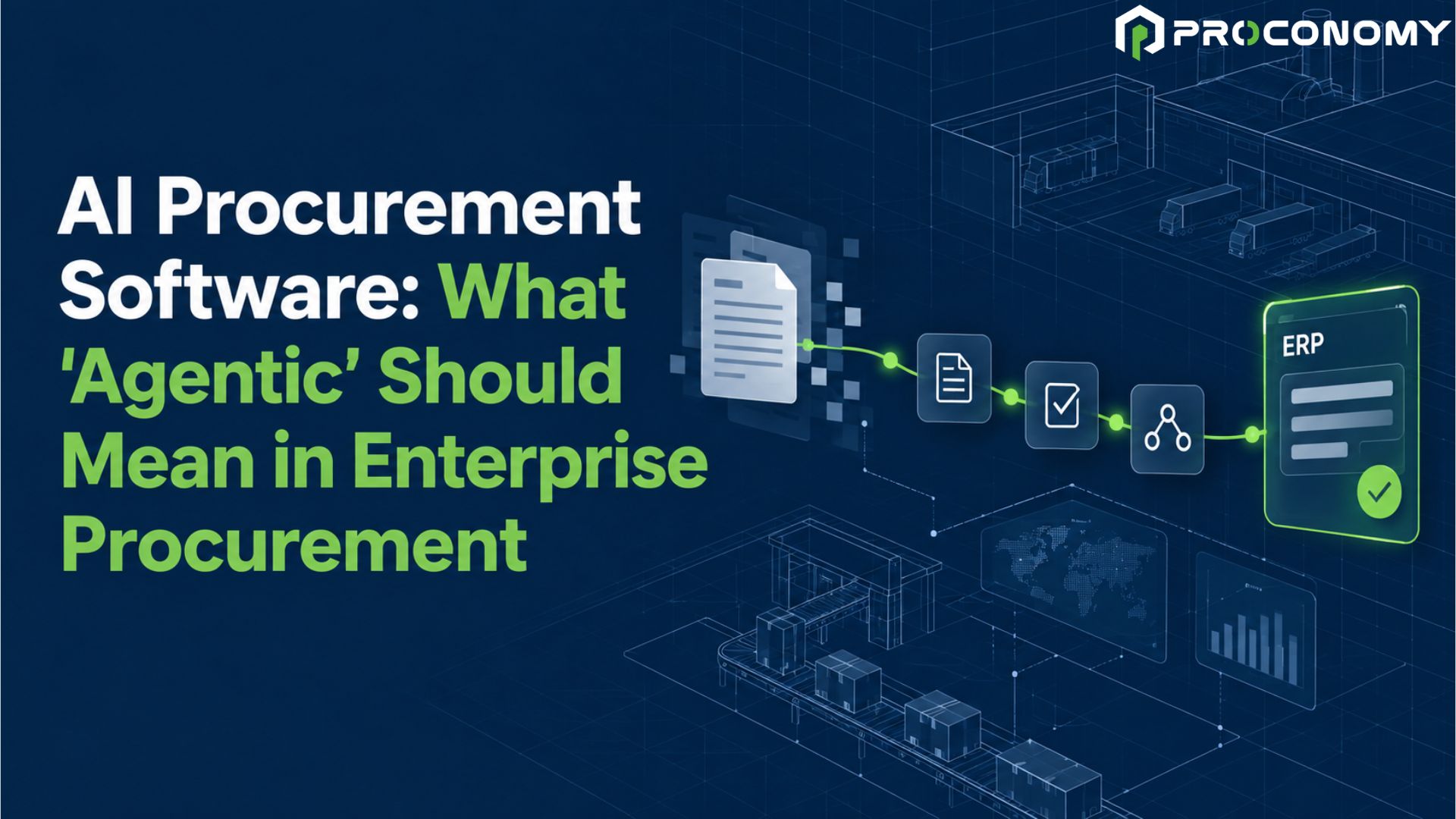
AI has reached procurement. Execution has not.
Procurement technology has spent years improving visibility. Dashboards show spend. Procurement suites store supplier records. ERP systems record purchase orders, receipts, invoices and payments. New AI tools can summarise contracts, draft emails and answer questions in seconds.
Yet the daily work of procurement is still full of manual coordination.
A buyer notices a request in an inbox, works out what information is missing, asks the requester for a drawing, checks whether the supplier is approved, finds the right contract, determines which sourcing route applies, reminds an approver, follows up with suppliers, reconciles responses and rekeys the final outcome into ERP.
The transaction may be digital, but the process around it remains manual.
This is the gap that AI procurement software should close. McKinsey found that almost 60% of source-to-pay activities could be fully or largely automated using available technologies. The opportunity is not limited to invoice processing. It extends into areas such as supplier selection, sourcing and supplier management.
However, adding AI to procurement does not automatically close the execution gap. A tool that produces a recommendation still leaves someone responsible for moving the work forward. A chatbot may make information easier to find while approvals, supplier follow-ups and exception handling remain unchanged.
The practical question for CPOs and CIOs is therefore not:
“Does this procurement product use AI?”
The better question is:
“What work can the AI execute, under whose authority, using what evidence, and where must it stop?”
See the operating problem clearly: Explore how manufacturers can move procurement beyond ERP, Excel and email while keeping ERP as the system of record.
Why procurement remains manual around ERP
ERP is essential. It provides control over master data, accounting, transactions and financial records. However, ERP is primarily designed to record approved business events, not coordinate every conversation and decision that must happen before and after them.
That distinction creates a layer of manual work around ERP.
1. Requests arrive before they are ERP-ready
A maintenance engineer may write:
“The gearbox on line three has failed, and we need a replacement this week.”
The requirement is real, but it may be missing a category, cost centre, specification, quantity, delivery point, approved supplier or estimated value.
Someone must convert that need into structured procurement data and determine the correct route.
2. Decisions depend on context held across systems
A supplier cannot be evaluated on price alone. Procurement may need to consider:
- Quality performance
- Delivery history
- Approved-source status
- Supplier risk
- Contract position
- Tooling ownership
- Plant requirements
- Open corrective actions
- Lead times and capacity
- Payment and commercial terms
This information may be distributed across ERP, PLM, QMS, contract systems, spreadsheets and emails.
3. Policies do not execute themselves
An approval matrix may be documented, but a buyer still has to apply it.
Category thresholds, plant-level authority, preferred supplier rules, sourcing requirements and risk controls may all depend on a person interpreting the policy correctly.
4. Exceptions create most of the effort
Standard transactions are rarely the real bottleneck. Work slows when:
- A quotation is incomplete
- A supplier certificate has expired
- An invoice does not match the purchase order
- An approver is unavailable
- A delivery is late
- A quality issue changes supplier eligibility
- A purchase request lacks technical information
- An engineering change affects demand
These exceptions require people to gather context, decide who should act and follow up until the issue is resolved.
5. The process often has no single record
ERP can show that a purchase order exists. It may not show:
- The original request
- Information collected during intake
- The rule that selected the procurement route
- Supplier evidence considered
- Approvals obtained
- Exceptions encountered
- The reason an exception was accepted
Reconstructing the decision may require searching multiple inboxes, spreadsheets and systems.
AI procurement software creates value when it operates in this coordination layer. It should prepare the work, apply permitted rules, execute routine steps, return consequential decisions to people and update the authoritative system after approval.
What is AI procurement software?
AI procurement software uses artificial intelligence to support or execute procurement activities across processes such as intake, sourcing, contracting, purchasing, supplier management, spend analysis and supplier quality.
The category can include several levels of capability.
1. Prediction
AI can forecast demand, identify risk patterns or detect unusual transactions.
2. Classification
AI can read unstructured requests, emails or documents and convert them into structured procurement data.
3. Generation
AI can draft an RFQ, contract clause, supplier communication, negotiation brief or document summary.
4. Recommendation
AI can rank suppliers, propose a buying route or suggest the next action.
5. Execution
AI can take an authorised step within a workflow, such as requesting missing information, inviting eligible suppliers, routing an approval or writing an approved outcome to ERP.
6. Monitoring
AI can monitor dates, obligations, supplier risks, quality signals and process exceptions, then act or escalate according to predefined policies.
Not every AI procurement solution needs to perform every level. The problem begins when basic generation or recommendation is presented as autonomous execution.
For enterprise procurement, a more useful definition is:
AI procurement software applies procurement context and policy to move work forward, executes only the actions it is authorised to take, returns consequential decisions to named people and retains a complete record of what happened.
This definition connects intelligence with accountability. It also makes the term “agentic” testable.
What “agentic” should mean in enterprise procurement
In simple terms, an AI agent is software that can pursue a goal through multiple steps and take actions, rather than only provide an answer.
In enterprise procurement, that capability needs a more specific definition.
Agentic AI in procurement should include seven characteristics.
1. It works toward a defined procurement outcome
The goal should be operational and observable.
Examples include:
- Turning a request into an approved requisition
- Preparing an RFQ for release
- Collecting supplier qualification evidence
- Resolving an invoice exception
- Progressing a supplier corrective action
- Monitoring a contract obligation
“Help the buyer” is not a sufficiently defined outcome.
“Collect the missing fields and route the request according to policy” is.
2. It understands the context required for the decision
An agent should assemble the category, entity, plant, value, risk, supplier history, contract position, quality standing and other relevant facts.
It should recognise when required evidence is missing and obtain it before progressing the workflow.
3. It can choose the next permitted step
Fixed automation follows a single script. An agent can handle variation within a defined boundary.
If a request is below a threshold and covered by an existing contract, it may follow one route. If the requirement needs sourcing or supplier onboarding, it may initiate a different path.
4. It can act across the workflow
Real agency requires action. The software may:
- Create a structured record
- Request information
- Prepare documents
- Send approved communications
- Schedule reminders
- Compare responses
- Create tasks
- Update connected systems
5. Its authority is explicit and limited
The agent should have:
- A named identity
- Defined data access
- Permitted actions
- Value thresholds
- Workflow-specific authority
It should not inherit unrestricted system privileges simply because it can access an integration.
6. It knows when to stop for a person
Supplier awards, contractual acceptance, supplier status changes, policy exceptions and high-value approvals often require human judgement or formal authority.
The workflow should stop at these checkpoints and wait for the person named in the policy.
7. It leaves evidence that can be reconstructed
Every action should record:
- What the agent observed
- Which policy or permission applied
- What action it took
- Who approved the consequential step
- What information was written to the system of record
If a vendor cannot demonstrate these characteristics on a real workflow, “agentic” may be describing its interface rather than its operating model.
Explore the category: See how governed autonomous procurement combines agent execution with enterprise controls.
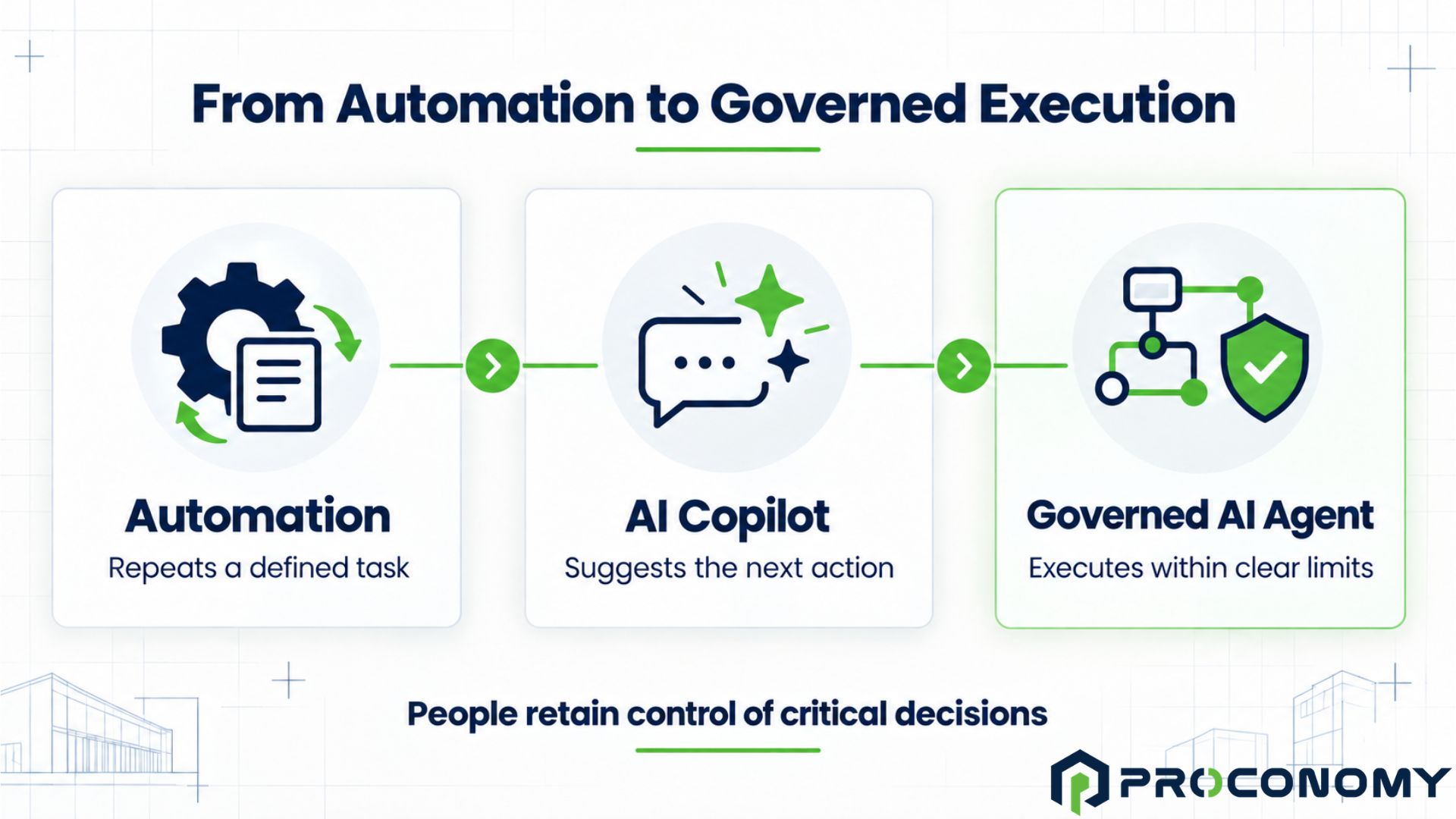
Procurement automation, AI copilots and AI agents compared
These technologies can complement one another, but they perform different roles.
| Capability | Traditional automation | AI copilot | Governed AI agent |
|---|---|---|---|
| Primary role | Repeat a predefined task | Assist a user | Progress an outcome |
| Handles variation | Limited | Interprets and suggests | Interprets and acts within boundaries |
| Typical output | Completed task | Answer, draft or recommendation | Executed workflow step |
| Human effort | Human starts or manages the flow | Human reviews and performs the action | Human handles checkpoints and exceptions |
| Authority model | System permissions and rules | User authority | Explicit agent permissions, limits and policies |
| Exception handling | Stops or fails | Advises the user | Resolves permitted cases or escalates |
| Audit evidence | Logs task completion | Stores interaction history | Links context, rule, action, approval and outcome |
Traditional procurement automation is valuable for stable, repetitive processes.
AI copilots improve productivity where judgement, drafting or information retrieval matters.
Governed AI agents become useful when work crosses multiple steps and systems but still requires strict authority boundaries.
The objective is not to replace every automation or user interface with an agent. It is to assign each type of technology to the work it is best suited to perform.
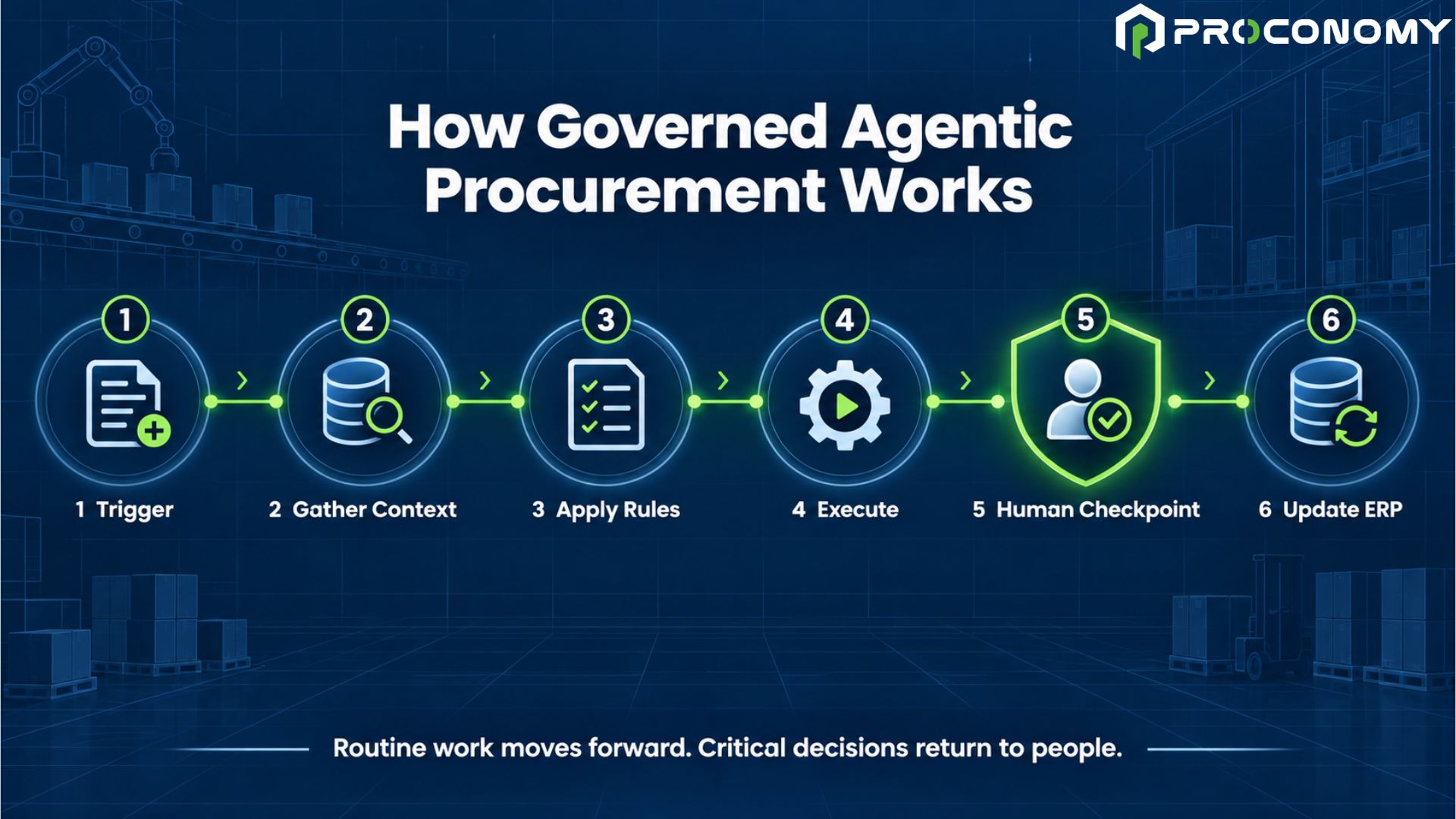
How governed agentic procurement should work
A practical governed workflow can be understood in seven stages.
Stage 1: A trigger starts the work
A request, supplier response, contract date, inventory signal, quality event, invoice mismatch or data condition creates a governed record.
Work begins because an event occurred, not because someone happened to notice an email.
Stage 2: The agent gathers the required context
The agent reads the request and connected data.
It assembles information such as:
- Category
- Entity and plant
- Cost centre
- Estimated value
- Supplier position
- Contract coverage
- Quality standing
- Required documentation
- Risk level
It asks for missing information when necessary.
Stage 3: Rules define what may happen
Policies, permissions, approval thresholds, segregation of duties, category rules and entity-specific requirements are evaluated before the agent acts.
Stage 4: The agent executes authorised work
Within its defined boundary, the agent may:
- Select a procurement route
- Prepare a sourcing event
- Invite qualified suppliers
- Follow up on responses
- Normalise quotations
- Draft approved wording
- Route tasks and approvals
- Resolve a standard exception
Stage 5: Consequential decisions return to people
When the workflow reaches a supplier award, contractual commitment, supplier status decision, high-value approval or policy exception, it stops for the person named in the policy.
The agent can prepare the decision. It does not silently acquire the authority to make it.
Stage 6: The approved outcome reaches the system of record
After approval, the relevant record is written to ERP or another authoritative system.
This may include:
- A requisition
- A purchase order
- A supplier update
- A contract reference
- A receipt status
- A payment decision
Stage 7: The complete history is retained
The organisation can reconstruct the request, supporting data, applied rule, agent action, human approval, system update and final outcome without rebuilding the story from emails.
This model is the difference between AI that provides advice and AI that increases procurement capacity.
See it on your process: Request a workflow demonstration using one of your procurement workflows, including the part that usually creates follow-ups or exceptions.
High-value AI procurement use cases for complex manufacturers
Complex manufacturing is a demanding environment for AI procurement software.
Direct, indirect, MRO and project procurement may run simultaneously. Plants and entities can have different authority structures. Supplier quality can determine whether a commercial option is acceptable. Engineering changes can alter demand after sourcing has started.
The strongest use cases are therefore workflow-specific.
Procurement intake and routing
An agent can read a plain-language request, extract the relevant fields, identify missing information and select the appropriate route based on category, value, risk and entity.
It can direct a standard request to catalogue buying, an existing contract, a sourcing process or supplier onboarding, then route the required approval.
This reduces the dependence on a buyer interpreting every incoming request.
See how a governed procurement intake and orchestration workflow can turn an operational need into structured, routed work.
Sourcing and RFx coordination
AI can prepare a sourcing event from approved templates, identify eligible suppliers, collect responses, follow up on missing submissions and normalise currencies, units and commercial terms.
The buyer can then focus on negotiation and the award decision.
The critical control is supplier eligibility. For direct materials, an agent should not invite a supplier that fails approved-source, quality, capacity or entity-specific requirements simply because it offers a lower price.
Supplier onboarding and qualification
An agent can:
- Request supplier documents
- Check submissions for completeness
- Monitor expiry dates
- Coordinate parallel reviews
- Route evidence to procurement, quality, finance and compliance
- Return ambiguous or high-risk cases to specialists
This is particularly valuable when one supplier requires different approval scopes across plants, entities or commodity groups.
Explore supplier management and onboarding for complex manufacturers.
Contract lifecycle coordination
AI can assemble drafts using approved language, identify deviations, route the appropriate reviewer, track obligations and connect contract terms with purchasing activity.
Legal judgement remains with authorised professionals, but the coordination around that judgement no longer depends entirely on manual reminders.
Connected contract lifecycle management can also help procurement identify whether a request is covered by an active agreement before starting a new sourcing cycle.
Procure-to-pay exception handling
Instead of requiring a buyer or accounts payable analyst to inspect every mismatch, an agent can classify the exception, gather supporting evidence and resolve cases that fall within predefined tolerances.
Price, quantity, receipt and tax exceptions outside those limits can be routed to the correct owner.
The approved outcome should be written back to ERP without manual rekeying.
Learn how procure-to-pay software can support execution while preserving ERP as the system of record.
Supplier quality workflows
AI agents can coordinate:
- PPAP evidence
- APQP milestones
- Supplier corrective actions
- 8D follow-ups
- Document requests
- Quality approvals
They can monitor due dates, follow up on missing evidence and bring supplier quality status into sourcing and award decisions.
However, an agent should not close a quality issue independently. It can coordinate the process and assemble the evidence, while an authorised quality professional verifies the outcome.
See how supplier quality management can connect quality actions with procurement decisions.
Multi-plant and multi-entity governance
An enterprise may want one group-level procurement policy without forcing every plant to use identical approval limits, approvers or local requirements.
AI procurement software should evaluate the relevant entity rules at runtime and preserve local authority within a shared operating model.
This is where generic AI assistants often fall short. Enterprise procurement needs context-specific execution, not one universal answer.
Controls enterprise AI procurement software needs
Governance should not be a policy document placed beside the technology. It should be built into the execution of every agent action.
Agent identity
Every agent should have a distinct identity.
The system must show whether an action was performed by:
- A person
- An integration
- An AI agent
Least-privilege permissions
An agent should access only the information and actions required for its role.
A routing agent may classify a request and select a buying route, but it should not have the authority to approve a supplier award.
Value and risk thresholds
Authority should vary based on:
- Transaction value
- Category
- Supplier risk
- Entity
- Plant
- Workflow
- Type of exception
A low-value standard request may progress automatically, while a higher-value or higher-risk case stops for approval.
Non-bypassable human checkpoints
Important decisions must return to named people.
The control should be built into the workflow so it cannot be removed through an informal prompt or silently skipped.
Data boundaries
The organisation should know:
- Which information an agent can access
- What data it can retain
- Which model or service processes the information
- Whether sensitive data can cross an approved boundary
- How access is restricted by role and workflow
Explainability at the action level
“The AI decided” is not an adequate explanation.
The record should show:
- The relevant context
- The rule or permission applied
- The action taken
- Any required human approval
Reversibility and interruption
Where practical, an agent action should be reversible.
Administrators also need the ability to:
- Suspend an agent
- Change its permissions
- Reduce its authority
- Stop a workflow
These controls should not require the organisation to disable the entire procurement platform.
Segregation of duties
An agent must not collapse responsibilities that are intentionally separated.
For example, creating a supplier, changing its bank details and approving a payment should not become one unrestricted automated sequence.
Monitoring and audit
Teams need visibility into:
- Agent activity volume
- Exceptions
- Failures
- Overridden recommendations
- Policy violations
- Workflow outcomes
- Human intervention rates
Governance becomes more effective when it can be observed and measured.
For a deeper view of these controls, explore security and AI governance for autonomous procurement.
How AI procurement software should work with ERP
The strongest architecture does not require a manufacturer to move everything out of ERP before AI can create value.
ERP should continue to own authoritative transactions and financial records. AI procurement software should operate as a governed execution layer around it.
This layer connects the event that starts the work with the data, rules, actions, approvals and evidence needed to complete it. Once the outcome is approved, the platform writes it back to the appropriate system of record.
This model offers several advantages:
- Existing ERP controls and investments remain in place
- Procurement workflows can improve without waiting for a complete ERP replacement
- Users do not need to rekey approved outcomes
- AI has access to the wider context required before a transaction is created
- The organisation gains a connected record of how the transaction came to exist
For manufacturers, ERP is only one part of the technology architecture.
Product and engineering data may reside in PLM. Quality evidence may be stored in QMS. Contracts may sit in another platform. Identity, finance and collaboration systems also contribute important context.
The agentic layer needs governed connections with these systems without creating a new, uncontrolled copy of enterprise data.
Explore the integration model for ERP, PLM, QMS and finance systems and the connected Proconomy platform.
How to evaluate AI procurement software
Product demonstrations can make almost any AI solution appear capable.
A strong evaluation should test execution, boundaries and evidence using a procurement workflow that your organisation recognises.
Workflow and capability
Ask:
- What procurement outcome can the agent complete from the initial trigger to an approved system update?
- Which steps does it execute, and which steps does it only recommend?
- How does it obtain missing information?
- How does it handle a case that does not match the standard route?
- Can it support direct, indirect, MRO and project procurement where required?
Authority and governance
- What actions is each agent permitted to take?
- Can permissions and spend limits vary by entity, plant, category or workflow?
- Which human checkpoints cannot be bypassed?
- How are segregation of duties and approval authority enforced?
- Can an administrator immediately suspend an agent or reduce its authority?
Data and integration
- Which systems provide the context used by the agent?
- Does the approved outcome write back to ERP without rekeying?
- How are data access, retention and model usage controlled?
- Can the platform connect supplier quality, contract and sourcing data within one decision?
Evidence and value
- Can the vendor reconstruct an action from the original trigger to the final outcome?
- Can it show which rule or permission allowed every step?
- Which baseline metrics will be measured before rollout?
- How are exceptions, overrides and agent failures monitored?
- Can the vendor demonstrate your workflow instead of relying on a polished generic scenario?
- Can adoption begin with one workflow without requiring an enterprise-wide replacement programme?
The most revealing demonstration is usually an imperfect case.
Include a missing field, late supplier response, expired certificate, approval threshold or quality exception. Then observe what the agent does, where it stops and what it records.
Evaluate your starting point: Use the procurement maturity assessment to identify which workflow may be most ready for governed execution.
How to implement agentic AI in procurement one workflow at a time
Large AI programmes often begin with a platform decision and then search for use cases.
Procurement can take a more grounded path.
1. Select a workflow with measurable coordination costs
Good candidates have:
- Frequent manual follow-up
- Clear boundaries
- Repeatable inputs
- An observable outcome
- A manageable level of risk
Intake, sourcing coordination, supplier onboarding and invoice exception handling are common starting points.
2. Map the work as it happens today
Document:
- The trigger
- Systems involved
- Decisions
- Handoffs
- Approvers
- Exceptions
- Final system record
Pay particular attention to work performed in email and spreadsheets because this is where hidden coordination costs often sit.
3. Separate execution from judgement
List the steps an agent may perform and the decisions that must remain with people.
This prevents two common mistakes:
- Automating too little to create meaningful value
- Automating authority the organisation never intended to delegate
4. Encode the existing policy
Convert approval matrices, supplier requirements, category rules, thresholds and entity differences into executable logic.
The first implementation should make existing policy operational. It does not need to redesign every procurement policy simultaneously.
5. Establish a baseline
Measure the current:
- Cycle time
- Number of buyer interactions
- Follow-up effort
- Rekeying
- Exception rate
- Approval delay
- Policy compliance
Without a baseline, the programme will be forced to rely on anecdotes.
6. Start with constrained authority
An agent can begin with coordination rights, such as collecting information, preparing work and sending reminders.
Its execution rights can expand after the organisation has evidence that controls and exception routes operate as intended.
7. Test normal and abnormal cases
Include:
- Missing documents
- Data conflicts
- Unavailable approvers
- Unqualified suppliers
- Out-of-range values
- Integration failures
- Policy exceptions
A governed design proves itself at the edges of the workflow.
8. Review the audit record
Procurement, IT, security, audit and process owners should be able to inspect what happened and agree that the available evidence is sufficient.
9. Expand through a common governance model
Once the first workflow is stable, extend the same identity, permission, checkpoint and audit model to the next workflow.
This approach is more scalable than creating disconnected AI pilots with different control structures.
Metrics that prove business value
Agentic AI should be measured as an operating-model change, not simply as a feature-adoption exercise.
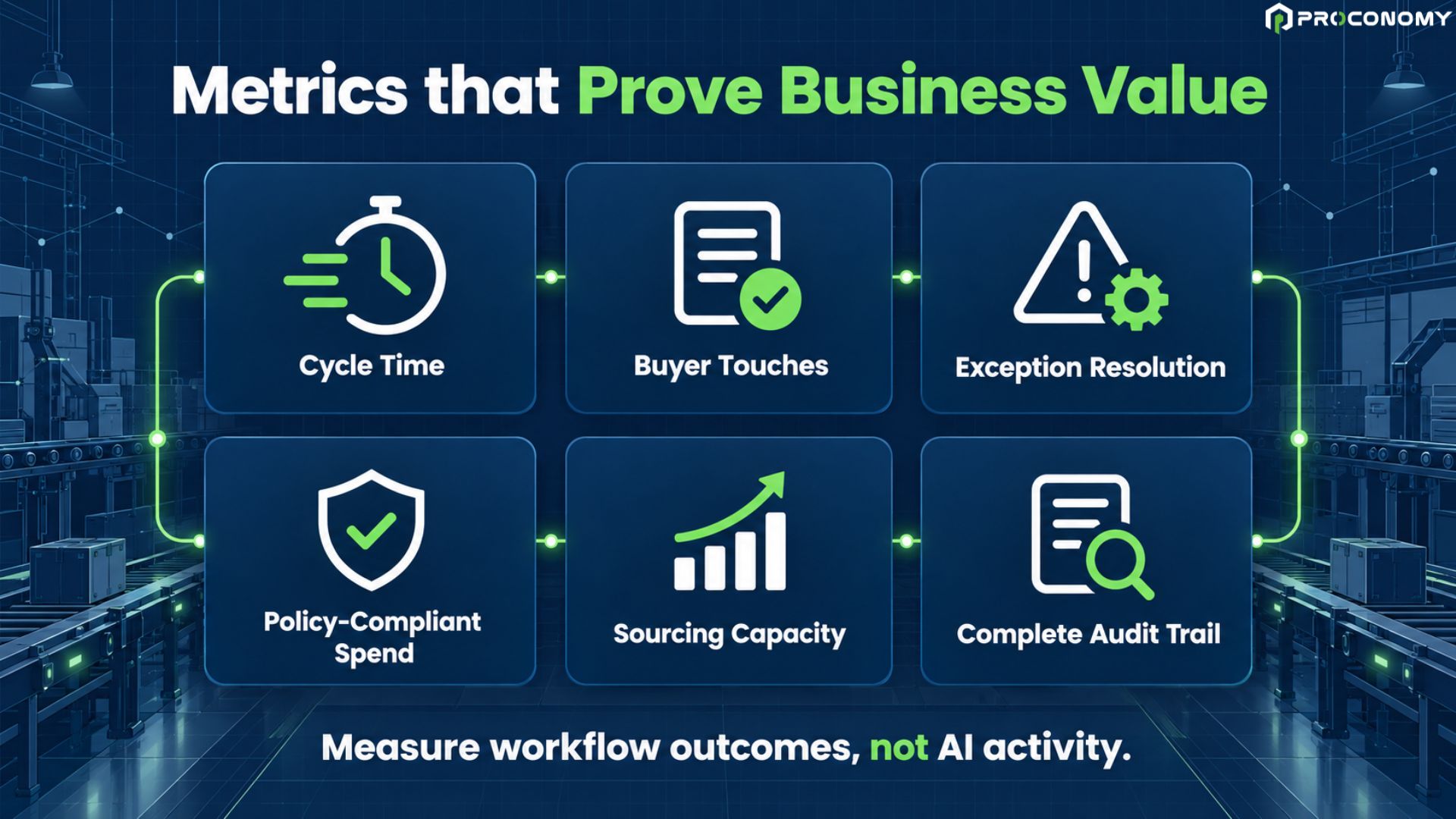
Useful metrics include:
- Request-to-route cycle time
- Buyer interactions per request or sourcing event
- Time spent following up with requesters, suppliers and approvers
- Percentage of work completed without buyer intervention
- Percentage of exceptions resolved within policy
- Approval waiting time
- Sourcing events per buyer
- Supplier onboarding cycle time
- Invoice exception resolution time
- Manual rekeying volume
- Policy-compliant spend
- Agent override rate
- Failed or halted agent actions
- Percentage of actions with a complete audit trail
- Time required to reconstruct a procurement decision
McKinsey has estimated that organisations can lose 3% to 4% of external spend through excessive transaction costs, inefficiency and noncompliance.
This figure should not be treated as a guaranteed savings outcome. It does demonstrate why measurement must cover more than labour hours.
Better procurement execution can influence compliance, sourcing coverage, cycle time and spend leakage, as well as team capacity.
Use the procurement capacity ROI calculator to estimate the cost of manual coordination using your organisation’s inputs.
Common warning signs when evaluating “agentic” procurement claims
The agentic AI market is developing quickly, and not every claim represents the same level of capability.
Gartner has forecast that more than 40% of agentic AI projects will be cancelled by the end of 2027 due to factors including rising costs, unclear value and inadequate risk controls.
Look for these warning signs during an evaluation.
The demonstration ends with a recommendation
If a user must still copy the output, send the email, create the sourcing event, route the approval and update ERP, the product is assisting rather than executing.
The agent has broad access but vague authority
Access is not the same as authority.
Ask for the exact action list, spend limit, data boundary and approval checkpoint assigned to each agent.
Governance appears only in presentation slides
Policies should be visible in the running workflow.
The vendor should demonstrate:
- The point at which the agent stops
- The person who receives the decision
- The evidence stored after an action
- How an exception is handled
Every use case uses the same generic assistant
Procurement intake, supplier quality, contracts and invoice exceptions require different context, controls and outcomes.
A generic conversational interface may not provide the necessary process depth.
The solution requires a complete data-cleaning programme before value can begin
Data quality matters, but a well-designed workflow can improve data as work progresses.
For example, the agent can request missing information, display extracted fields for validation and enforce required evidence before proceeding.
ERP replacement is presented as a prerequisite
If the problem is manual coordination around ERP, replacing the ERP may add disruption without addressing the execution layer.
Evaluate whether the AI solution can work with existing systems and keep them authoritative.
The business case relies only on headcount reduction
A more sustainable business case usually combines:
- Increased procurement capacity
- Faster cycle times
- Broader sourcing coverage
- Improved policy compliance
- Reduced rekeying
- Stronger decision evidence
- Lower spend leakage
What good AI procurement software looks like
Good AI procurement software can feel almost unremarkable at the moment of use.
Work enters through a governed channel. The system gathers the necessary context. Routine steps progress. Exceptions reach the appropriate person. Consequential decisions wait for authority. Approved outcomes reach ERP. The complete history remains available.
The intelligence matters, but the operating design matters more.
For complex manufacturers, “agentic” should not mean giving software unlimited discretion. It should mean giving specialised agents enough bounded authority to remove manual coordination while preserving the controls that protect commercial, financial and quality decisions.
That is the difference between adding AI to procurement and changing how procurement runs.
Bring one real workflow to a live workflow demonstration. See where agents execute, where the process stops for a person and what remains on the record.
Conclusion
The next generation of AI procurement software will not be defined by how convincingly it talks. It will be defined by how reliably it acts.
For enterprise procurement, reliable action requires a defined outcome, relevant context, explicit authority, human checkpoints, system integration and complete evidence.
Without these elements, “agentic” risks becoming a new label for familiar assistance. With them, it can remove the manual coordination that has continued around ERP for years.
People set the rules. Agents move the work forward. Exceptions and consequential decisions return to people. ERP remains authoritative.
That is what agentic should mean in enterprise procurement.
Ready to test the difference? See governed autonomy on one of your procurement workflows.
See this on your own workflow
Send us one process your team finds frustrating and we will show the model applied to it — governance included.