

CAPEX Procurement: Why Projects Overrun After Contract Award
Published 2026-08-27 · Last updated 2026-10-01
CAPEX procurement needs cost control beyond the contract award. McKinsey’s review of more than 300 billion-dollar-plus megaprojects reported average cost overruns of approximately 80%, a benchmark for very large projects rather than every plant investment. For manufacturers, practical controls include clear package scopes, qualified contractors, changes priced before work begins, current commitments and verified payment milestones. Connecting these decisions helps teams identify budget exposure before it becomes an invoice. A negotiated contract is only the beginning

CAPEX procurement is the process of sourcing and purchasing long-term assets, equipment and project services.
For manufacturers, that can mean a new production line, a plant expansion, a utilities upgrade or a tooling programme. The commercial decision includes much more than the equipment price: installation, civil works, delivery, testing and acceptance can all affect the final cost.
Imagine a manufacturer that has negotiated a competitive price for a new production line. The purchase order is approved, the equipment supplier is selected and the project appears to be within budget. Then a foundation drawing changes, a utility connection proves insufficient and commissioning support turns out to be outside the supplier’s scope.
Each decision sounds reasonable. The difficulty is that work can begin before anyone agrees its full commercial impact. By the time procurement sees the quotation, the project has already created an obligation or a dispute.
The scale of the wider problem is substantial.
In an article, McKinsey reported that its review of more than 300 billion-dollar-plus megaprojects found average cost overruns of approximately 80%.
That finding concerns exceptionally large projects; it is not a forecast for a manufacturer’s next expansion, nor does it attribute every overrun to procurement.
For a procurement team, the useful question is narrower: which costs can become visible and controllable before the business commits to them?
The answer starts with treating the award as one decision in a longer project procurement workflow. Scope, supplier eligibility, changes, milestones and commercial approvals need to remain connected until the project is accepted and closed.
What makes CAPEX procurement different from repeat buying?
Routine purchasing often benefits from established specifications, contracted rates and past orders. A capital project may combine familiar components in a new configuration, with different site conditions and dependencies. Historical prices can help, but they do not automatically make competing proposals equivalent.
The biggest difference is the number of decisions that remain open after award. An equipment supplier may depend on civil works, electrical connections or specialist installation before it can deliver the agreed result.
These characteristics make capital procurement particularly sensitive to gaps in scope and coordination:
- Project-specific specifications: Capacity, layout, utilities and acceptance requirements may differ from the last purchase.
- Interdependent packages: A delay in foundations can affect installation, testing and the planned production start.
- Commercial exclusions: Freight, unloading, commissioning, spares or training may sit outside a supplier’s headline price.
- Long delivery windows: Currency movements, logistics constraints and design revisions can change the economics.
- Several decision owners: Engineering, operations, procurement and finance each hold part of the information needed to approve a change.
A repeat supplier or an existing rate contract can still be useful. The control comes from checking whether those arrangements cover the actual project requirement.
Six reasons capital project costs rise after award
Poor estimates and unrealistic schedules can create exposure before a contract is signed. After award, that exposure can grow when changing requirements are not connected to commercial decisions. The following six issues deserve attention in manufacturing projects.
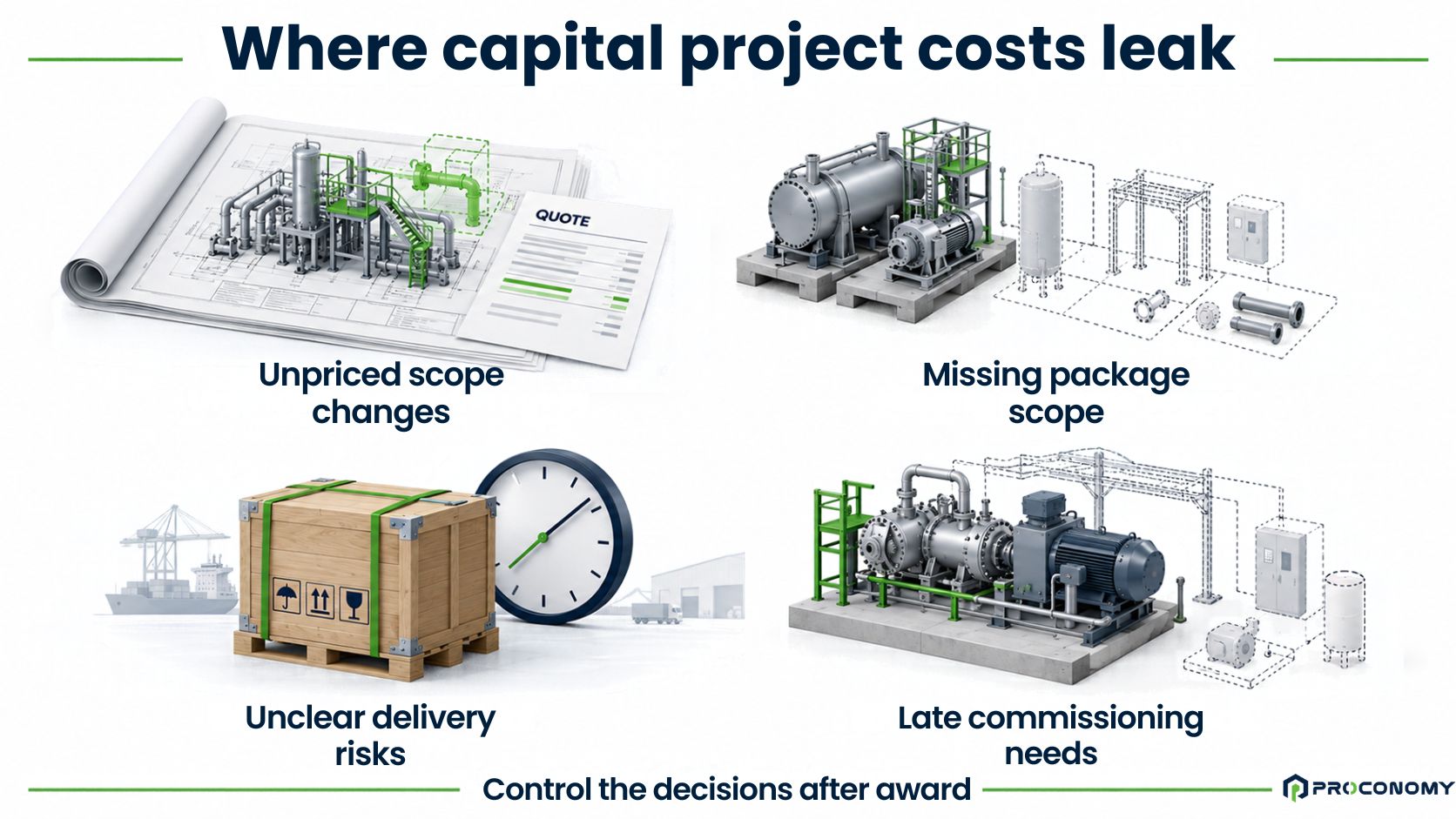
1. Scope changes are authorised informally
A revised drawing reaches the contractor through a site meeting or an email. The contractor proceeds, while the buyer assumes the change is covered by the existing price. The disagreement appears later as a variation claim.
The practical control is a change record that identifies the original scope, proposed revision, reason, cost and schedule impact. The commercial decision should happen before the revised work is released.
2. Package boundaries leave work unowned
The equipment supplier includes delivery to site, but unloading belongs to another contractor. Civil works include foundations, but the final mounting arrangement requires additional work. Neither offer looked unreasonable in isolation.
Engineering and procurement should review the interfaces between packages before award. Every material dependency needs an owner, an inclusion or exclusion, and a clear assumption about what another party will provide.
3. Late purchases narrow the available options
Commissioning consumables, critical spares, specialist supervision or operator training are discovered close to startup. At that point, the original supplier may be the only practical source within the required window.
Identify these requirements while preparing the RFQ. Include them in the main package where appropriate, or create a separate sourcing package with enough time for a meaningful comparison.
4. Commercial risks have no explicit owner
Exchange-rate movements, expedited freight, storage and delayed site readiness can affect delivered cost. When the contract does not clearly allocate responsibility, the project team can discover the exposure only when a supplier asks for payment.
Record pricing assumptions, validity periods, delivery responsibilities and the process for handling delays. Commercial and legal reviewers should assess the terms before acceptance, rather than treating risk allocation as a standard attachment.
5. Contractor qualification happens too late
Experience on a previous project does not establish current capacity, financial resilience, insurance or site safety readiness. A contractor may offer an attractive rate yet struggle to mobilise the people and equipment required.
Use a qualification process suited to the package’s risk. A consistent supplier management and onboarding workflow helps place eligibility evidence before the sourcing decision, while qualified people evaluate what the evidence means.
6. Invoices become the first reliable cost signal
A project can show low expenditure while carrying substantial unpaid commitments. Pending changes and unawarded packages can increase its forecast exposure further, even though they have not become invoices.
The project review needs a current view of approved obligations and expected remaining costs. A spend report alone cannot show whether the next decision will fit within the available budget.
Price and approve changes before work begins
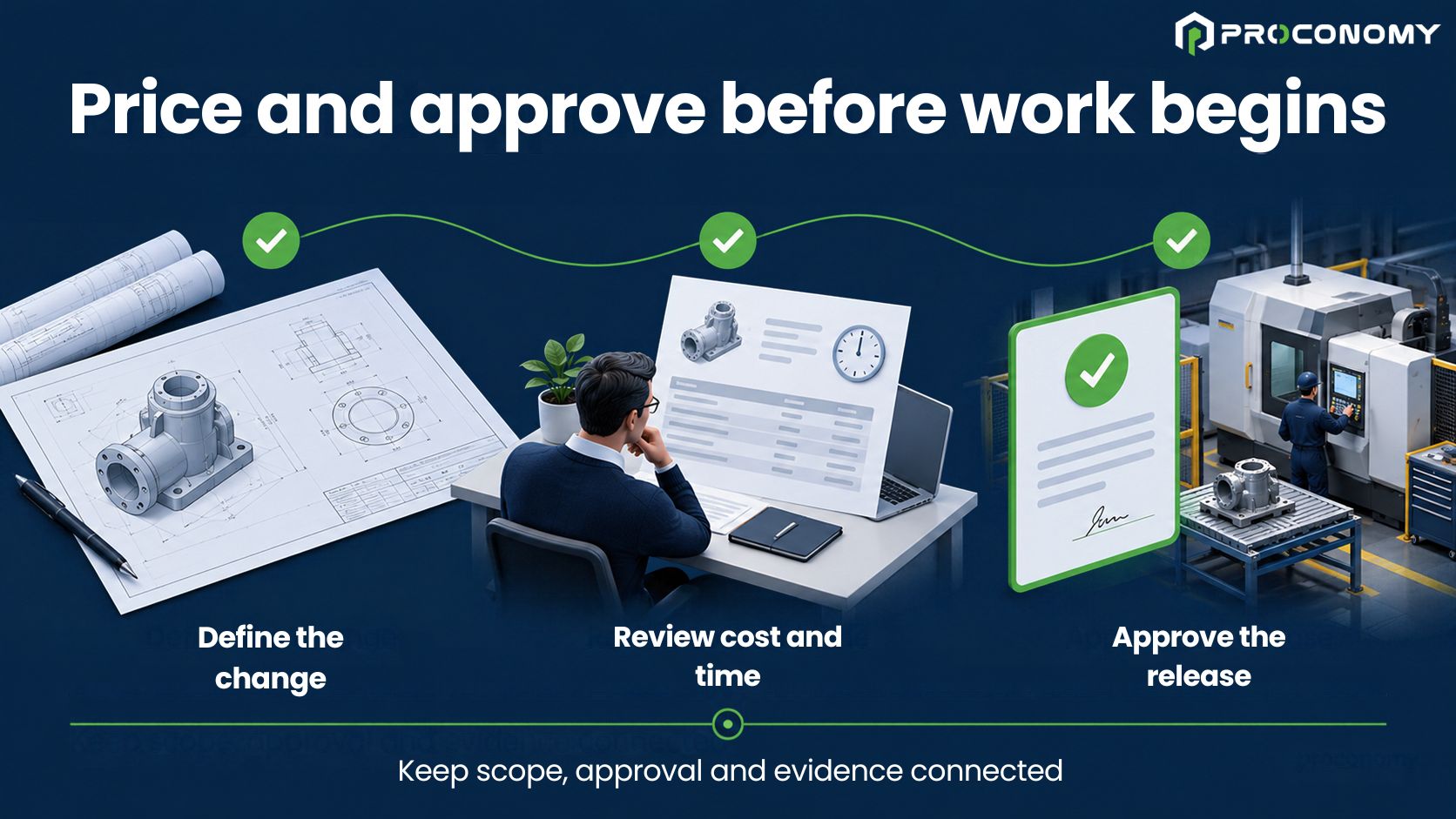
One of the most useful controls in CAPEX procurement is straightforward: define, price and approve a scope change before releasing the affected work. This preserves the opportunity to evaluate alternatives while the business can still choose what to do.
The rule needs an operating process, not just a clause in the contract. Teams must know what to submit, who reviews it and how an approved decision reaches the contractor.
Use the following sequence for a normal project change:
- Record the revision. Link the change to the affected package, drawing or specification, and explain why it is needed.
- Check the technical requirement. Engineering assesses whether the revision is necessary and whether a workable alternative exists.
- Establish the commercial impact. Procurement reviews the supplier’s price, relevant rates, exclusions and available options.
- Assess time and dependencies. The project owner checks delivery, installation and effects on other packages.
- Confirm budget and authority. Finance and the designated approver review the exposure under the applicable approval policy.
- Release and retain the decision. Issue the approved instruction, update the contractual record and reflect the commitment in project reporting.
The contractor should receive a clear release reference and the approved scope version. A technical discussion, receipt of a drawing or acknowledgement of an email should not be confused with commercial authorisation.
Urgent safety or asset-protection work needs a defined exception route. Specify who can authorise the minimum necessary action, what evidence must be captured and when commercial review must follow. An emergency should remain visible as an exception, with a named owner and timely follow-up.
Keeping amendments and approvals with the agreement is a practical use of contract lifecycle management. The aim is to make the operative scope and terms clear to the people executing them.
See how these controls connect
Explore how Proconomy connects package sourcing, contractor qualification, scope changes and milestone approvals in a governed workflow.
Track commitments and forecasts separately
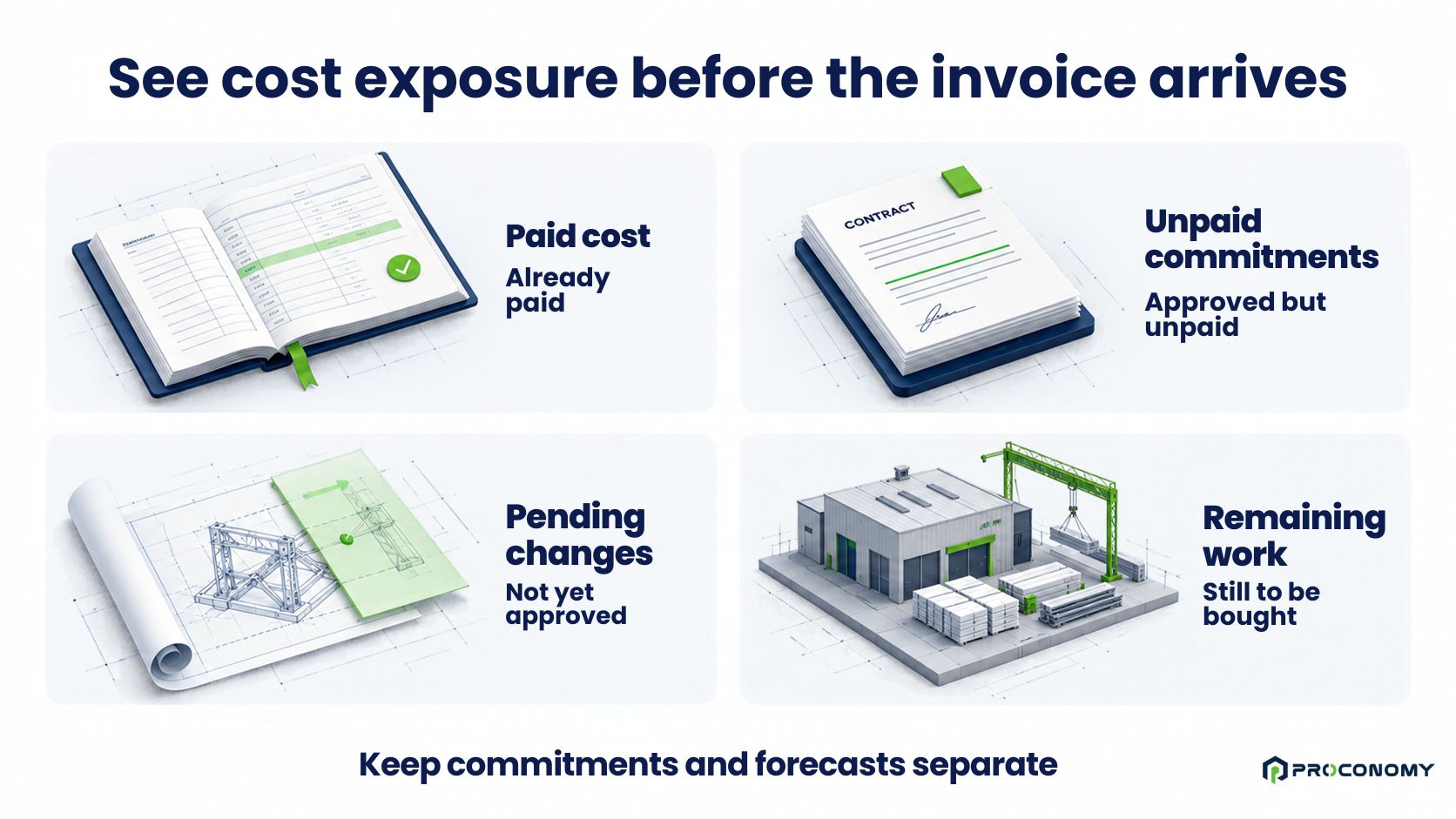
A project cost review should distinguish what has been paid, what has been approved but remains unpaid, and what is expected to cost money in future. Combining these categories carelessly can hide risk or double-count expenditure.
Agree the definitions with finance before building a dashboard. In particular, a purchase order’s full value must not be added to paid invoices as if both represent separate costs.
| Cost view | What it represents | The decision it supports |
|---|---|---|
| Paid cost | Cash already paid for project purchases or work | Cash usage and payment history |
| Unpaid commitments | The remaining unpaid balance of approved orders, contracts and changes | Existing obligations still to be settled |
| Pending change exposure | Estimated cost of proposed changes not yet approved | Decisions that could consume the remaining budget |
| Remaining uncommitted work | Forecast cost of work or packages still to be bought | Whether the full project remains affordable |
| Risk allowance | A separately identified allowance for uncertainty under the agreed forecasting method | How much room remains for identified risks |
These are illustrative management categories. Reconcile them to the organisation’s accounting and project-control definitions, including accruals, certified but unpaid work, cancellations and recoverable taxes.
For example, suppose an equipment package is awarded at ₹2 crore and ₹50 lakh has been paid against it. Before any changes, its remaining unpaid commitment is ₹1.5 crore. The package’s paid cost plus remaining commitment is still ₹2 crore, not ₹2.5 crore.
If a proposed revision is estimated at ₹12 lakh, show it separately while it awaits approval. Once approved and incorporated into the order or contract, transfer that value into commitments rather than continuing to count it as pending exposure. This is an illustrative example, not a Proconomy customer result.
At the project level, compare the latest forecast total with the authorised budget and keep the original baseline visible. A new approval may authorise more spending, but it should not erase the explanation for why the forecast changed.
Build commercial control into each project package
A single capital approval can cover equipment, civil works, utilities, installation and commissioning. Each package needs enough detail to support a sourcing decision and enough ownership to remain controlled during execution.
Start with the deliverable and its acceptance conditions. Then document the commercial assumptions that could otherwise become a late negotiation.
Before inviting suppliers, make these items explicit:
- Scope and boundaries: The work included, exclusions, interfaces and responsibilities of other contractors.
- Technical baseline: The approved drawing or specification version, performance requirements and relevant site conditions.
- Budget and approvers: The package allocation, decision authority and route for exceeding the allocation.
- Comparison basis: Pricing format, quantities, rate assumptions, freight, installation and commissioning requirements.
- Delivery and acceptance: Due dates, site readiness obligations, testing requirements and evidence of completion.
- Change and payment rules: How variations are submitted, who can authorise them and what supports each payment release.
This preparation helps suppliers quote on a consistent basis. A structured sourcing and RFx process can keep clarifications and evaluated terms attached to the award, so the execution team does not need to reconstruct the decision from email.
Avoid selecting on headline price alone. A cheaper offer with major exclusions or a weak delivery plan can become the more expensive option once the asset must be installed and made operational.
Tie payment releases to verified milestones
A milestone payment should correspond to an agreed contractual event and the evidence required for it. An arriving invoice is a request for payment; it does not establish that the milestone has been achieved.
The evidence varies by package. Equipment readiness may require inspection records, while installation completion may need a signed checklist or certification from the responsible project representative.
For each milestone, define a few practical checks:
- The event: What exactly must be delivered, completed or demonstrated?
- The verifier: Who is authorised to confirm achievement?
- The evidence: Which inspection, acceptance or completion records are required?
- The commercial check: Does the amount match the contract, approved changes and previous releases?
- The exception route: Who decides how defects, incomplete work or disputed claims affect release?
Advance payments, retention and performance security need their own agreed controls. They should not be forced into a completion-based approval when the contract sets a different basis.
A connected procure-to-pay workflow helps bring the approved commercial terms and acceptance evidence into the payment review. Engineering or the nominated verifier still establishes whether the relevant work meets the requirement.
A manufacturing example: one revision, several connected decisions
Consider an illustrative plant expansion in which the equipment supplier revises a machine’s foundation requirement after award. The civil contractor needs to change reinforcement and mounting arrangements, and the revision may affect installation readiness.
Without a defined route, engineering can approve the drawing technically while the site team asks the contractor to proceed. Procurement receives the revised price later, after the work has reduced the project’s negotiating options.
With a governed route, the revised drawing opens a change record against the civil package. Engineering explains the requirement, procurement reviews the quotation, and the project owner assesses the schedule implications. The authorised approver sees the total exposure before deciding whether to release the change.
After approval, the team updates the package commitment and gives the contractor a clear instruction. Completion evidence remains connected to the change when the corresponding milestone is reviewed for payment.
The benefit is a better-informed decision with a traceable basis. The workflow cannot remove the need for sound engineering or eliminate every project risk, but it can make the commercial consequence visible before work begins.
How Proconomy supports CAPEX procurement
Proconomy’s project procurement solution brings package scopes, budgets, approval routes, contractor qualification, agreed changes and milestone controls into a connected workflow. Its published approach makes committed spend visible when packages are awarded and keeps important commercial decisions with named people.
For manufacturers, the value lies in linking the work around those decisions. Supplier responses, contractual records and approved purchasing outcomes can move through a common process rather than becoming separate trackers.
Proconomy’s ERP and PLM integration approach supports keeping existing systems of record in place. During evaluation, map the project codes, approval rules and data exchanges needed for your chosen workflow so the operational view and finance records stay aligned.
Governed autonomy also needs clear boundaries. The platform’s AI governance and access controls describe permitted actions and human checkpoints; engineering acceptance, contractual judgement and commercial authority need to follow the organisation’s policy.
What to measure in your first workflow
Start with a manageable project package and establish a baseline before changing the process. Look at decision timeliness, completeness of evidence and visibility of exposure alongside the final cost outcome.
The following measures help a team assess whether the controls are working:
- Pre-work change approval: The share of scope changes commercially approved before affected work starts, with emergency exceptions reported separately.
- Change decision time: Time from a complete submission to an authorised decision, including where requests wait.
- Commitment visibility lag: Time between an approved award or change and its appearance in the project cost view.
- Qualification completeness: Whether required contractor evidence was current before invitation or award.
- Milestone evidence completeness: Whether releases carried the verification required by the contract.
- Forecast movement: Changes in forecast final cost against the original and current authorised baselines, with reasons recorded.
These are measures to compare with your existing process, not promised improvement percentages. Review the findings with engineering, procurement, project delivery and finance so a faster process still produces a reliable decision.
Keep the next decision within view
CAPEX procurement cost control depends on decisions throughout delivery. Clear packages make quotations comparable. Current contractor evidence supports eligibility. Priced changes make exposure visible. Verified milestones connect payment to the agreed commercial event.
The most useful starting point is one workflow where the cost becomes visible too late. Make that decision traceable, assign its approval route and connect it to the project’s current commitments.
Bring one capital project workflow Share a package sourcing, scope-change or milestone-payment process with Proconomy. See how the workflow runs, where it returns to a person for approval and what evidence remains connected to the decision.
See this on your own workflow
Send us one process your team finds frustrating and we will show the model applied to it — governance included.