

Vendor Risk Management: What Procurement Must Monitor Continuously
Vendor risk management requires continuous monitoring of supplier financial health, quality, delivery performance, compliance, and operational risks. A 2026 ISM and Amazon Business study found that only 45% of organizations feel prepared for supply chain disruptions. This blog explores 10 critical supplier risks procurement teams should monitor and how automation, AI Agents, and connected workflows help manufacturers identify risks early, strengthen supplier governance, and prevent operational disruptions.

Your Supplier was Approved. But Is It Still Safe to Buy From Them?
A supplier passes onboarding, submits the required certificates, clears financial checks, and receives approval to participate in sourcing events.
Six months later, the situation may have changed.
The supplier could be facing financial difficulties. Its quality rejection rate may have increased. A critical certificate may have expired. Repeated delivery delays could indicate capacity constraints. Or a change in its manufacturing facility may have introduced a new operational risk.
Yet procurement may continue issuing Purchase Orders because the supplier remains marked as approved in the ERP.
This exposes a fundamental weakness in traditional vendor risk management: supplier approval is often treated as a permanent status, even though supplier risk changes continuously.
The problem is particularly serious for complex manufacturers operating across multiple plants, business units, and supplier networks. A single supplier disruption can affect production schedules, customer commitments, working capital, and regulatory compliance.
The urgency is supported by industry research. A 2026 study by the Institute for Supply Management and Amazon Business found that only 45% of surveyed organizations considered themselves prepared for supply chain disruptions.
For procurement leaders, the question is no longer simply, "Did we assess this supplier before onboarding?"
It is, "What has changed since the supplier was approved, and should that change affect our next procurement decision?"
That is where continuous vendor risk monitoring becomes essential.
What is Vendor Risk Management in Procurement?
Vendor risk management is the structured process of identifying, assessing, monitoring, and mitigating risks associated with external suppliers and service providers.
Its purpose is to ensure that suppliers remain capable, compliant, financially stable, and operationally reliable throughout the business relationship.
In procurement, effective vendor risk management extends beyond supplier qualification. It connects supplier risk information with sourcing, purchasing, contract management, supplier performance, and corrective actions.
A complete vendor risk management process generally includes the following activities:
- Supplier risk identification: Determine which risks could affect supply continuity, quality, compliance, cost, or business operations.
- Initial vendor risk assessment: Evaluate supplier capabilities and risk exposure before approval.
- Supplier segmentation: Classify suppliers based on business criticality, spend exposure, substitutability, and potential operational impact.
- Continuous risk monitoring: Track changes in supplier conditions, performance, documents, and external risk indicators.
- Risk mitigation: Assign actions such as additional inspections, corrective action requests, alternative sourcing, or management reviews.
- Risk governance: Maintain decision ownership, approval records, escalation history, and supporting evidence.
The objective is not to eliminate every supplier risk. It is to identify material changes early enough for procurement and other responsible teams to respond.
For enterprises with large and distributed supplier networks, connected supplier management helps maintain supplier information, qualification evidence, and approval status in a more consistent process.
Why Traditional Vendor Risk Assessments are no Longer Enough
Most procurement organizations recognize the importance of supplier risk assessment.
The problem is that many assessments still happen at fixed points, such as onboarding, contract renewal, or an annual supplier review.
These checkpoints provide useful information, but they do not guarantee visibility between reviews.
Consider a manufacturer purchasing critical components from an approved supplier.
The supplier cleared its assessment in January. By April, its on-time delivery performance has deteriorated. By June, several quality corrective actions remain open. In August, the supplier changes a sub-tier manufacturer without notifying the buyer.
If these signals remain disconnected across ERP records, quality systems, spreadsheets, and emails, the procurement team may not recognize the combined risk until a production issue occurs.
The limitations of periodic supplier assessments
Traditional supplier risk management often struggles because different teams observe different parts of the supplier relationship.
Common limitations include:
- Outdated risk profiles: Supplier assessments do not reflect changes occurring between scheduled reviews.
- Fragmented information: Finance, procurement, quality, and compliance teams maintain separate supplier records.
- Reactive escalation: Issues receive attention only after a failed delivery, rejected batch, or audit finding.
- Manual monitoring: Employees track certificate expiry, corrective actions, and supplier performance through spreadsheets and email.
- Disconnected procurement decisions: Supplier risk information is not consistently considered when sourcing events are created or awards are approved.
The biggest limitation is not always a lack of data. It is the inability to convert changing supplier information into timely procurement action.
A supplier can be compliant at onboarding but unsuitable for a particular sourcing decision months later.
Continuous vendor risk management closes this gap by treating supplier eligibility as an ongoing condition, rather than a one-time approval.
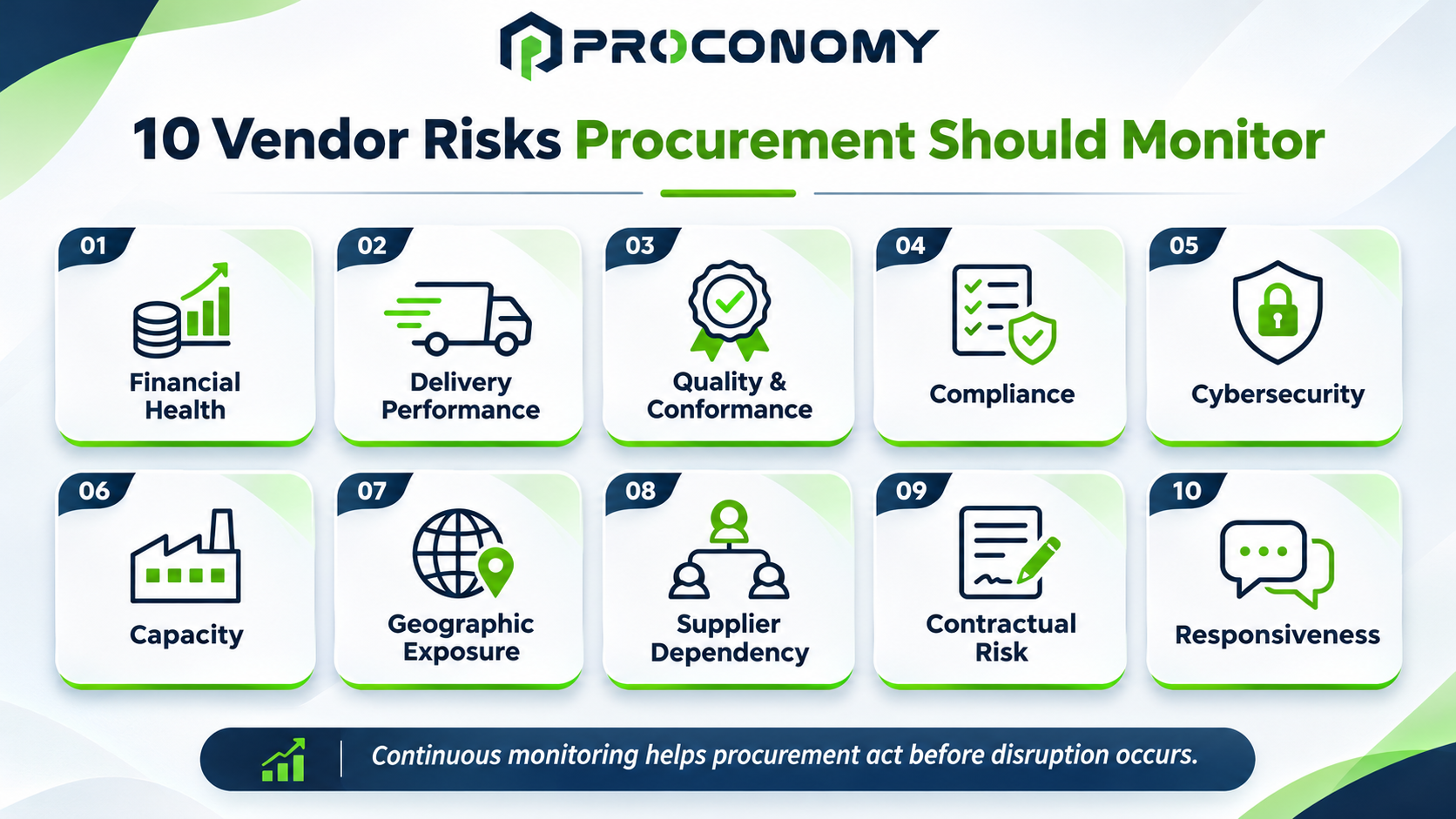
10 Vendor Risks Procurement Teams Must Monitor Continuously
A practical supplier risk management program should focus on signals that affect procurement decisions.
Not every supplier requires the same monitoring intensity. However, procurement should maintain visibility across the following 10 risk categories, with monitoring requirements determined by supplier criticality and business exposure.
1. Supplier Financial Health
A supplier's financial position can deteriorate well before it stops fulfilling orders.
Rising debt, cash flow pressure, delayed payments to subcontractors, and declining profitability may indicate financial distress. For manufacturers dependent on specialized suppliers, these issues can threaten production continuity.
Procurement teams should monitor financial indicators appropriate to the supplier's size, disclosure requirements, and business criticality.
What procurement should monitor:
- Changes in credit ratings or third-party financial health assessments.
- Significant deterioration in available financial statements.
- Insolvency filings, legal proceedings, or restructuring announcements.
- Unusual advance payment requests or repeated requests to change payment terms.
- Evidence of financial distress affecting the supplier's operational capabilities.
Recommended monitoring approach: Review material external alerts when they arise, assess financial information periodically according to risk tier, and trigger reassessment when significant financial changes become known. Where concerns emerge, procurement and finance should jointly assess exposure across active Purchase Orders, advance payments, and critical materials before deciding on mitigation.
2. Supplier Delivery Performance
Delivery performance is one of the most visible indicators of supplier reliability.
However, procurement should look beyond whether a shipment arrived late. Repeated changes to confirmed dates, partial deliveries, and unacknowledged Purchase Orders can signal deeper problems.
A supplier may still meet its overall monthly delivery target while repeatedly missing commitments for high-priority components.
What procurement should monitor:
- On-time delivery (OTD) and on-time in-full (OTIF) performance.
- Frequency of delayed or partial deliveries.
- Purchase Orders awaiting supplier acknowledgment.
- Changes to confirmed delivery dates.
- Repeated expedite requests or missed recovery commitments.
- Delivery performance by plant, material, and Purchase Order.
Recommended monitoring approach: Track delivery exceptions as transactions occur, review trends weekly for critical suppliers, and escalate repeated deviations against agreed service levels. Prioritize exceptions based on production requirements rather than relying only on aggregate supplier performance.
A connected supplier portal can help procurement obtain structured order acknowledgments and supplier-raised exceptions before they become production disruptions.
3. Supplier Quality and Product Conformance
A supplier may continue delivering on time while its product quality gradually deteriorates.
For complex manufacturers, recurring quality issues can create production delays, material rejections, rework, and additional inspection costs. These problems often become visible through increasing nonconformances or unresolved corrective actions.
Procurement teams need access to supplier quality information so they can consider unresolved issues before allocating additional business.
What procurement should monitor:
- Incoming inspection rejection rates.
- Defects per million (PPM) or other applicable defect measures.
- Repeated nonconformances and customer complaints.
- Open Supplier Corrective Action Requests (SCARs).
- Overdue 8D corrective action reports.
- APQP and PPAP milestones where applicable.
- Unapproved changes to materials, processes, or manufacturing locations.
Recommended monitoring approach: Capture quality events when they occur, monitor corrective action deadlines, and review supplier quality standing before significant sourcing decisions. Critical or repeated defects should trigger coordinated reviews involving procurement, quality, and the supplier.
Manufacturing example: When a quality issue affects future sourcing
Consider an automotive component manufacturer sourcing precision-machined parts from an approved supplier.
The supplier meets delivery commitments, but incoming inspections repeatedly identify dimensional deviations. Quality teams raise corrective actions, and the supplier submits improvement plans. However, some actions remain overdue.
Meanwhile, procurement begins a new sourcing event for a similar component.
If procurement and quality information remain disconnected, the supplier may be shortlisted based on commercial competitiveness and historical delivery performance alone.
A connected supplier quality process makes the unresolved issues visible during supplier evaluation. Procurement can then involve quality reviewers, request evidence of corrective action, and determine whether additional qualification is required before awarding new business.
This is where Supplier Quality Management becomes relevant. Quality events, corrective actions, evidence, and supplier standing can be connected rather than managed through separate follow-up processes.
4. Regulatory and Compliance Risk
Regulatory obligations can change throughout the supplier relationship.
A certificate valid during onboarding may expire before the next order. A supplier could lose a required approval, appear on a restricted-party list, or fail to comply with applicable environmental, safety, labor, or trade regulations.
Requirements also vary by product category, industry, geography, and legal entity.
What procurement should monitor:
- Expiry dates of mandatory certificates and licenses.
- Supplier tax and registration documentation.
- Relevant sanctions and restricted-party screening results.
- Industry-specific compliance requirements.
- Material regulatory violations or adverse findings.
- Changes to supplier ownership, legal identity, or operating location.
Recommended monitoring approach: Use date-based alerts for expiring documents, reassess material changes as they arise, and perform periodic compliance reviews according to regulatory requirements and supplier risk.
For multi-entity manufacturers, compliance monitoring should reflect which supplier is approved for which legal entity, material, and intended use. An expired mandatory approval should trigger the appropriate review or restriction rather than allowing supplier eligibility to remain unchanged without evaluation.
5. Cybersecurity and Data Protection Risk
Supplier risk is not limited to physical materials and services.
External vendors may access enterprise systems, procurement information, engineering designs, employee data, or confidential commercial documents.
A cybersecurity incident involving a supplier can interrupt critical services or expose sensitive business information.
What procurement should monitor:
- Supplier access to sensitive data and enterprise systems.
- Security certification status where contractually required.
- Reported cybersecurity incidents and material breaches.
- Overdue remediation of identified security weaknesses.
- Changes to critical subcontractors or data-processing locations.
- Contractual compliance with data protection and security obligations.
Recommended monitoring approach: Coordinate with IT security and legal teams, reassess suppliers after material incidents or access changes, and monitor remediation according to defined risk thresholds.
Procurement should ensure that cybersecurity findings are visible to appropriate decision-makers, rather than attempting to replace the technical assessments performed by security specialists. Material security exceptions should be considered during contract renewals and decisions involving expanded supplier access.
6. Supplier Capacity and Operational Resilience
A supplier can be financially stable and fully compliant while still lacking the capacity to meet future demand.
Production bottlenecks, equipment failures, labor shortages, utility interruptions, and unexpected demand increases can affect supplier output.
These issues are particularly important for direct material suppliers supporting high-volume manufacturing.
What procurement should monitor:
- Available production capacity against committed demand.
- Capacity utilization and planned expansion.
- Material lead-time changes.
- Plant shutdowns and major equipment disruptions.
- Workforce shortages or prolonged labor disputes.
- Business continuity plans for critical production sites.
Recommended monitoring approach: Review capacity commitments during planning cycles, track significant operational changes, and reassess critical suppliers when demand or production conditions change. Capacity monitoring should be connected to forecast demand, open Purchase Orders, and supplier recovery commitments.
Manufacturing example: When demand increases faster than supplier capacity
Consider an industrial equipment manufacturer that depends on a supplier for specialized castings.
The supplier has consistently met its delivery commitments. However, the manufacturer plans to increase production after receiving several large customer orders.
The supplier confirms that its current facilities are operating close to available capacity. Additional production would require extended shifts or new equipment.
If procurement relies only on historical delivery performance, it may assume the supplier can accommodate the increase.
Continuous capacity monitoring creates an opportunity to address the constraint before additional Purchase Orders are released.
Procurement can work with production planning and the supplier to confirm available capacity, revise delivery schedules, evaluate inventory requirements, or initiate alternative sourcing where necessary.
The key is to identify potential capacity shortages while the manufacturer still has options, rather than after delivery commitments have already been missed.
7. Geographic and Geopolitical Exposure
A supplier's reliability can be affected by events outside its direct control.
Trade restrictions, tariffs, political instability, natural disasters, extreme weather, and transportation disruptions can create risks for an otherwise capable supplier.
The challenge becomes more complex when manufacturers depend on international suppliers or concentrated sourcing regions.
What procurement should monitor:
- Supplier manufacturing and distribution locations.
- Exposure to geopolitical conflicts and trade restrictions.
- Tariff and import/export regulation changes.
- Climate-related and natural disaster alerts.
- Critical port, transportation, and logistics disruptions.
- Dependencies on high-risk sourcing regions.
Recommended monitoring approach: Monitor relevant external events as they develop and map them to affected supplier locations, materials, and active orders.
When a disruption occurs, procurement should first identify the affected materials, Purchase Orders, and plants. This helps teams prioritize alternate routes, inventory allocation, supplier communication, and contingency sourcing based on operational exposure.
8. Supplier Concentration and Dependency Risk
The greatest vendor risk may not be caused by an individual supplier's performance.
It may result from the manufacturer's dependence on that supplier.
A supplier responsible for a highly specialized component can create significant operational exposure even when its quality and delivery performance are excellent.
This risk is particularly high for single-source and sole-source materials.
What procurement should monitor:
- Single-source and sole-source material exposure.
- Percentage of category spend concentrated with one supplier.
- Number of plants dependent on the same supplier.
- Availability of technically approved alternatives.
- Supplier switching lead times and qualification requirements.
- Dependencies on common sub-tier suppliers.
Recommended monitoring approach: Review concentration when sourcing strategies, demand forecasts, or supplier allocations change, and conduct deeper assessments for critical categories. Evaluate the practical availability of alternatives, not merely whether another supplier exists in the supplier database.
Manufacturing example: One supplier supporting multiple plants
Consider a manufacturer operating four production plants that all depend on the same supplier for a specialized electronic control component.
The supplier has strong quality ratings, competitive pricing, and a reliable delivery history.
From a supplier performance perspective, there may be little reason for concern.
However, a manufacturing disruption at the supplier's facility could affect all four plants simultaneously.
The risk is not poor supplier performance. It is the absence of a qualified alternative.
A continuous supplier risk management program identifies this dependency and allows procurement to evaluate diversification, alternate component qualification, inventory buffers, or business continuity arrangements before a disruption occurs.
This example also demonstrates why supplier risk scores should consider both the likelihood of disruption and the potential business impact.
9. Contractual and Commercial Risk
Supplier contracts establish expectations for pricing, delivery, service levels, quality, and compliance.
However, those obligations provide limited protection if nobody monitors whether they are being fulfilled.
Untracked contract renewals, missed obligations, or repeated commercial exceptions may expose manufacturers to unexpected costs and disputes.
What procurement should monitor:
- Contract expiry and renewal dates.
- Supplier performance against agreed service levels.
- Repeated price deviations and unauthorized charges.
- Changes to commercial terms.
- Insurance or guarantee expiry where applicable.
- Material contractual breaches and unresolved disputes.
Recommended monitoring approach: Monitor time-bound obligations automatically where possible, review exceptions as they occur, and route material changes to procurement, legal, or finance.
Connecting contractual obligations with purchasing and supplier performance records helps teams identify recurring deviations, investigate their causes, and maintain evidence for commercial reviews or negotiations.
10. Supplier Responsiveness and Corrective Action Performance
Not every supplier risk appears in a financial statement or formal compliance report.
Some warning signs emerge from everyday collaboration.
A supplier that repeatedly ignores requests, fails to acknowledge orders, or misses corrective action deadlines may be showing early signs of operational weakness.
These indicators deserve attention because they can reveal problems before formal performance measures deteriorate.
What procurement should monitor:
- Delayed responses to critical procurement requests.
- Unacknowledged Purchase Orders.
- Repeated missed corrective action deadlines.
- Incomplete compliance or quality submissions.
- Unresolved supplier disputes.
- Repeated commitments without documented closure.
Recommended monitoring approach: Track task ownership and due dates as part of ongoing supplier collaboration, with escalation based on business impact and urgency.
A supplier's responsiveness should be evaluated as a trend rather than through isolated incidents. Recurring delays in acknowledgments, evidence submission, or corrective action closure may justify a structured supplier review, particularly when the supplier supports critical production requirements.
Vendor Risk Management Monitoring Matrix: What to Track and When
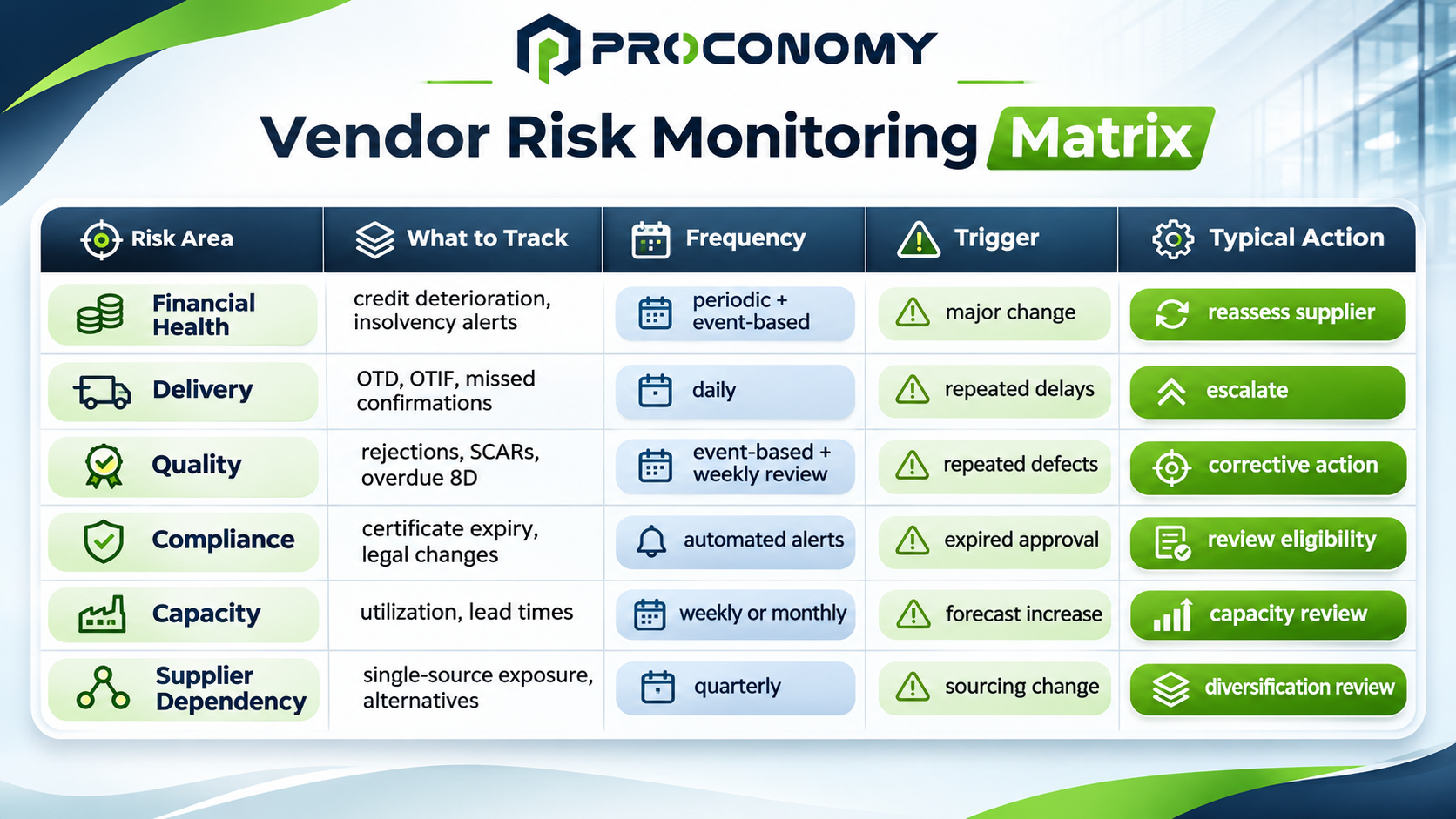
The right monitoring frequency depends on the supplier's criticality and the speed at which risk can change.
For example, delivery exceptions for a critical component may require daily visibility, while a comprehensive financial review may occur quarterly or after a significant event.
The following matrix provides an illustrative starting point for complex manufacturers. Actual review schedules should be configured according to risk, contractual obligations, and internal policies.
| Risk category | Key indicators | Suggested monitoring frequency | Typical action |
|---|---|---|---|
| Financial health | Credit deterioration, insolvency alerts | Event-based, plus periodic review | Financial reassessment |
| Delivery | OTD, OTIF, missed confirmations | Daily or transaction-based | Escalate delivery risk |
| Quality | Rejections, SCARs, overdue 8D | Event-based, with weekly review | Quality containment and corrective action |
| Compliance | Expiring certificates, legal changes | Automated expiry alerts and event-based checks | Suspend or review eligibility where required |
| Cybersecurity | Incidents, findings, access changes | Event-based, plus risk-tier review | IT security assessment |
| Capacity | Utilization, shortages, lead times | Weekly or monthly for critical suppliers | Capacity review and contingency planning |
| Geographic exposure | Disruptions, tariffs, adverse events | Event-based | Assess affected suppliers and orders |
| Concentration | Single-source exposure, alternate capacity | Quarterly or when sourcing changes | Supplier diversification review |
| Contractual | Expiry, obligations, price exceptions | Date-based and transaction-based | Contract review |
| Responsiveness | Overdue acknowledgments and actions | Daily for critical exceptions | Follow-up or escalation |
The objective is not to generate more alerts. It is to create a monitoring process that identifies meaningful exceptions and assigns the next action to the appropriate owner.
How to Prioritize Suppliers for Continuous Risk Monitoring
Continuously monitoring every supplier at the same intensity can overwhelm procurement teams.
A better approach is to segment suppliers according to business impact, risk exposure, and the availability of alternatives.
A supplier with relatively low annual spend may still be business-critical if it provides a specialized component required to keep a production line operational.
A practical supplier risk segmentation model
Procurement teams can use three broad categories to determine monitoring requirements.
Tier 1: Business-critical suppliers
These suppliers present significant operational exposure due to factors such as production dependency, limited alternatives, regulatory importance, or long qualification lead times.
They generally require active exception monitoring, defined escalation owners, and regular cross-functional reviews.
Tier 2: Important suppliers
These suppliers support material business activities but have more manageable dependency risks or available alternatives.
They may require periodic performance reviews, automated alerts, and reassessment after material events.
Tier 3: Lower-criticality suppliers
These suppliers typically present limited business impact and can be replaced without significant disruption.
They may be monitored through basic compliance checks, transactional exceptions, and scheduled reassessments.
Supplier segmentation should consider the following criteria:
- Operational criticality and potential production impact.
- Spend exposure and financial dependency.
- Availability of qualified alternative suppliers.
- Product quality and regulatory requirements.
- Geographic and supply chain dependencies.
- Historical delivery, quality, and compliance performance.
A useful risk score should separate the likelihood of disruption from its potential business impact.
For example, a critical single-source component supplier with moderate delivery instability may require more immediate attention than a noncritical supplier with a worse overall score.
This prevents procurement from treating every supplier risk as equally important.
From Risk Alerts to Procurement Decisions: What Should Happen Next?
A vendor risk management program is only effective when identified risks result in appropriate action.
A dashboard showing hundreds of alerts does not automatically improve supply chain resilience.
Procurement needs a structured process that connects each material risk signal to a business decision.
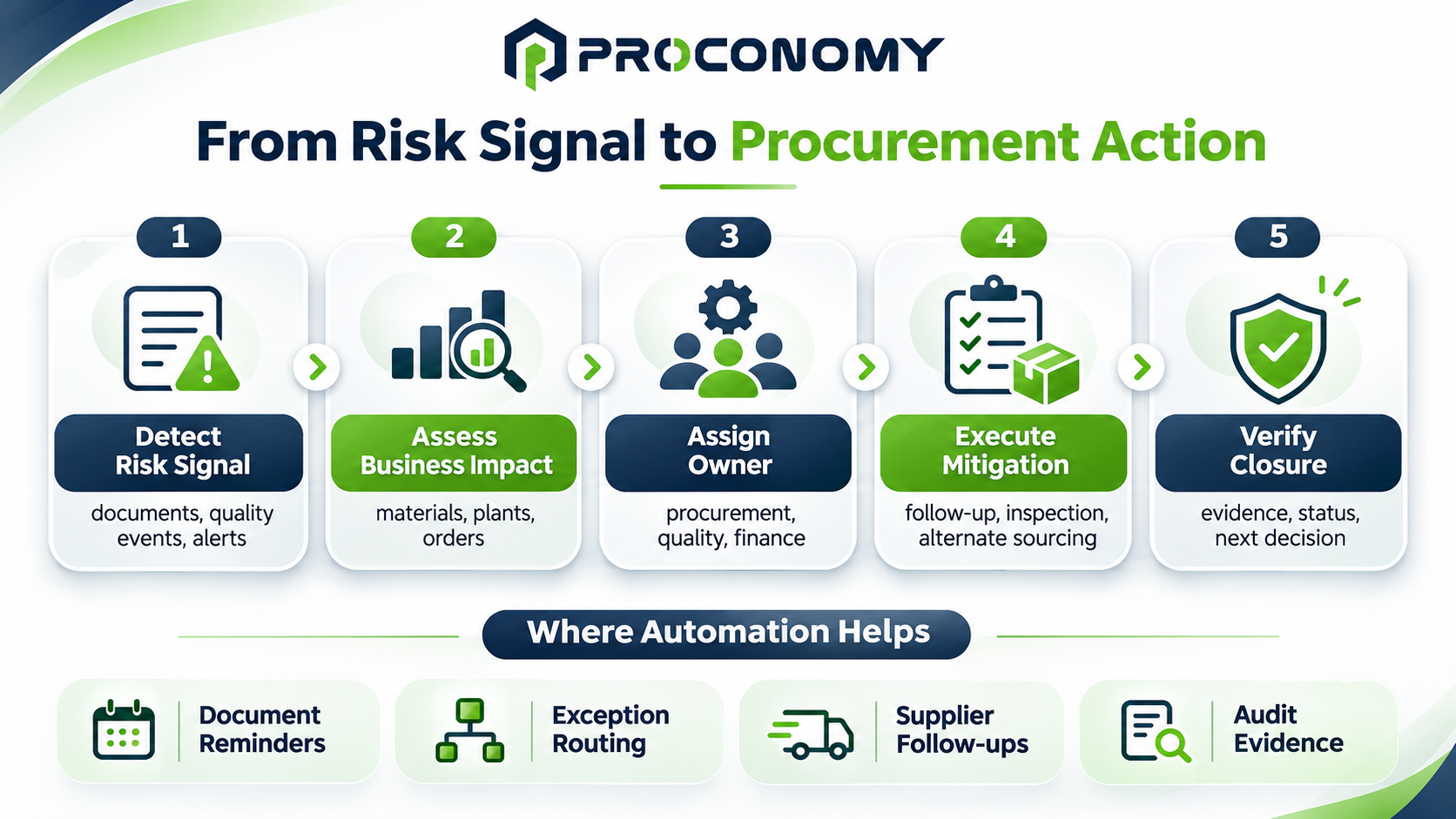
A five-step vendor risk response workflow
The following workflow illustrates how procurement teams can move from risk identification to governed action.
Step 1: Detect the risk signal
A material change is identified through a supplier document, quality event, ERP transaction, financial alert, or external risk source.
For example, a supplier's quality rejection rate increases beyond an agreed threshold.
Step 2: Assess the business impact
The risk is evaluated against the supplier's criticality, affected materials, active Purchase Orders, plant dependencies, and existing mitigation measures.
An issue affecting a noncritical consumable may require a different response from one affecting a sole-source production component.
Step 3: Assign ownership
The exception is routed to the function responsible for evaluating it.
Quality may assess product conformance, finance may review financial distress, and procurement may evaluate alternative sourcing.
Step 4: Execute the approved mitigation
Depending on the risk, approved actions may include additional inspections, a supplier corrective action, revised sourcing allocations, management review, or temporary purchasing restrictions.
High-impact decisions should remain subject to defined approval authority.
Step 5: Verify closure and update supplier standing
The responsible team reviews the evidence, confirms whether the mitigation worked, and records the outcome.
The supplier's risk status should then be updated so future procurement decisions reflect the latest information.
The important distinction is that risk monitoring should change how procurement operates, not simply add another report for teams to review.
How AI Agents and Automation Improve Continuous Vendor Risk Management
Traditional supplier risk management creates significant coordination work.
Procurement teams collect documents, follow up with suppliers, review spreadsheets, consolidate reports, and escalate exceptions across departments.
This administrative burden becomes difficult to manage as supplier networks expand.
Automation and AI Agents can help execute repetitive monitoring and coordination activities while allowing procurement teams to retain control over consequential decisions.
Where AI Agents can add value
AI Agents are most useful when a defined event should trigger a governed sequence of work.
Examples include:
- Document monitoring: Identify approaching supplier certificate expiry dates and initiate requests for updated documents.
- Risk signal consolidation: Bring relevant supplier, quality, and purchasing information together for review.
- Exception routing: Direct material risk changes to the appropriate procurement, finance, quality, or compliance owner.
- Supplier follow-ups: Request missing information and track overdue submissions.
- Quality corrective actions: Follow up outstanding SCAR or 8D stages and collect supporting evidence.
- Supplier eligibility checks: Apply configured qualification and approval requirements before a supplier is used in a sourcing process.
- Audit evidence preparation: Maintain records of alerts, approvals, actions, and outcomes.
AI-assisted workflows should operate within clearly defined permissions and escalation rules.
For example, an agent may identify an expired supplier certificate and initiate a renewal request. However, any decision to suspend a critical supplier or approve an exception should follow the organization's authorized review process.
This is the difference between simple alert automation and governed procurement execution.
Why human oversight remains important
Supplier risk decisions can affect production continuity, commercial relationships, and contractual obligations.
Procurement technology should therefore make it clear:
- Which risk signals triggered a workflow.
- What information was used in the assessment.
- Which automated actions were permitted.
- Which decisions required human review.
- Who approved a mitigation or exception.
- What evidence supports the final outcome.
The objective is to automate routine coordination without removing accountability.
How Proconomy Connects Supplier Risk Monitoring With Procurement Execution
For complex manufacturers, vendor risk management becomes difficult when supplier data, quality performance, approvals, and purchasing decisions are managed separately.
A supplier may have one approval status in the ERP, another quality standing in a spreadsheet, and a different set of compliance documents maintained by procurement.
This makes it harder to determine whether the supplier remains suitable for a particular purchase.
Proconomy addresses this challenge through a connected, governed autonomous procurement platform that brings supplier workflows and procurement execution together.
Its approach is especially relevant for organizations operating across multiple plants and business entities.
1. Maintain a connected supplier record
Through Supplier Management, Proconomy supports supplier onboarding, qualification, documentation, and ongoing maintenance of supplier records.
Requirements can be configured according to industry, entity, category, and purchasing context.
Documents approaching expiry can trigger follow-up activity, while exceptions are routed to accountable reviewers.
2. Connect supplier quality to sourcing decisions
Through Supplier Quality Management, quality issues can move through structured corrective action workflows.
Supplier Corrective Action Requests, 8D evidence, reviews, and closure outcomes contribute to supplier quality standing.
This makes it possible to consider unresolved quality issues when evaluating supplier eligibility, subject to configured governance rules.
3. Improve supplier collaboration
The Supplier Portal provides a structured way for suppliers to maintain information, respond to procurement requests, acknowledge orders, and submit corrective action evidence.
This reduces reliance on disconnected emails and manual follow-ups.
4. Execute workflows under defined controls
Proconomy's governed automation and AI Agents support authorized execution, exception routing, and evidence capture.
Procurement, finance, quality, and risk teams retain their respective approval responsibilities.
This is particularly important when a risk finding could affect supplier activation, purchasing eligibility, or sourcing decisions.
5. Work alongside existing enterprise systems
Proconomy connects procurement workflows with existing enterprise systems, including ERP environments.
The ERP remains the system of record, while Proconomy supports the coordination, governance, and execution activities surrounding procurement transactions.
The result is a more connected approach to supplier risk management, where supplier information can inform the decisions procurement teams make.
Want to see how supplier risk and quality exceptions move through a governed procurement workflow?
Vendor Risk Management KPIs Procurement Leaders Should Track
Monitoring activities should translate into measurable operational outcomes.
Instead of measuring only how many supplier assessments were completed, procurement leaders should evaluate whether their risk management program identifies meaningful issues and helps resolve them.
The following KPIs provide a practical starting point.
| KPI | What it measures | Business insight |
|---|---|---|
| Critical supplier monitoring coverage | Percentage of critical suppliers covered by required monitoring | Identifies suppliers with insufficient risk visibility |
| Overdue supplier documents | Number or share of required documents past expiry | Reveals potential qualification and compliance gaps |
| Supplier risk alert response time | Time from a qualifying alert to first action | Shows how quickly teams respond to emerging risks |
| Open high-severity exceptions | High-impact risks awaiting resolution | Highlights unresolved operational exposure |
| Corrective action closure time | Time taken to close supplier corrective actions | Measures the effectiveness of quality follow-ups |
| Repeat supplier incidents | Recurrence of defined risk events | Indicates whether corrective actions prevent repeat problems |
| Single-source dependency exposure | Critical materials without qualified alternatives | Identifies business continuity vulnerabilities |
| Supplier eligibility exceptions | Purchasing or sourcing decisions requiring risk-related overrides | Reveals potential gaps in risk governance |
The most useful KPIs are connected to risk reduction and decision quality.
For example, reducing the number of overdue corrective actions matters more than simply increasing the number of supplier reviews completed.
Procurement leaders should also distinguish between improved risk detection and actual risk reduction. An increase in recorded alerts may initially reflect better visibility, rather than deteriorating supplier performance.
How to Build a Continuous Vendor Risk Management Program
Building a continuous monitoring program does not require monitoring every supplier and every risk from day one.
A practical implementation begins with the suppliers and risks that could create the greatest business disruption.
Step 1: Identify critical suppliers and dependencies
Start by mapping suppliers to materials, plants, business units, and critical operations.
Identify single-source dependencies and suppliers with long replacement or qualification lead times.
Step 2: Define relevant risk indicators
Choose the indicators most closely connected to business exposure.
For direct material suppliers, delivery, quality, capacity, and concentration may be particularly important. For technology vendors, cybersecurity and data protection obligations may carry greater weight.
Step 3: Establish data ownership and reliable sources
Determine where each risk signal originates and which function is responsible for its accuracy.
Supplier information may come from ERP transactions, quality systems, supplier submissions, external financial information, or compliance records.
Step 4: Configure thresholds and escalation rules
Define which events require attention, who receives the alert, and what actions are permitted.
A risk threshold should have a corresponding owner and response process.
Step 5: Automate routine coordination
Use automation to support certificate reminders, document collection, supplier follow-ups, corrective action tracking, and exception routing.
Reserve human review for decisions that require judgment or carry significant business consequences.
Step 6: Connect risk findings with procurement decisions
Ensure that relevant supplier standing is visible when procurement creates sourcing events, evaluates suppliers, or approves commercial decisions.
Risk information should be available when it can influence the outcome.
Step 7: Review effectiveness and refine the program
Monitor response times, unresolved risks, recurring supplier issues, and the effectiveness of mitigation actions.
Refine monitoring thresholds and supplier classifications as business priorities change.
The goal is a risk management program that becomes part of everyday procurement operations rather than a separate administrative exercise.
What Should You Look for in Vendor Risk Management Software?
Organizations evaluating vendor risk management software should look beyond dashboards, supplier scores, and risk alerts.
The critical question is whether the technology helps procurement identify material changes, respond appropriately, and maintain control.
Before selecting a solution, evaluate the following capabilities:
- Supplier visibility: Can teams view supplier qualification, compliance, quality, and operational information in a connected record?
- Configurable risk monitoring: Can the platform monitor relevant events, expiry dates, and operational exceptions based on supplier criticality?
- Cross-functional workflows: Can procurement, finance, quality, and compliance teams review findings while retaining their approval responsibilities?
- Risk-based supplier eligibility: Can relevant supplier standing inform sourcing and purchasing decisions?
- Automation and AI governance: Can routine work be automated without bypassing approvals or exceeding defined permissions?
- Integration capabilities: Can the platform exchange necessary information with ERP, quality, finance, and other enterprise systems?
- Auditability: Can the organization reconstruct why an exception was raised, who reviewed it, and what decision was made?
- Supplier collaboration: Can suppliers submit evidence, respond to issues, and maintain information through a structured process?
During evaluation, ask the vendor to demonstrate an exception rather than only the normal workflow.
For example, request a scenario where a supplier has an expired certificate and an open corrective action while being considered for a sourcing event.
Observe what happens, which teams are notified, what the system can automate, and where a human decision is required.
For more evaluation guidance, read What to Demonstrate Before Buying an Autonomous Procurement Platform.
Final Thoughts: Supplier Risk Should Inform Every Important Procurement Decision
Vendor risk management cannot remain a periodic assessment exercise.
Supplier financial conditions, delivery reliability, quality performance, compliance status, and operational capabilities can change at any point during the supplier relationship.
For complex manufacturers, these changes can directly affect production continuity, cost, regulatory exposure, and supplier performance.
Continuous vendor risk monitoring helps procurement identify meaningful changes earlier. However, monitoring alone is not enough.
The real value comes from connecting risk signals to defined actions, responsible teams, and governed purchasing decisions.
When supplier records, quality events, compliance evidence, and sourcing workflows are connected, procurement is better positioned to respond before small supplier issues become major operational disruptions.
Proconomy helps complex manufacturers connect supplier management, supplier quality, and governed procurement automation so important exceptions can move from identification to action.
See Continuous Supplier Risk Monitoring in Action Do supplier documents, quality exceptions, and purchasing decisions sit in different systems across your organization?
See this on your own workflow